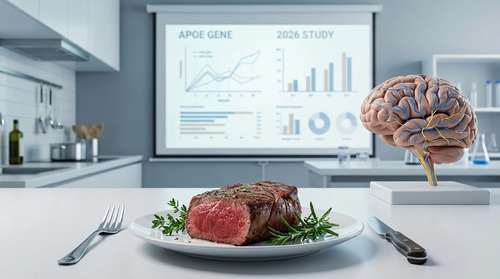
For decades, the consensus in brain health food trends has leaned heavily toward plant-forward plates to protect against cognitive decline. But a major shift is currently rippling through the medical community. The groundbreaking meat and Alzheimer's study 2026, published in JAMA Network Open with findings widely highlighted on April 2, 2026, reveals that a one-size-fits-all approach to nutrition might be fundamentally flawed. Researchers from Sweden's Karolinska Institutet discovered that for a specific, genetically defined portion of the population, eating more unprocessed meat is actually linked to a dramatically lower risk of dementia.
The APOE Gene Diet Connection Explained
To understand this reversal, you have to look at our DNA. The apolipoprotein E (APOE) gene is one of the strongest known genetic risk factors for Alzheimer's disease. Everyone inherits two copies of this gene, and those carrying the APOE 3/4 or APOE 4/4 variants typically face a much steeper road regarding cognitive preservation. In the United States, roughly one in four people carries these high-risk genotypes.
Lead study author Jakob Norgren, PhD, and his team analyzed data from the Swedish National Study on Aging and Care (SNAC-K), tracking 2,157 adults over 60 for up to 15 years. When analyzing the data from the meat and Alzheimer's study 2026, the team uncovered a fascinating APOE gene diet connection. Among individuals with the high-risk gene variants, those who consumed the most meat experienced significantly slower declines in both global cognition and episodic memory compared to those who ate the least. In fact, the group consuming higher amounts of meat did not show the expected cognitive drop-off normally associated with their genetic profile.
How Red Meat and Cognitive Protection Intersect
What exactly does "high meat consumption" look like in this context? It is far from a restrictive carnivore diet. The highest intake group consumed a median of about 870 grams of meat per week—roughly 4.5 ounces per day—adjusted for a standard 2,000-calorie diet.
For people without the APOE4 variants, meat intake had no significant impact on dementia risk. But for carriers, the data on red meat and cognitive protection was striking. Participants in the high-risk genetic group who consumed lower amounts of meat had more than twice the risk of developing dementia compared to individuals without the gene variants. However, that elevated risk practically vanished for APOE4 carriers in the highest meat-eating tier. This indicates that Alzheimer's prevention through diet is heavily dependent on an individual's specific biological makeup.
The Crucial Detail: Processed vs. Unprocessed Meat
Before you rush to the deli counter, there is a massive caveat that neurologists want you to understand. The study drew a sharp line between a fresh chicken breast or steak and a package of bacon.
Senior researcher Sara Garcia-Ptacek noted that higher consumption of processed meat—think sausages, hot dogs, and cured deli slices—was associated with a higher risk of dementia across the board, regardless of a person's genetics. The cognitive benefits were strictly linked to unprocessed meats like beef, pork, and poultry. Eating unprocessed, high-quality protein seems to offer the protective mechanism, while the additives and preservatives in processed variations negate any potential benefit and actively harm brain health.
Why Processed Meat Remains a Threat
Researchers theorize that the preservation methods used in processed meats introduce inflammatory compounds into the body. Inflammation is a known catalyst for cognitive degradation, which easily overrides the nutritional benefits of the meat's protein content. This sharp distinction emphasizes that the quality and preparation of food are just as critical as the macronutrients themselves.
Advancing Nutritional Genomics in 2026
The broader implications of the meat and Alzheimer's study 2026 catapult us into a new era of personalized nutrition for brain health. For years, broad public health guidelines have suggested limiting meat intake to stave off heart disease and cognitive decline. Because Alzheimer's drugs are not suitable or safe for every patient, preventing the disease through lifestyle modifications remains a top priority for medical professionals. Now, the rapidly expanding field of nutritional genomics 2026 is proving that your ideal diet is written in your DNA.
Norgren hypothesized that because the APOE4 variant is evolutionarily older, it might have developed during a time when human ancestors consumed a heavily animal-based diet. Consequently, modern bodies carrying this ancient gene might still require the specific nutrient profile provided by unprocessed meat to maintain neurological function.
The Future of Dietary Guidelines
Historically, organizations like the Swedish Food Agency have called for deep investigations into how dietary patterns influence dementia risk. This study answers that call by highlighting how generalized advice can actually disserve substantial population segments. Moving forward, clinical trials will likely test targeted, meat-inclusive diets specifically on APOE4 carriers to establish concrete clinical guidelines.
While these findings stem from an observational study and clinical trials are the next logical step, they offer immediate hope. If you know you carry the APOE4 variant, your genetic destiny is not necessarily fixed. Tailoring your plate to your unique genetic profile is quickly becoming the most powerful tool in modern preventative medicine.