In a stunning departure from forty years of federal nutrition policy, the U.S. government has officially initiated a federal nutrition policy reset that effectively retires the iconic "MyPlate" graphic in favor of a radical new approach. Released under the "Make America Healthy Again" (MAHA) initiative, the 2025-2030 Dietary Guidelines for Americans introduce an inverted food pyramid 2026 model that prioritizes nutrient-dense animal proteins and full-fat dairy while declaring an all-out war on ultra-processed foods. This overhaul, championed by HHS Secretary Robert F. Kennedy Jr. and USDA Secretary Brooke Rollins, represents the most aggressive shift in American dietary advice since 1980, sparking a fierce protein vs fiber debate 2026 among health experts.
The Death of MyPlate and the Rise of the 'Inverted Pyramid'
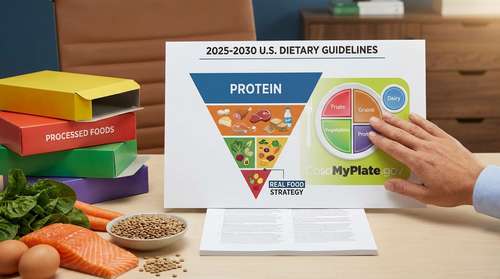
For nearly two decades, the USDA's MyPlate symbol encouraged Americans to fill half their plate with fruits and vegetables, with smaller portions for grains and protein. The new guidelines dismantle this visual entirely. In its place, officials have unveiled an "inverted pyramid" concept that places high-quality protein and healthy fats at the broad top—the foundation of the diet—rather than at the bottom or side.
This visual reset is not merely aesthetic; it signals a profound philosophical change. The new real food nutrition strategy argues that nutrient density, not calorie counting, should be the primary driver of health. By flipping the pyramid, the guidelines explicitly encourage Americans to build their meals around "prime" proteins—including steak, eggs, and raw milk—relegating refined grains and sugary products to the narrowest, "avoid" tip of the spectrum.
High Protein Diet Recommendations: A 100% Increase
Perhaps the most controversial aspect of the new policy is the drastic revision of protein targets. The 2025-2030 Dietary Guidelines for Americans now recommend a daily protein intake of 1.2 to 1.6 grams per kilogram of body weight—a staggering 50% to 100% increase over previous standards.
For an average 180-pound adult, this translates to roughly 100-130 grams of protein daily, a target that officials argue is necessary to combat the nation's metabolic health crisis and obesity epidemic. "We are ending the war on saturated fats and prioritizing the building blocks of life," stated a senior HHS official during the rollout. The guidelines specifically highlight red meat and full-fat dairy as "preferred" sources, challenging decades of advice that urged consumers to choose lean meats and skim milk to avoid cholesterol.
The Ultra-Processed Food Ban in Schools
While the protein recommendations are permissive, the stance on industrial food products is punitive. The new guidelines implement a de facto ultra-processed food ban for the National School Lunch Program. Starting next fall, schools receiving federal funding will be prohibited from serving foods containing artificial dyes, high-fructose corn syrup, and a laundry list of industrial additives.
This federal nutrition policy reset defines "ultra-processed" broadly, targeting popular items like pre-packaged snack cakes, sugary cereals, and even certain plant-based meat alternatives that are heavily engineered. The move aims to remove "food-like substances" from cafeterias entirely, forcing a return to scratch cooking and whole ingredients. "If you can't pronounce the ingredients, it doesn't belong on a child's tray," reads the new mandate.
Redefining 'Healthy' Fats
In another pivot, the guidelines distinguish between "traditional" fats and "industrial" seed oils. While previous iterations capped saturated fat intake to reduce heart disease risk, the 2025-2030 edition softens this limit, suggesting that natural fats found in butter, tallow, and coconut oil are preferable to processed vegetable oils (like soybean and canola) which are now flagged for "caution" due to concerns over oxidation and inflammation.
The Protein vs. Fiber Debate 2026
The rollout has not been without detractors. The shift has ignited a firestorm in the nutrition community, dubbed the protein vs fiber debate 2026. Critics, including members of the ousted scientific advisory committee, argue that the new focus on animal products ignores the extensive body of evidence supporting plant-based diets for longevity and cancer prevention.
"This is a policy based on ideology, not established science," warned Dr. Neal Barnard of the Physicians Committee, noting that the new targets could lead to excessive saturated fat consumption. However, supporters argue that the "MyPlate" era presided over skyrocketing chronic disease rates, and a return to ancestral eating patterns—a real food nutrition strategy—is the only way to reverse the trend. As these guidelines move from paper to policy, American families, schools, and food manufacturers are bracing for a seismic shift in how the nation eats.