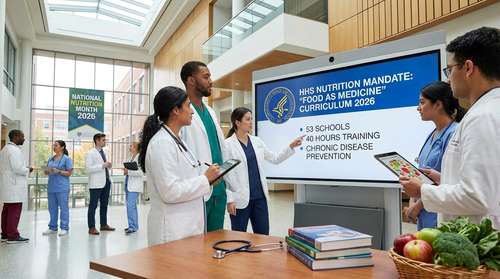
In a landmark shift for American healthcare, the U.S. Department of Health and Human Services (HHS) announced on Thursday that 53 leading medical schools have committed to requiring at least 40 hours of formal nutrition education for future physicians. This major policy pivot, spearheaded by HHS Secretary Robert F. Kennedy Jr. as part of the "Make America Healthy Again" agenda, aims to combat the nation's chronic disease epidemic by prioritizing medical school nutrition training over a pill-first approach.
The announcement, timed to coincide with National Nutrition Month 2026, represents a fundamental change in medical pedagogy. Starting in the fall of 2026, participating institutions—including George Washington University, Tufts University, and the University of Oklahoma College of Medicine—will implement a curriculum designed to equip doctors with the science-backed tools needed to treat food as medicine.
A Historic Pivot in Medical Education
For decades, nutrition has been a glaring blind spot in medical training. According to HHS data, medical students currently receive an average of just 1.2 hours of nutrition instruction per year, with 75% of schools requiring no clinical nutrition coursework at all. The new HHS nutrition mandate seeks to close this gap by ensuring that the next generation of physicians understands the critical link between diet and disease.
"Chronic disease is bankrupting our health system, and poor nutrition sits at the center of that crisis," Secretary Kennedy stated during the press conference at HHS headquarters. "Today medical schools are committing to change how America trains its doctors—by putting nutrition back where it belongs: at the heart of patient care."
The initiative requires schools to provide a minimum of 40 hours of nutrition education or demonstrate a "competency equivalent" across four years of training. To support this transition, HHS has released a framework of 71 evidence-based competencies, covering topics from metabolic health to dietary interventions for autoimmune disorders.
The 'Food as Medicine' 2026 Agenda
The push for food as medicine 2026 initiatives reflects a growing consensus that the U.S. healthcare system cannot sustain its current trajectory. With national healthcare spending topping $4.5 trillion annually—90% of which goes toward managing chronic and often preventable conditions—policymakers are scrambling for preventive solutions.
The RFK Jr nutrition policy emphasizes that doctors must be as proficient in prescribing lifestyle changes as they are in writing pharmaceutical prescriptions. By integrating nutrition into the core curriculum, the administration hopes to empower physicians to address the root causes of type 2 diabetes, obesity, and cardiovascular disease rather than merely managing symptoms.
Funding and Implementation
To ensure these new standards are effectively adopted, HHS is not just issuing directives but also providing resources. The department announced a $5 million allocation through the National Institutes of Health (NIH) for a "nutrition education challenge." This funding will help medical schools, nursing residencies, and dietitian programs develop innovative coursework and clinical training opportunities.
Education Secretary Linda McMahon, who joined Kennedy for the announcement, emphasized that while the commitments are voluntary, they signal a "mutual recognition" between the government and the medical community. "We are not mandating curriculum," McMahon clarified, "but celebrating a shared goal to improve the health of our nation."
Medical Community Reaction
The response to the nutrition education for doctors initiative has been largely positive, though not without caveats. Major medical organizations have long advocated for better dietary training. Dr. Bobby Mukkamala, president of the American Medical Association (AMA), appeared alongside federal officials to endorse the move.
"Giving physicians the skills to have impactful conversations with our patients about food and lifestyle is one of the most practical, immediate steps we can take to improve health and prevent disease," Mukkamala said. He noted that the momentum to bring evidence-based nutrition into residency training is stronger than ever.
However, some experts remain cautious about the broader "Make America Healthy Again" platform, citing concerns over Secretary Kennedy's previous stances on vaccines and established medical science. Despite this friction, the specific focus on chronic disease prevention through better nutrition has found bipartisan and cross-industry support. Even critics of the administration acknowledge that increasing nutrition literacy among doctors is a "necessary and desirable outcome."
What This Means for Patients
For the average patient, this shift could mean a drastically different experience in the doctor's office within a few years. Instead of a 15-minute visit focused solely on medication management, future appointments might include detailed dietary assessments and