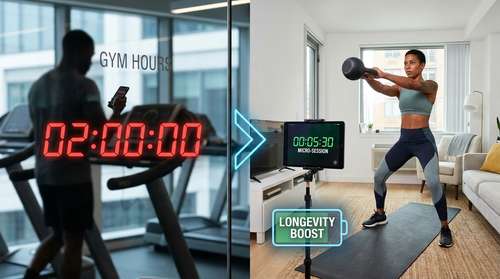
For decades, the golden rule of fitness was an unyielding 150 minutes of moderate activity per week. But as of May 23, 2026, that standard is being officially rewritten. A groundbreaking 30 minutes exercise per week study released today proves that short, intense bursts of activity—widely known as micro-workouts—can completely transform your cardiovascular health. If you are struggling with a time-poor schedule, micro-workouts 2026 represent a scientifically validated escape route from hours spent slogging away at the gym.
This new research cements what sports scientists have been investigating for years: the minimum effective dose fitness approach is not just a shortcut, but a highly effective strategy for long-term health. By utilizing hyper-efficient bursts of movement, you can secure the same physiological advantages as traditional marathon training sessions, forever changing how we view daily activity.
The Science Behind the 30-Minute Exercise Per Week Study
The newly published landmark study evaluates the concept of 'exercise snacks'—intentional bursts of physical activity lasting five minutes or less. Researchers discovered that accumulating just 30 minutes of these vigorous micro-workouts over a seven-day period provides the identical cardiovascular benefits of two and a half hours of moderate-intensity continuous training.
This aligns with foundational early 2026 data from the British Journal of Sports Medicine, which showed that sedentary adults who engaged in brief, high-intensity intervals experienced massive improvements in cardiorespiratory fitness and VO2 max. The true exercise snacks benefits are rooted in how our bodies respond to acute spikes in heart rate. Pushing your body near its maximal effort for just 30 to 60 seconds efficiently clears blood glucose, strengthens the heart muscle, and stimulates vascular health without the need for prolonged exertion.
Why High Intensity Interval Training Trends Are Shifting
The global time-poverty crisis leaves a massive percentage of adults globally unable to meet traditional longevity fitness standards. In fact, compliance has historically been the biggest barrier to widespread public health. People simply do not have the time to commute, change clothes, train, shower, and return to their demanding work schedules.
Current high intensity interval training trends focus heavily on stripping away these logistical barriers. When study participants are asked to perform a simple two-minute bout of stair climbing or body-weight squats, regimen adherence skyrockets to over 80%. You do not need specialized equipment, a treadmill desk, or a boutique gym membership to participate in this revolution. You just need the willingness to push yourself hard for a very brief window of time.
Defining the Minimum Effective Dose Fitness
In medical science, the minimum effective dose refers to the smallest amount of a substance required to trigger a meaningful physiological outcome. Applied to your workout routine, it answers a crucial question: what is the absolute least amount of work you can do while still making substantial gains? Researchers have determined that exercise intensity matters far more than the duration of a single continuous session. A mere 30 minutes of vigorous effort—broken down into one- or two-minute daily fragments—is enough to interrupt sedentary physiology, preserve muscle mass, and stimulate cardiovascular adaptation.
The Hidden Metabolic Advantages
Beyond cardiovascular improvements, breaking your movement into bite-sized pieces yields profound metabolic changes. Studies show that exercise snacks performed shortly after eating a meal significantly optimize how your body processes glucose. Rather than letting blood sugar spike after a heavy lunch, a two-minute burst of squats acts as a sponge, pulling glucose out of the bloodstream and directly into the muscle tissue where it is needed. This minimal time investment delivers outsized benefits for insulin sensitivity, making it a critical tool for those managing their weight or fighting off metabolic syndrome. Furthermore, research points out that these quick bursts can temporarily decrease appetite and even boost creative thinking by up to 61% when compared to remaining completely sedentary.
How to Build Efficient Workout Routines in 2026
Transitioning to efficient workout routines 2026 is simpler than you might expect. The goal is to seamlessly habit-stack these micro-movements onto your existing daily routines. Because the bouts are so short, you rarely break a heavy sweat, meaning you do not need to pause your day for a shower.
Here are highly actionable ways to inject these exercise snacks into your schedule:
- Stair Climbing Sprints: Take three flights of stairs at a rapid, all-out pace instead of taking the elevator.
- Desk-Side Squats: Perform 60 seconds of deep, explosive body-weight squats before sitting down for a virtual meeting.
- Strategic Jumping Jacks: Execute a quick minute of jumping jacks right before you brush your teeth every morning and evening.
- Power Commuting: Carry your groceries or a heavy backpack with a brisk walking pace to force your heart rate into the vigorous zone.
Redefining Longevity Fitness Standards
For years, achieving peak physical conditioning felt like an exclusive privilege reserved for those with abundant free time and disposable income. This groundbreaking May 23 research dismantles that barrier entirely. We are rapidly entering an era where longevity fitness standards prioritize intensity, accessibility, and frequency over mere duration. By embracing this 30-minute revolution, you can protect your heart, enhance your metabolism, and reclaim your precious time.
Ultimately, the most effective exercise program is the one you can actually stick to day in and day out. If hitting the gym for a full hour feels completely impossible right now, taking just two minutes to dramatically elevate your heart rate is no longer a compromise. It is a scientifically proven path to a longer, healthier, and more vibrant life.