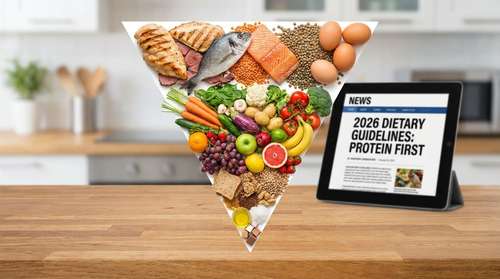
If you recently looked at federal nutrition advice and thought the world had turned completely on its head, you are not alone. The release of the 2025-2030 DGA Update earlier this year officially dismantled the carbohydrate-heavy foundation of the past four decades. Instead, officials introduced the Upside-Down Food Pyramid, a radical shift that anchors our daily meals with high-quality proteins and healthy fats. And according to breaking data released today, May 6, 2026, the public is catching on incredibly fast.
A massive new IFIC Nutrition Survey reveals that nearly half of the country—47% of Americans—are already navigating the 2026 Food Pyramid and actively restructuring their grocery lists. Let's examine what this nutritional overhaul looks like in practice, why the federal government finally flipped the script on healthy eating, and how you can seamlessly apply these guidelines to your own kitchen.
The Protein-First Revolution: Decoding the 2025-2030 DGA Update
For years, the base of the standard dietary graphic was dominated by bread, cereal, and pasta. The original food pyramid, launched in 1992, instructed Americans to eat up to 11 servings of these carbohydrates every single day. This advice unfortunately coincided with a skyrocketing epidemic of obesity, diabetes, and fatty liver disease. The New Dietary Guidelines for Americans absolutely shatter that old mold. Introduced by the US Department of Health and Human Services (HHS) alongside the USDA, the updated framework directly targets the rising rates of diet-driven chronic illnesses by explicitly limiting ultra-processed foods, refined carbohydrates, and added sugars.
Instead of pushing empty starches, the government has officially established a Protein-First Diet. The updated recommendations advise adults to consume between 1.2 and 1.6 grams of protein per kilogram of body weight daily. This represents a massive and welcomed increase from previous minimums, aiming to help individuals preserve critical muscle mass, stabilize blood glucose, and improve overall metabolic health as they age. Whether sourced from animal products like poultry, eggs, and red meat, or plant-based options like lentils and soy, nutrient-dense protein is now the undisputed centerpiece of the American plate.
IFIC Nutrition Survey: How 47% of Americans Are Adapting
Changing federal guidance is one thing; getting the public to actually change their ingrained eating habits is another entirely. Yet, the newly published IFIC Nutrition Survey demonstrates an unusually rapid adoption curve that is currently surprising public health experts across the nation.
Released today, May 6, 2026, the extensive polling indicates that 47% of consumers are actively modifying their diets to align with the Upside-Down Food Pyramid. Shoppers are consciously moving away from the middle aisles of the grocery store, reporting a steep decline in purchases of packaged, ready-to-eat carbohydrates.
Consumers are clearly paying close attention to the updated messaging. The survey data highlights that Americans are prioritizing whole, single-ingredient foods over the convenient, highly processed snacks that previously dominated pantries. This rapid pivot highlights one of the most significant Healthy Eating Trends 2026 has brought to the forefront: a widespread, consumer-led rejection of synthetic ingredients in favor of satiating, nutrient-dense meals.
The Triumphant Return of Healthy Fats
Perhaps the most shocking element of the 2026 Food Pyramid for anyone who grew up during the low-fat craze of the 1990s is the triumphant return of dietary fat. The New Dietary Guidelines for Americans officially recognize full-fat dairy, avocados, nuts, seeds, and even animal fats like butter and beef tallow as valuable, healthy components of a daily routine.
By recategorizing these items as healthy fats, the guidelines acknowledge a fundamental biological truth: eating fat does not inherently make you fat. Rather, pairing these rich fats with your protein sources helps promote sustained satiety. This keeps you full longer and naturally reduces the urge to graze on refined sugars and empty carbohydrates throughout the afternoon.
How to Build Your Upside-Down Plate Today
Transitioning to the 2025-2030 DGA Update recommendations doesn't require a culinary degree or an expensive personal chef. However, it does ask you to rethink your traditional meal prep strategy. If you want to join the 47% of Americans who are successfully adapting to the new guidance, follow these highly effective, practical steps:
- Anchor with Protein: Start every single meal by securing a high-quality protein source. Aim for roughly 30 grams per meal to hit that new 1.2 to 1.6g/kg daily target, scaling the exact amount based on your body weight and physical activity level.
- Rethink Your Grains: You do not have to eliminate carbohydrates entirely, but you absolutely must upgrade them. Swap white bread, instant rice, and refined pasta for fiber-rich whole grains.
- Layer in Healthy Fats: Do not fear the full-fat Greek yogurt, the handful of almonds, or the generous olive oil drizzle. Use these whole-food fats to add robust flavor and keep your hunger cues firmly in check.
- Eliminate the Ultra-Processed: If a food comes in a crinkly package with a massive ingredients list full of unpronounceable chemical additives, leave it on the supermarket shelf. Focus your budget on the outer perimeter of the store.
The Future of American Nutrition
The sweeping shift toward an Upside-Down Food Pyramid is much more than a fleeting social media fad; it is a long-overdue correction in national public health policy. By moving away from grain-heavy recommendations and fully embracing a Protein-First Diet, federal health agencies are finally aligning with decades of rigorous modern metabolic science.
As the latest IFIC Nutrition Survey clearly indicates, the public was more than ready for this change. We are witnessing a massive cultural pivot where obsessively counting calories is taking a back seat to prioritizing actual food quality. Navigating the 2026 Food Pyramid simply means returning to the foundational basics of human nutrition: eating whole foods, securing adequate protein, and serving up a hearty dose of common sense.