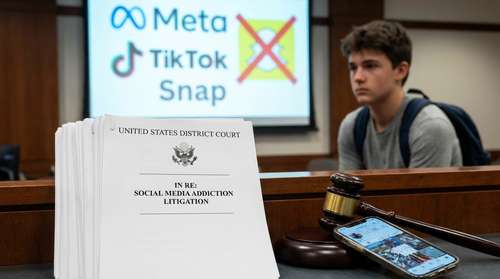
In a watershed moment for the nationwide social media mental health lawsuit, Winston-Salem/Forsyth County Schools (WS/FCS) in North Carolina officially voted to join the massive multi-district litigation against Big Tech giants this week. Their addition pushes the coalition of plaintiffs to nearly 2,000 school districts across the United States, all united by a singular, devastating claim: that Meta, TikTok, and Snap Inc. have engineered a teen mental health crisis through deliberately addictive social media algorithms. As of March 6, 2026, this legal juggernaut represents one of the largest coordinated efforts to hold Silicon Valley accountable for the deteriorating well-being of American youth.
The Tipping Point: Schools Fight Back Against "Addictive Design"
The decision by the WS/FCS Board of Education on Thursday marks a critical turning point in the school district social media litigation. By joining the federal multi-district litigation (MDL) overseen by Judge Yvonne Gonzalez Rogers in California, these districts are not just seeking damages; they are demanding a fundamental restructuring of how social media platforms operate. The lawsuit alleges that companies like Meta (Instagram and Facebook), ByteDance (TikTok), and Google (YouTube) have exploited the neurobiological vulnerabilities of children for profit.
According to court filings from the consolidated master complaint, the defendants are accused of utilizing "variable reward schedules"—similar to slot machines—to induce compulsive use. Educators argue that this Meta Instagram teen harm is not an accident but a feature. "We are seeing students who cannot focus, who are riddled with anxiety, and whose self-esteem is shattered by algorithmic loops they cannot escape," said a representative for the North Carolina district. The litigation contends that these platforms have created a public nuisance, effectively besieging an entire generation with content that promotes body dysmorphia, disordered eating, and dangerous viral challenges.
Billions in Damages: The Financial Toll on Education
The financial stakes of the Meta TikTok lawsuit 2026 are astronomical. School districts claim they have been forced to divert billions of dollars from educational programs to fund emergency mental health interventions. The lawsuit seeks restitution for these costs, which include hiring additional school counselors, implementing crisis intervention teams, and developing curriculum to combat digital addiction.
The Hidden Costs of the Crisis
Beyond the direct costs of hiring psychologists, schools are grappling with the secondary effects of youth anxiety and social media. Districts report a surge in disciplinary issues, property damage from TikTok challenges, and a dramatic drop in academic performance. In Indiana alone, where over 100 districts have joined the suit as of March 4, superintendents describe a landscape where they are no longer just educators, but triage nurses for a mental health epidemic.
Legal experts suggest that if the plaintiffs prevail in the bellwether trials—now scheduled for June 2026—the settlements could rival the historic tobacco and opioid master settlement agreements. "This isn't just about money," notes legal analyst Sarah Jenkins. "It's about forcing these companies to fund the cleanup of the mess they allegedly made."
The Road to June 2026: A Legal Showdown Looms
While personal injury cases involving individual families have seen some quiet settlements recently—including TikTok and Snap resolving claims with specific plaintiffs in early 2026—the school district social media litigation is barreling toward a public showdown. The presiding judge has selected a group of "bellwether" or test cases involving districts from states like Maryland, Florida, and California to proceed to trial first.
These upcoming trials will test the strength of the schools' arguments against Big Tech's primary defense: Section 230 of the Communications Decency Act. The tech giants argue they are platforms, not publishers, and thus immune from liability for user content. However, the schools' legal strategy cleverly sidesteps this by focusing on product design rather than content. They argue that the addictive social media algorithms themselves are defective products, a legal theory that has so far survived multiple motions to dismiss.
Big Tech's Defense and the Future of Digital Safety
In response to the growing legal pressure, companies like Meta have rolled out new parental supervision tools and "quiet modes" for teens. They maintain that they have robust safety measures in place and that the lawsuit oversimplifies complex mental health issues. A Meta spokesperson stated earlier this week that the company "wants teens to have safe, age-appropriate experiences online" and highlighted over 30 new safety tools introduced in recent years.
Yet, for the 2,000 school districts now involved, these measures are too little, too late. As the June 2026 trial date approaches, the eyes of the nation are on this courtroom battle. A victory for the schools could mandate sweeping changes to the digital landscape, potentially banning features like infinite scroll and autoplay for minors, and offering a lifeline to a generation currently drowning in a digital flood.