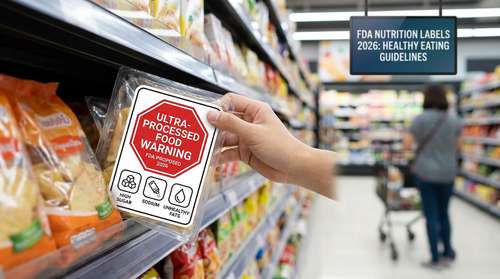
When you walk down a grocery store aisle today, you are met with a maze of marketing claims and confusing ingredient lists. But a sweeping change is arriving that will permanently alter how Americans buy groceries. Driven by a push to combat chronic disease, the FDA nutrition labels 2026 overhaul is set to introduce a transparent, aggressive approach to food packaging. Rather than burying critical health data on the back of a box, the U.S. government is advancing historic regulations to place front-of-pack icons directly in your line of sight—specifically targeting the hidden dangers of heavily manufactured ingredients.
With roughly 70 percent of the U.S. food supply now classified as ultra-processed, health experts have long argued that our current labeling standards are failing public health. The highly anticipated nutrition facts panel update moves beyond just counting calories or grams of sugar. Instead, it directly addresses the processing methods and industrial additives linked to metabolic and inflammatory diseases.
The Push for Front-of-Pack Nutrition Icons
The journey to this moment began with a January 2025 proposal where the FDA suggested a "Nutrition Info" box detailing saturated fat, sodium, and added sugars. However, recent developments have accelerated these food industry regulations into far more ambitious territory.
In March 2026, U.S. Health Secretary Robert F. Kennedy Jr. confirmed that a formalized federal definition for ultra-processed foods (UPFs) would be established by April, serving as the immediate launchpad for mandatory front-of-package food labeling. Instead of a simple text box, the modernized labels are expected to leverage an intuitive traffic-light graphic—red, yellow, and green—that accounts for all ingredients inside a product.
These bold ultra-processed food warnings aim to cut through the noise. Shoppers will instantly know if a colorful box of cereal or a seemingly healthy yogurt contains industrial emulsifiers, artificial colorants, or heavy modifications that strip away nutritional value.
Prioritizing Metabolic Health Nutrition
Why the sudden urgency? Federal health agencies have drawn a hard line connecting UPFs to the skyrocketing rates of type 2 diabetes, obesity, and cardiovascular disease. Researchers point out that children currently consume over 60 percent of their daily calories from these heavily modified products.
By prioritizing metabolic health nutrition, the FDA and USDA's collaborative guidelines are attempting to correct decades of dietary decline. The human body does not process a whole food the same way it metabolizes a product extruded, refined, and packed with artificial preservatives. The upcoming FDA nutrition labels 2026 initiative forces companies to disclose when a food has been scientifically engineered to be hyper-palatable, a formulation tactic that often overrides our natural satiety signals.
Defining "Ultra-Processed" for Consumers
Until recently, the U.S. lacked a regulatory definition for UPFs, often relying on the international "Nova" classification system. The federal government's new framework, finalized after a massive public data-gathering effort initiated by the FDA and USDA in July 2025, specifically identifies foods undergoing multiple manufacturing steps and containing additives that serve no functional nutritional role. This clear definition forms the backbone of the healthy eating guidelines 2026, giving regulators the legal footing needed to enforce strict visual warnings on packaging.
Decoding the Nutrition Facts Panel Update
While the front-of-pack graphics will steal the spotlight, the traditional back-of-the-box label is also facing immense scrutiny. The comprehensive nutrition facts panel update acts as the detailed ledger supporting the front-cover claims. If a product triggers an ultra-processed food warning, the updated panel will make it immediately obvious why.
Ingredients that historically blended into the background—like high-fructose corn syrup, hydrogenated oils, and complex emulsifiers—will now heavily influence a product's overall rating. Regulators are effectively closing the loopholes that allowed snacks disguised as "health foods" to thrive. For example, a protein bar loaded with synthetic fibers and chemical sweeteners may have previously boasted a "low sugar" claim. Under the new framework, the sheer volume of industrial processing required to create that bar will trigger a warning, providing a more accurate reflection of its impact on the human body.
How Food Industry Regulations Are Evolving
For food and beverage manufacturers, this represents a seismic shift in operations. Forward-thinking brands are already scrambling to reformulate their product lines to avoid carrying a red-light warning or a UPF designation on their packaging.
These evolving food industry regulations are turning nutritional transparency into a competitive advantage. If a popular snack brand can remove artificial dyes and refined starches to earn a green-light front-of-pack nutrition icon, they stand to capture a massive share of health-conscious consumers. Conversely, companies that rely on cheap, highly processed fillers will have to display their manufacturing choices right on the front of the box.
The era of hiding behind obscure chemical names printed in tiny font is ending. As the new front-of-package requirements roll out across the nation, the grocery store will transform from a place of dietary guesswork into an environment where informed choices are immediate and unavoidable. Shoppers are finally getting the clarity they need to protect their health, one clear label at a time.