In a major breakthrough for longevity science 2026, researchers at UCLA have identified a specific protein responsible for the slowing of muscle repair as we age. The study, published this week in the journal Science, reveals that a protein called NDRG1 acts as a "survival brake," deliberately slowing down stem cell activity to preserve their lifespan. While this discovery offers a potential path for muscle aging reversal, the scientists warn of a complex evolutionary trade-off: turning off this brake restores youthful healing but risks depleting the body's essential stem cell reserves.
The Biological Cost of Aging: Speed vs. Survival
For decades, scientists believed that aging muscles healed slowly simply because the machinery was breaking down—a gradual wear and tear of the body's regenerative capacity. However, the new UCLA stem cell research flips this narrative on its head. The slowdown isn't a failure; it's a feature.
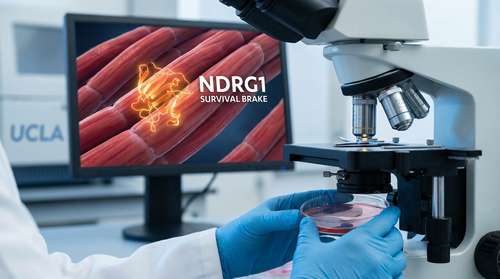
Led by Dr. Thomas Rando, director of the Eli and Edythe Broad Center of Regenerative Medicine and Stem Cell Research, the team discovered that as muscle stem cells age, they accumulate high levels of the NDRG1 protein—up to 3.5 times more than in younger cells. This protein suppresses the mTOR signaling pathway, which is the cellular driver for growth and activation. By dampening this signal, NDRG1 forces cells into a quiescent, protective state.
"It's counterintuitive, but the stem cells that make it through aging may actually be the least functional ones," Dr. Rando explained in a press briefing. "They survive not because they're the best at their job, but because they're the best at surviving."
Understanding 'Cellular Survivorship Bias'
The study introduces a concept the researchers term cellular survivorship bias. In youth, muscle stem cells are like sprinters: they are primed for explosive activity and rapid muscle tissue repair. They activate instantly upon injury but burn through their energy reserves and genetic integrity quickly. As time passes, these "high-performance" cells die off due to metabolic stress.
What remains in older muscle tissue is a population of cells that naturally produce higher levels of NDRG1. These cells are the "marathon runners." They are slower to activate and repair tissue, which explains why a pulled hamstring takes weeks to heal in your 60s compared to days in your 20s. However, their sluggishness protects them from the toxic byproducts of rapid division, allowing them to persist deep into old age.
The Trade-Off Experiment
To test this theory, the research team chemically inhibited the NDRG1 protein in aged mice. The results were visually stunning: the elderly stem cells "woke up" and began repairing muscle tissue at speeds comparable to young mice. Under the microscope, the treated muscle fibers regenerated thick, healthy tissue rapidly.
However, this rejuvenation came with a steep price. Without the protective "brake" of NDRG1, the stem cell pool became vulnerable. Over time, the reinvigorated cells exhausted themselves and died off, leaving the muscle with no reserve capacity for future injuries. This finding highlights a critical challenge for regenerative medicine news: simply hitting the gas pedal on aging cells might provide a short-term boost at the cost of long-term viability.
Implications for Longevity Science 2026
This discovery marks a pivot point for anti-aging therapies. Previous approaches often focused solely on stimulating cell growth. This research suggests that effective muscle aging reversal will require a nuanced approach—perhaps temporarily releasing the NDRG1 brake to heal an acute injury, then re-engaging it to preserve the remaining stem cells.
Postdoctoral scholars Jengmin Kang and Daniel Benjamin, co-leads of the study, emphasize that future therapeutics must balance "sprinting" (repair) with "marathon" (survival) capabilities. If scientists can fine-tune the modulation of NDRG1, it could lead to treatments that help older adults recover from surgeries or falls without permanently depleting their regenerative resources.
The Future of Human Muscle Repair
As we move further into 2026, the focus of longevity research is shifting from simply extending life to extending "healthspan"—the period of life spent in good health. Sarcopenia, or age-related muscle loss, remains a leading cause of frailty and loss of independence.
While a pill to block NDRG1 is not yet ready for human trials, this UCLA stem cell research provides a precise molecular target. By understanding that slower healing is a survival mechanism rather than just deterioration, doctors may soon be able to trick the body's oldest cells into one last sprint, helping patients recover strength and mobility in their golden years.