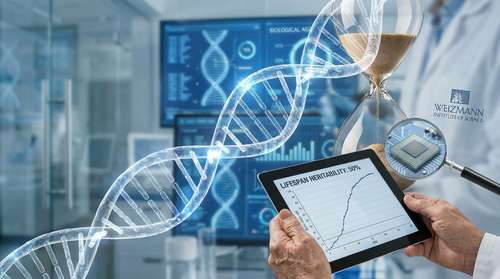
For decades, wellness experts and longevity gurus have preached that your daily habits are the ultimate architects of your life expectancy. But a groundbreaking human lifespan study 2026, published today in the journal Science, is dramatically rewriting the rules of human aging. According to breakthrough Weizmann Institute aging research, the age-old debate of nature versus nurture has a new victor. Genetics and longevity are far more intertwined than previously believed. The landmark findings reveal that your DNA dictates roughly 50% of the variation in your lifespan—more than double the estimates accepted by the scientific community just yesterday.
The Hidden Truth About the Heritability of Aging
Historically, researchers pegged the heritability of aging at a modest 10% to 25%, with some recent large-scale pedigree studies suggesting it could be as shockingly low as 6%. This low benchmark fueled a booming wellness industry focused almost exclusively on diet, exercise, and stress management to maximize lifespan. However, the latest study led by doctoral student Ben Shenhar and Professor Uri Alon at the Weizmann Institute of Science proves that the true genetic blueprint for human aging has been obscured by flawed historical data.
By peeling back layers of statistical noise, the Israeli research team demonstrated that longevity is deeply rooted in our biology. When external, non-age-related causes of death are removed from the equation, the profound connection between DNA and healthy aging finally emerges. This revelation brings human lifespan heritability right in line with what scientists have long observed in animal models used to study the biology of aging.
How Weizmann Institute Aging Research Cracked the Code
To understand why previous research missed the mark, we have to look at how scientists historically measured the heritability of aging. Most earlier studies relied on basic genealogical records from the 19th and early 20th centuries. These archives only logged a person's age at death, completely failing to account for how they died.
Shenhar and Alon realized that grouping all deaths together severely skewed the data. They drew a strict statistical line between extrinsic mortality—deaths caused by external factors like car accidents, violent events, or severe infectious diseases—and intrinsic mortality, which represents the natural, biological deterioration of the body. If one twin dies at 90 from natural causes and the other tragically dies at 30 from an infectious disease like cholera, their shared genes didn't fail them; random external circumstances did. Statistical models that treat these deaths equally will artificially lower the perceived impact of genetics.
Analyzing the Twin Registries
To prove their hypothesis, the researchers built advanced mathematical models to analyze comprehensive data from three massive twin registries in Denmark and Sweden. Crucially, this dataset included identical twins who were raised apart in completely different households.
By studying individuals with identical DNA but entirely different life environments, the team successfully isolated the true impact of genetics. Once extrinsic mortality was properly filtered out of the data pool, the genetic influence on intrinsic lifespan skyrocketed to roughly 50%.
Redefining Biological Age vs Chronological Age
This paradigm shift in understanding the heritability of aging is already sending shockwaves through the biotech and medical communities. If half of our life expectancy is hardwired, the race to identify specific longevity biomarkers just gained immense momentum. Interestingly, the study found that genetic influence varies depending on the specific cause of natural decline. For instance, dementia-related mortality showed a massive genetic component of up to 70% around age 80.
Currently, the medical field focuses heavily on treating isolated age-related conditions—like heart disease or cognitive decline—only after symptoms appear. This new framework encourages a massive pivot toward measuring biological age vs chronological age. Chronological age is simply the number of candles on your birthday cake, but biological age reflects the true cellular deterioration inside your body. By understanding the 50% genetic baseline, scientists can now hunt for the specific gene variants that extend life. The ultimate goal is moving beyond reactive medicine toward developing targeted therapies that slow down the fundamental biology of aging itself.
DNA and Healthy Aging: What This Means for Your Future
Does this mean your daily jog, sleep hygiene, and Mediterranean diet are useless? Absolutely not. While the Weizmann Institute aging research confirms that your genetic lottery ticket is incredibly important, it also highlights that the remaining 50% of your lifespan variation is still entirely up to environmental factors.
Shenhar explicitly emphasizes that this everything else category—encompassing nutrition, physical activity, pollution exposure, and lifestyle choices—remains a massive piece of the longevity puzzle. You cannot change your inherited DNA, but you can absolutely optimize the environmental factors that interact with those genes.
This human lifespan study 2026 does not hand us an excuse to abandon healthy habits. Instead, it provides a clearer, more accurate map of the human aging process. We are stepping into a bold era where personalized medicine won't just tell you which diseases you are prone to, but will offer therapeutic interventions tailored to your unique genetic aging clock. For now, the most effective strategy is to meticulously control the 50% you can, while science works on unlocking the therapeutic secrets of the half you inherited.