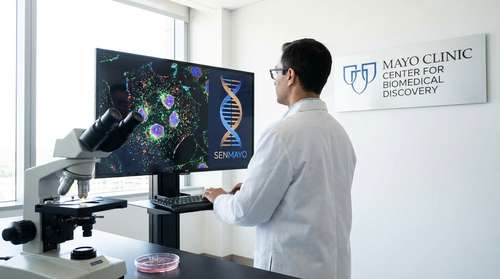
On May 15, 2026, scientists announced a monumental milestone in the quest to extend human healthspan. For decades, the field of longevity has faced a seemingly insurmountable hurdle: how to safely identify and remove the toxic, dying tissue responsible for human deterioration without harming healthy neighbors. Now, a highly anticipated senolytics breakthrough 2026 is changing the paradigm. Researchers at the Mayo Clinic have successfully engineered synthetic DNA molecules capable of seeking out and flagging the elusive cellular culprits driving our physical decline. This precision targeting finally opens the door to safely eliminating inflammation-driving tissues, presenting an unprecedented opportunity for an anti-aging medical discovery that works.
The Hidden Threat of Zombie Cells
To understand why this Mayo Clinic aging research is so transformative, you have to look at the biology of cellular decay. As our bodies endure stress and DNA damage over a lifetime, certain cells experience an irreversible form of cell-cycle arrest. These are senescent cells, frequently dubbed "zombie cells" by scientists because they refuse to die but no longer perform their intended functions. Instead of self-destructing through natural apoptosis, they linger in our tissues, secreting a toxic cocktail of inflammatory molecules that damages nearby healthy neighbors.
Over time, this slow poisoning is a primary driver behind a host of age-related conditions, including arthritis, cancer, and Alzheimer's disease. Until now, the biggest obstacle for an effective zombie cells treatment was visibility. Because senescent cells hide among billions of healthy ones, systemic drugs designed to kill them often caused collateral damage to functioning tissues.
How DNA Aptamers Solved a Decades-Old Mystery
The solution came from an unlikely genesis: a casual conversation between two graduate students, Keenan Pearson, Ph.D., and Sarah Jachim, Ph.D., which ultimately united two distinct laboratories. Operating under the guidance of biochemist Dr. L. James Maher III and Dr. Nathan LeBrasseur, Director of the Mayo Clinic's Robert and Arlene Kogod Center on Aging, the team pioneered the use of a cutting-edge molecular technology.
Sifting Through 100 Trillion Sequences
Aptamers are short, synthetic single strands of DNA that fold into unique three-dimensional shapes, allowing them to act like customized keys fitting into specific molecular locks. To find the right key, the researchers deployed an unbiased approach called SELEX (Systematic Evolution of Ligands by EXponential enrichment). Rather than guessing which marker to look for, they let the senescent cells essentially "choose" what stuck to them by screening a vast library of more than 100 trillion random DNA sequences.
The results, reported in the journal Aging Cell, revealed that these DNA aptamers longevity tools successfully homed in on a specific variant of a surface protein called fibronectin found on mouse senescent cells.
A Leap Toward Reversing Biological Age
This capability marks a total shift in how scientists approach reversing biological age. Previously, doctors lacked stand-alone indicators to universally differentiate a zombie cell from a healthy one, relying instead on a combination of complex biomarkers that made large-scale treatments risky. Early senolytic therapies often acted like blunt instruments, carrying the risk of side effects by occasionally sweeping up healthy, post-mitotic cells along with the targeted decay.
The precision of these new molecular tags solves this by allowing researchers to attach destructive drug payloads directly to the aptamers. Acting as microscopic delivery vehicles, they latch onto the fibronectin protein of a senescent cell and release their payload, effectively eliminating the source of inflammation while leaving neighboring healthy structures entirely untouched. If this targeted delivery scales successfully from mouse models to human clinical trials, it could revolutionize treatments for conditions ranging from cardiovascular disorders to osteoarthritis, radically shifting the landscape of modern medicine.
The Frontline of Precision Geroscience News
As we absorb the implications of this precision geroscience news, the medical community is already looking toward the next phase of clinical applications. While this foundational breakthrough was verified in mouse models, the overarching principle confirms that unbiased cell-based selection can yield highly specific diagnostic reagents for complex biological problems. The Mayo Clinic team has emphasized that aptamer technology is not only highly accurate but also more versatile and cost-effective to produce than the traditional antibodies used in similar medical tagging procedures.
Looking ahead, researchers are actively exploring how these DNA molecules can be utilized to map the accumulation of zombie cells in human patients through advanced imaging techniques. Such diagnostics would allow doctors to prescribe customized senolytic treatments before the visible symptoms of aging and cognitive decline ever surface.
By definitively solving the problem of how to spot the invisible enemies within our tissues, the scientific community has cleared the largest roadblock in longevity research. We are now standing on the precipice of an era where targeted therapies might allow us to manage our cellular health with unprecedented exactness, offering a realistic path to extended vitality and healthspan.