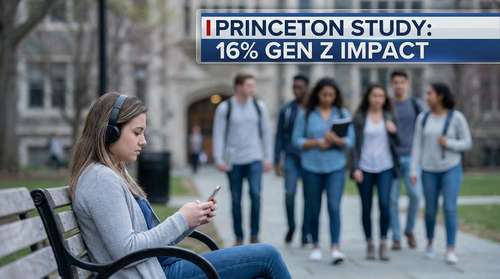
The escalating Gen Z mental health crisis 2026 has officially reached a critical turning point. For years, psychologists, parents, and educators have debated the exact toll that hyper-curated digital ecosystems take on developing minds. Now, a groundbreaking experimental survey funded by Princeton University has quantified the damage with alarming precision. Released on March 15, 2026, the comprehensive report isolates constant screen time as a primary catalyst for emotional distress among adolescents and young adults. More importantly, it provides definitive, peer-reviewed evidence that taking structured, month-long breaks from scrolling can tangibly restore psychological well-being.
Analyzing the Princeton Social Media Study Results
To accurately measure the impact of social media on youth mental health, researchers at Princeton collaborated with Saiful Mujani Research and Consulting (SMRC) to execute a sweeping behavioral experiment. Spanning from November 17, 2025, to January 14, 2026, the initiative tracked 1,502 randomly selected internet users across 30 provincial capitals in Indonesia. This diverse, cross-cultural sampling proves that digital fatigue is a global phenomenon, not just a localized Western anomaly.
Unlike standard observational surveys that rely heavily on subjective self-reporting, this initiative utilized a rigorous, two-part panel format. Participants were actively assessed while using their accounts normally, then randomly sorted into three distinct factions. The first group entirely stopped using social networks for one month. The second group initiated a household-wide digital freeze, logging off alongside their family members. A third control group maintained their usual online habits. The subsequent Princeton social media study results evaluate clinical variables including affect, overall life satisfaction, sleep quality, and baseline anxiety.
The Startling Gen Z Anxiety and Depression Statistics
According to Deni Irvani, the Executive Director of SMRC, the collected data exposes a sharp and undeniable generational divide. The research identified that a staggering 16% of Generation Z—defined in this study as individuals born after 1997—currently experience significant mental and emotional disturbances directly tied to their digital habits.
To put this figure into perspective, older demographics demonstrate far more psychological resilience to algorithmic pressures. Millennials clocked in at an 8% disturbance rate, exactly half that of their younger counterparts. Meanwhile, Gen X and Boomers both registered at just 7%. This stark contrast highlights how social media addiction in young adults creates unique vulnerabilities. While 90% of the broader survey population reported generally good emotional health, the concentrated 10% suffering from poor or very poor conditions skewed heavily toward the youngest demographic tested.
Why Are Young Adults More Vulnerable?
Tech platforms purposefully engineer their interfaces to capture and monetize human attention. However, younger users often lack the historical baseline of a disconnected, analog world. They process major life milestones, engage in relentless peer comparisons, and consume intense global news entirely through personalized, algorithmically driven feeds. This constant exposure distorts reality, elevates cortisol levels, and leaves young adults particularly susceptible to feelings of inadequacy and isolation.
The Tangible Mental Health Effects of Social Media Detox
Perhaps the most encouraging takeaway from the extensive Princeton research involves the reversibility of these troubling symptoms. The experiment successfully proved that removing the digital stimulus directly heals the mind. Both treatment groups—the individuals who quit solo and those who paused usage alongside their households—exhibited massive improvements in their overall psychological stability when compared to the control group.
The mental health effects of social media detox manifested rapidly. Within just one month of logging off, participants reported measurable rebounds in their daily life satisfaction and nighttime sleep quality. They also experienced sharp, quantifiable declines in depressive thoughts and ambient anxiety. Interestingly, the group dynamic yielded fascinating behavioral observations. Stepping away from screens as a collective household minimized the intense fear of missing out and fostered stronger, more authentic interpersonal connections offline.
Navigating Digital Mental Health Trends 2026
As public health officials and educators process these latest revelations, the narrative surrounding screen time is aggressively shifting from passive consumption to proactive management. Tracking digital mental health trends 2026, we expect the findings from this study to heavily influence future wellness guidelines. Universities and high schools are already exploring structural changes to support student populations, encouraging digital sobriety among cohorts who recognize the heavy toll these applications exact.
If you or a loved one are feeling the crushing weight of the endless scroll, the clinical data supports a highly effective, cost-free intervention: just log off. You do not need to permanently delete your profiles to experience the benefits. To start reclaiming your focus and joy, consider implementing these proven strategies:
- Establish tech-free zones: Ban smartphones from the bedroom to immediately improve your sleep hygiene.
- Try a 30-day pause: Mimic the study's parameters by taking a strict, month-long hiatus from your most-used apps.
- Recruit an accountability partner: Detox alongside a friend or family member to reduce feelings of isolation.
- Prioritize physical community: Replace screen time with face-to-face hobbies, exercise, or local events.
As the latest science unequivocally confirms, stepping away from the feed might be the single most effective prescription for finding peace in our hyperconnected era.