For decades, scientists have been fighting Alzheimer's disease by looking at the aftermath of the battle—cleaning up amyloid plaques and tau tangles. But a massive shift in dementia prevention trends 2026 has just occurred. Researchers at the University of California, Irvine (UC Irvine) have deployed a revolutionary artificial intelligence system called SIGNET to map the actual battle plans of the disease. For the first time, we aren't just seeing which genes are involved; we are seeing exactly how they command one another to destroy brain tissue.
The SIGNET Breakthrough: Moving Beyond Genetic Coincidence
Until this week, most genetic studies on Alzheimer's suffered from a critical blind spot: they could identify which genes were active at the same time, but not which ones were in charge. It was the scientific equivalent of noticing that umbrellas and rain appear together, without understanding that rain causes the umbrellas to open.
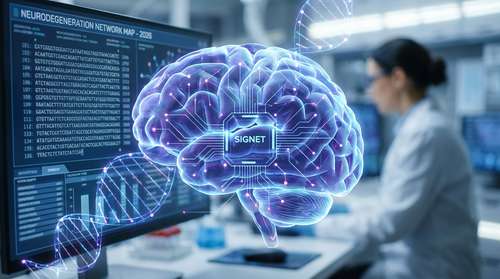
The new SIGNET AI gene mapping platform changes this entirely. Led by researchers Min Zhang and Dabao Zhang at UC Irvine's Joe C. Wen School of Population & Public Health, the team used the tool to analyze single-cell molecular data from 272 brain samples. Unlike previous tools, SIGNET distinguishes between mere correlation and actual causation. It has successfully constructed the first cause-and-effect regulatory networks for six major brain cell types, effectively drawing a circuit diagram of neurodegeneration.
Excitatory Neurons: The Ground Zero of Brain Rewiring
The findings, published in Alzheimer's & Dementia, reveal a chaotic landscape within specific brain cells. The most aggressive genetic rewriting appears to happen in excitatory neurons—the cells responsible for sending activating signals throughout the brain. SIGNET identified nearly 6,000 directed gene-to-gene interactions in these cells alone, showing that as the disease progresses, the internal communication lines of these neurons are fundamentally scrambled.
"We are shifting the field from observing correlations to uncovering the causal mechanisms that actively drive disease progression," the researchers noted. This distinction is vital because it explains why some previous treatments failed: they were targeting the passengers, not the drivers.
The APP Gene Surprise
One of the study's most specific and intriguing discoveries involves the amyloid precursor protein (APP) gene. Long known as the villain behind amyloid plaques, APP turns out to have a more complex role. The UC Irvine Alzheimer's study found that in inhibitory neurons, APP acts as a potent regulator, actively controlling the behavior of other genes. This suggests that simply suppressing APP might have unintended consequences, and that therapies need to be far more precise in how they address these genetic hubs of neurodegeneration.
Targeting the 'Hub Genes' to Prevent Brain Aging
The ultimate promise of this Alzheimer's AI breakthrough 2026 lies in the identification of "hub genes." These are the central command nodes that SIGNET identified as controlling vast networks of downstream genetic activity. Think of them as the generals in an army; taking out a single foot soldier (a minor gene) makes little difference, but neutralizing a general (a hub gene) can stop the entire attack.
This approach aligns perfectly with emerging healthy aging research news, which increasingly focuses on resilience and upstream prevention. By targeting these master switches, pharmaceutical developers can theoretically halt the genetic cascade that leads to memory loss before significant physical damage occurs to the brain tissue.
A New Era for Neurodegenerative Medicine
The data powering this breakthrough came from the long-running Religious Orders Study and the Rush Memory and Aging Project, ensuring the AI was trained on high-quality, real-world human biological data. While the current focus is on preventing brain aging with AI, the SIGNET architecture is disease-agnostic. The UC Irvine team believes this same causal mapping technology could soon be applied to untangle the genetic webs behind cancer, autoimmune disorders, and other complex conditions.
As we move further into 2026, the message is clear: the era of guessing is over. With tools like SIGNET, we are finally reading the instruction manual of the Alzheimer's brain, and for the first time, we have the pen to rewrite it.