As we observe National Nutrition Month 2026 this March, the dietary landscape in the United States is undergoing its most radical transformation in half a century. The newly implemented 2025-2030 Dietary Guidelines for Americans have sparked a fierce national debate by drastically resetting federal nutrition policy. Moving away from decades of grain-heavy recommendations, the updated framework explicitly prioritizes "real food"—placing animal proteins, full-fat dairy, and healthy fats at the absolute center of the American plate.
Released earlier this year by the U.S. Department of Agriculture (USDA) and the Department of Health and Human Services (HHS) under the "Make America Healthy Again" initiative, this ten-page policy shift turns conventional wisdom entirely upside down. Health experts are currently divided over the striking visual overhaul, which boldly features steak, butter, and olive oil while declaring an unprecedented war on refined carbohydrates and artificial ingredients.
Decoding the Upside-Down New Food Pyramid 2026
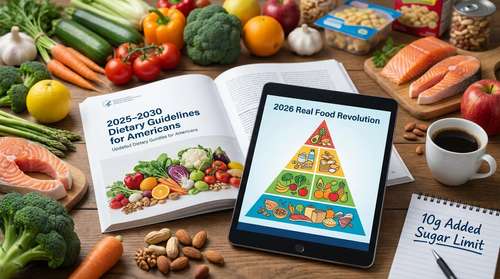
For years, Americans were told to build their diets on a massive foundation of breads, pastas, and cereals while utilizing dietary fats sparingly. The new food pyramid 2026, released via realfood.gov, completely flips that outdated model. Visualized as an inverted triangle, the widest top tier now champions high-quality proteins, full-fat dairy, and non-starchy vegetables. Conversely, grains have been demoted to the narrowest bottom section, serving only as an occasional dietary addition.
This structural restructuring heavily emphasizes protein-rich diet benefits. The updated guidelines recommend consuming 1.2 to 1.6 grams of protein per kilogram of body weight daily to support metabolic function and muscle retention. For the first time, federal officials are actively encouraging the consumption of fat-rich whole foods like eggs, avocados, wild-caught seafood, and full-fat dairy options like whole milk and cheddar cheese. Even previously demonized cooking fats, such as butter and beef tallow, are now suggested as highly suitable alternatives to heavily refined seed oils.
The Medical Community's Saturated Fat Divide
While holistic nutrition advocates praise the return to nutrient-dense, single-ingredient foods, the conventional medical establishment remains somewhat fractured. The visual prominence of red meat and dairy appears to contradict the lingering recommendation to keep saturated fats below 10 percent of daily calories. A single meal featuring a grass-fed steak cooked in butter easily surpasses this mathematical threshold, leaving some cardiologists split on the long-term cardiovascular implications of the new framework.
The 10 Gram Added Sugar Limit and the War on Processed Food
Perhaps the most aggressive policy change found within the 2025-2030 Dietary Guidelines for Americans is the strict 10 gram added sugar limit per individual meal. Previous iterations allowed up to 10 percent of total daily calories to come from added sugars—roughly 50 grams for a standard 2,000-calorie diet. Furthermore, the new policy dramatically raises the age restriction, now advising that children avoid all added sugars until age 10.
To enforce this paradigm shift, the HHS has placed a massive target on manufactured convenience snacks. The newly categorized ultra-processed foods list 2026 explicitly targets packaged, ready-to-eat products laden with non-nutritive sweeteners, petroleum-based dyes, and artificial preservatives. The government's message is unambiguous: if a food item comes in a brightly colored package with a long shelf life and hidden high-fructose syrups, it is no longer considered part of a healthy lifestyle.
Food manufacturers are already scrambling to reformulate their product lines. With the government naming and shaming highly processed foods as a direct cause of unprecedented chronic disease, multinational brands are heavily investing in clean-label alternatives to avoid losing their footing in the rapidly shifting American marketplace.
Embracing Personalized Nutrition Trends 2026
The sweeping changes in federal policy also reflect a broader societal pivot toward individualized healthcare. Rather than offering a rigid, one-size-fits-all prescription, the framework aligns perfectly with the explosive personalized nutrition trends 2026. The guidelines explicitly encourage Americans to adjust their macronutrient intake based on individual age, metabolic health, gut microbiome composition, and physical activity levels.
However, implementing these localized changes on a national scale poses a significant logistical challenge. Schools and federal meal programs, which feed nearly 30 million children daily, are already feeling the immense pressure. Translating this "eat real food" directive into actionable, budget-friendly school lunches is a monumental task that officials project will take until 2027 to execute fully. In the meantime, clinical dietitians are working overtime during this National Nutrition Month 2026 to help families navigate the grocery aisles without relying on the cheap, processed convenience foods they have purchased for generations.
Ultimately, the updated federal guidelines represent a historic, bold gamble on public health. By discarding the high-carbohydrate models of the past and returning to foundational whole foods, health agencies are betting that a national diet rich in natural proteins and healthy fats is the ultimate key to reversing America's unprecedented chronic disease epidemic.