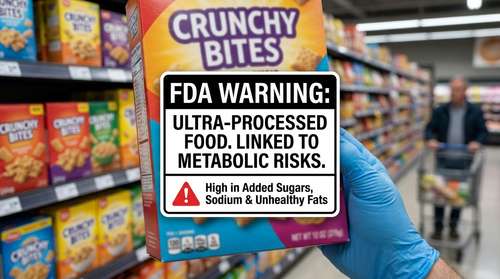
Federal regulators have officially changed how the United States treats industrial food production. The implementation of mandatory FDA ultra-processed food labels marks a definitive pivot from decades of voluntary corporate compliance to immediate consumer transparency. Finalized this week on April 21, 2026, the sweeping front-of-package regulation directly targets products laden with synthetic additives, emulsifiers, and artificial flavorings. For the first time, shoppers will not have to scrutinize microscopic ingredient lists to know if a product is highly industrialized; the packaging will tell them upfront. This landmark decision aligns seamlessly with the Make America Healthy Again (MAHA) agenda, signaling a ferocious government response to skyrocketing rates of diet-related chronic diseases across the nation.
A Paradigm Shift: The FDA Food Regulation Update
The road to this historic mandate has been paved with intense scientific debate and a dramatic reshaping of federal priorities. Earlier labeling proposals, inherited from previous administrations, focused predominantly on limiting saturated fat, sodium, and added sugars through a passive informational box. However, current Health and Human Services leadership, alongside FDA Commissioner Dr. Martin Makary, explicitly rejected that narrow scope earlier this spring. Recognizing that metabolic health news has consistently pointed to the complex industrial processing itself as the core culprit behind chronic illness, regulators drafted a vastly more aggressive standard.
The newly minted new nutrition labeling 2026 requirements discard the outdated framework in favor of direct, highly visible warnings. Under the finalized rule, products meeting the federal definition of ultra-processed will carry unmistakable front-of-package markers. These visual cues—utilizing a distinct traffic-light warning graphic—alert consumers instantly to the presence of synthetic food dyes, petroleum-based additives, and complex emulsifiers that do not exist in standard home kitchens. The regulation requires large food manufacturers to revamp their packaging formats over the next two years, forcing a long-overdue reckoning for the multi-billion-dollar packaged food industry.
Parallel Movements in State Legislation
While the federal government establishes these stringent baseline warnings, state legislatures have concurrently pushed the envelope to demand better food quality. California recently advanced AB 2244, a parallel certification program functioning similarly to an organic seal, to voluntarily identify non-UPF products. The combination of state-level innovation and this massive FDA food regulation update creates an unavoidable spotlight on the American supply chain. Food conglomerates can no longer obscure cheap, heavily refined ingredients behind clever marketing campaigns or deceptive packaging.
The Undeniable Health Risks of Ultra-Processed Foods
Why did federal health officials take such an unprecedented, market-altering step? The answer lies in the catastrophic toll these engineered products take on the human body. The health risks of ultra-processed foods extend far beyond mere weight gain or consuming empty calories. Extensive clinical data now overwhelmingly links UPF consumption to the rapid onset of metabolic syndrome—a dangerous cluster of conditions that includes insulin resistance, elevated blood pressure, and abnormal cholesterol profiles.
When agricultural commodities are stripped of their natural fiber matrices, extruded, and injected with artificial stabilizers, they bypass the body's natural satiety signals. Ingredients like polysorbates and artificial gums, widely used to prolong shelf life and artificially enhance texture, have been proven to disrupt the gut microbiome and trigger systemic inflammation. By enforcing FDA ultra-processed food labels, public health officials are essentially treating these highly engineered food-like substances with the same regulatory severity historically reserved for recognized environmental health hazards. This renewed transparency gives families a fighting chance to protect their metabolic function before irreversible chronic disease takes root.
How to Avoid UPFs: Clean Label Food Shopping in a New Era
As these striking new visual warnings begin rolling out across supermarket shelves, consumer purchasing behavior is expected to shift dramatically. However, you do not need to wait for full corporate compliance to protect your family's health right now. Learning how to avoid UPFs relies on a fundamental shift in how you approach grocery shopping, primarily by prioritizing the perimeter of the store where fresh, perishable whole foods reside.
Mastering clean label food shopping requires looking critically beyond the front-of-package health claims that manufacturers use to project a "healthy" halo. Your best strategy is to focus on ingredients you can easily recognize and could theoretically purchase for your own pantry. If an ingredient panel reads like a chemical inventory—featuring high-fructose corn syrup, modified food starches, hydrogenated oils, or artificial colorings like Red 40 and Yellow 5—the product is highly processed. Instead, opt for single-ingredient items or minimally processed options such as plain frozen vegetables, dry legumes, and raw nuts. While the historic introduction of FDA ultra-processed food labels will serve as an invaluable tool for public health, building a daily diet centered on genuine, unadulterated food remains your absolute most effective defense against modern metabolic disease.