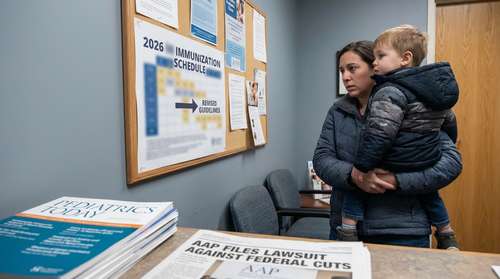
WASHINGTON, D.C. – The American Academy of Pediatrics (AAP) has formally launched a legal and public health challenge against the Department of Health and Human Services (HHS) following a historic and controversial overhaul of the nation’s immunization guidelines. The 2026 CDC vaccine schedule changes, announced earlier this month, have slashed the number of universally recommended childhood vaccinations from 17 to just 11, sparking outrage among pediatricians and public health officials who warn the move could reverse decades of progress in disease prevention.
Federal Shift to 'Shared Decision-Making' Sparks Outcry
On January 5, 2026, HHS officials, under the direction of Secretary Robert F. Kennedy Jr. and Acting CDC Director Jim O'Neill, unveiled the updated federal guidance. The new schedule removes routine recommendations for vaccines protecting against Hepatitis A, Hepatitis B, Influenza, Rotavirus, Meningococcal disease, and COVID-19. Instead of being standard for all children, these immunizations have been reclassified under a new framework of "shared clinical decision-making" or reserved specifically for high-risk groups.
Federal officials argue the changes are designed to align the U.S. with "peer nations" like Denmark and to prioritize parental choice. However, the AAP and other medical bodies contend that the new federal vaccine guidelines ignore the unique public health landscape of the United States and were implemented without the traditional rigorous review by the Advisory Committee on Immunization Practices (ACIP).
"Children's health depends on vaccine recommendations based on rigorous, transparent science," said AAP President Dr. Andrew D. Racine in a press statement. "Unfortunately, recent decisions by federal officials have abandoned this standard, causing unnecessary confusion for families and compromising access to lifesaving vaccines."
The Legal Battle: AAP vs HHS Lawsuit 2026
The conflict has escalated rapidly into a high-stakes legal battle. In what legal experts are calling the defining AAP vs HHS lawsuit 2026, the Academy, joined by the Infectious Diseases Society of America (IDSA) and other medical groups, filed a motion seeking a preliminary injunction to halt the implementation of the new schedule. The plaintiffs argue that the changes violate administrative procedure laws and disregard established scientific evidence.
Tensions flared further when the AAP alleged that nearly $12 million in federal grant funding was abruptly terminated in December 2025 as retaliation for their vocal opposition. On January 11, U.S. District Judge Beryl Howell issued a preliminary injunction ordering HHS to restore the funding, stating the organization was likely to succeed in its claim that the cuts were an unconstitutional attempt to chill public health advocacy.
Fears of a Measles Outbreak US 2026
Pediatricians are already reporting confusion on the ground, with parents unsure whether to follow the new federal advice or their doctor's recommendations. Public health experts warn that the childhood immunization schedule cuts could have immediate and devastating consequences. With routine protections for highly contagious diseases like measles and polio potentially weakening, officials in several states are bracing for resurgence events.
Dr. Robbie Goldstein, Commissioner of Public Health in Massachusetts, publicly rejected the new federal guidance, citing active risks. "At a moment when we are seeing a measles outbreak US 2026 scenarios become reality in pockets of the country, and the resurgence of whooping cough, this ill-advised federal action puts families in an impossible position," Goldstein stated.
More than 20 states, including California, New York, and Minnesota, have announced they will not adopt the new CDC schedule and will instead continue to endorse the evidence-based guidelines supported by the AAP. This has created a fractured immunization landscape where a child's protection against preventable diseases may depend entirely on their zip code.
Understanding Shared Decision Making Vaccines
The concept of shared decision making vaccines is not entirely new but has never been applied so broadly to routine childhood immunizations. Previously reserved for narrow situations—such as the MenB vaccine for adolescents—it implies that a vaccine is not necessary for everyone but should be considered based on individual risk factors.
Critics argue that applying this model to routine shots like Rotavirus or Hepatitis B is dangerous because it shifts the burden of complex medical risk assessment onto parents and time-strapped clinicians. "The notion that every parent can have a 30-minute deep dive into the epidemiology of Hepatitis B during a 15-minute wellness visit is simply not realistic," noted Dr. Sarah Nosal of the American Academy of Family Physicians.
Pediatric Health Alerts for Parents
Amidst the regulatory chaos, the AAP has issued pediatric health alerts for parents urging them to stick to the schedule that has kept children safe for decades. Doctors emphasize that despite the change in federal classification, the medical necessity of these vaccines has not changed. Diseases like the flu and meningitis remain serious threats to healthy children.
Parents are advised to schedule appointments with their pediatricians to discuss their child's specific needs. While the federal mandate may have softened, insurance requirements and school entry mandates in many states remain tied to the older, more comprehensive list of requirements, meaning the practical impact of the federal changes may face hurdles at the state level.
As the legal challenges proceed, the message from the medical community remains clear: vaccines save lives, and the rollback of these protections poses a significant risk to the future health of American children.