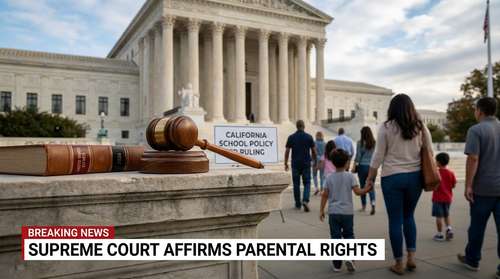
In a watershed moment for family law and education policy, the U.S. Supreme Court has issued a decisive 6-3 ruling in Mirabelli v. Bonta, effectively striking down state policies that allowed schools to conceal a child's gender identity transition from their parents. Delivered on March 2, 2026, the unsigned per curiam opinion vacates a Ninth Circuit stay and reinstates a permanent injunction against California's so-called "secrecy policies," affirming that parents have a fundamental constitutional right under the 14th Amendment to direct the upbringing and mental health care of their children.
A Landmark Victory for Parental Rights
The Court's order, which bypassed the traditional oral argument process via the emergency docket, represents the most significant assertion of parental authority in education in decades. The justices ruled that California's policy of withholding information about a student's social transition—including name and pronoun changes—violated both the First Amendment's Free Exercise Clause and the Fourteenth Amendment's Due Process Clause.
"California's policies conceal that information from parents and facilitate a degree of gender transitioning during school hours," the majority opinion stated. "These policies cut out the primary protectors of children's best interests: their parents." The Court rejected the state's argument that student privacy should supersede parental involvement, noting that the "unconsented facilitation of a child's gender transition" constituted a severe intrusion into the family unit.
Inside the 6-3 Decision: A Divided Court
The ruling exposed sharp ideological divides within the High Court. While the decision to side with the parents was backed by the six conservative justices, there were nuances in their support. Justice Amy Coney Barrett, joined by Chief Justice John Roberts and Justice Brett Kavanaugh, authored a concurring opinion emphasizing that the substantive due process claim was consistent with the Court's history of protecting the parent-child relationship.
Justices Clarence Thomas and Samuel Alito indicated they would have gone even further. They favored granting the application in full, which would have also provided immediate relief to the teacher plaintiffs, Elizabeth Mirabelli and Lori Ann West, who argued that being forced to withhold information from parents violated their own religious freedom. The current order focuses specifically on the relief for the parents.
In a stinging dissent, Justice Elena Kagan, joined by Justice Ketanji Brown Jackson, criticized the majority for using the emergency docket to decide such a consequential issue without full briefing or oral argument. Justice Sonia Sotomayor also dissented, noting she would have denied the application entirely.
The Case That Changed the Landscape
The legal battle originated in the Escondido Union School District, where teachers Mirabelli and West challenged policies that required them to deceive parents about students' gender identities. The case later expanded to include parents who discovered their children had been socially transitioned at school—adopted new names and pronouns—without their knowledge or consent.
Reactions from Advocates and Officials
The ruling has ignited a firestorm of reaction across the political spectrum. The Thomas More Society, which represented the plaintiffs, hailed the decision as a "watershed moment." Paul Jonna, special counsel for the Society, stated, "The Supreme Court has told California and every state in the nation in no uncertain terms: you cannot secretly transition a child behind a parent's back."
Conversely, LGBTQ+ advocacy groups expressed profound alarm. The California Legislative LGBTQ Caucus released a statement "strongly condemning" the ruling, warning that "forced outing is not a theoretical concern – it will result in discrimination, rejection, homelessness, and even violence." Equality California Executive Director Tony Hoang called the intervention "deeply disturbing," arguing it upends critical privacy protections for vulnerable youth.
California Attorney General Rob Bonta's office expressed disappointment but vowed to continue working to ensure "a safe, welcoming school environment for all students" while the litigation proceeds in the lower courts.
What This Means for Schools Nationwide
This ruling places school districts across the country on notice. While the injunction specifically targets California's policies, the constitutional principles articulated by the Supreme Court effectively render similar "secrecy" policies in other states legally indefensible. School boards in states like Washington, New Jersey, and Massachusetts may now face immediate legal challenges if they maintain policies that prioritize student privacy over parental notification.
Legal experts suggest that this decision effectively restores the default presumption that parents are entitled to all significant information regarding their child's mental and emotional health at school. As the case returns to the Ninth Circuit for further proceedings, the Supreme Court's guidance all but ensures that the "parental exclusion" era of school policy has come to an abrupt end.