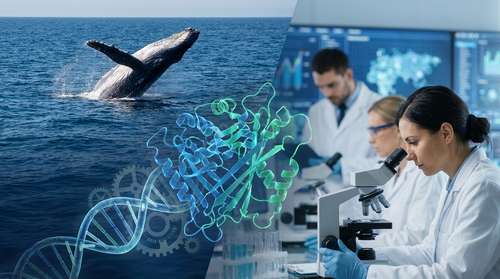
For centuries, the Indigenous Iñupiat people of Alaska have known that bowhead whales live across two human lifetimes. Modern science has confirmed these massive mammals can indeed navigate the icy Arctic waters for over two centuries. But how an 80-ton creature manages to survive that long without succumbing to cancer or cellular decay has remained one of biology's most compelling puzzles. This week, an extraordinary whale protein longevity breakthrough has finally provided an answer. Researchers from the University of Rochester have uncovered the biological machinery behind the whale's robust lifespan, revealing a mechanism that could fundamentally alter the trajectory of human medicine.
As part of an ongoing Nature journal longevity study 2026 initiative, scientists pinpointed a specific molecule known as cold-inducible RNA-binding protein, or CIRBP. The findings, published just days ago, highlight how this unique protein acts as a master custodian for the whale's genome. By effectively patching up genetic damage before it can trigger disease, this discovery is being hailed as a major DNA repair aging breakthrough.
The Biological Secret of the Bowhead Whale
Before understanding the treatment potential, you have to look at the sheer scale of the biological paradox. Large animals have significantly more cells than smaller ones, and longer-lived animals give those cells more time to mutate. By all conventional logic, a creature the size of a bowhead whale should be riddled with cancer. Yet, they remain remarkably disease-resistant.
Biologists Vera Gorbunova and Andrei Seluanov, leading the University of Rochester research team, discovered that the answer lies not in avoiding mutations entirely, but in managing them flawlessly. The researchers found that bowhead whales possess 100-fold higher levels of the CIRBP protein compared to other mammals, including humans.
When DNA suffers double-strand breaks—a severe form of genetic damage that drives the aging process and cancer formation—CIRBP springs into action. Instead of ordering the damaged cell to self-destruct, which is a strategy utilized by other cancer-resistant giants like the elephant, the whale's biology repairs the genetic strand with remarkable fidelity. This precise mechanism sits at the core of the CIRBP protein and aging connection, ensuring that cells continue to function correctly decade after decade.
Bridging the Gap from Whales to Humans
If the bowhead whale's extreme lifespan is driven by an abundance of a single protein, what happens if you apply that same biological tool to other species? The research team tested exactly that, moving the study from observation to active intervention.
When the scientists introduced the bowhead whale version of CIRBP into human cell cultures, the results were immediate and striking. The proportion of double-strand DNA breaks successfully repaired in human cells nearly doubled. Furthermore, the repairs were significantly cleaner, meaning the cells made far fewer deletion errors that typically lead to malignant tumors.
To verify the effects in a living organism, researchers also introduced the protein into fruit flies. The modified flies not only showed enhanced resistance to mutation-causing radiation but also experienced a noticeable extension in their natural lifespan. These outcomes represent one of the most promising anti-aging research breakthroughs in recent history, demonstrating that human DNA repair capacity is not fixed at its current biological ceiling.
The Cold Exposure Connection
The name "cold-inducible" is no coincidence. Bowhead whales spend their entire lives in frigid Arctic waters, an environment that naturally triggers the production of this vital protein. Collaborating with researchers in Alaska, the team noted that simply lowering the temperature of human cells by a few degrees stimulated them to produce more of their own natural CIRBP.
While it is too early to prescribe ice baths as a guaranteed medical intervention, this intriguing environmental trigger offers a potential lifestyle angle to longevity. Gorbunova has suggested that future strategies might involve both pharmacological treatments to boost the protein's activity and everyday lifestyle adaptations.
Decoding How to Live to 200 Years
The ultimate goal of this healthy aging scientific discovery is not merely to extend the human lifespan for the sake of setting records, but to drastically improve our "healthspan"—the period of life spent free from chronic illness. The cellular decay that causes wrinkled skin, failing organs, and neurodegenerative conditions is driven by the very DNA damage that CIRBP so effectively mends.
Understanding how to live to 200 years safely requires protecting the genome from the relentless wear and tear of daily life. The fact that researchers could double the repair efficiency in human cells simply by elevating a single protein proves that our innate biology has room for massive improvement. Rather than accepting cellular degradation as an inevitability of time, scientists now view it as a mechanical failure that can be actively repaired.
What Does This Mean for the Future of Medicine?
Over the coming months, the Rochester team plans to explore targeted therapies that could upregulate the CIRBP pathway in humans. This opens the door to potential preventative treatments that could be administered before age-related diseases even have a chance to take root.
While a clinical pill granting a two-century lifespan might still be years away, this whale protein longevity research has officially moved the concept of extreme human longevity out of the realm of science fiction and firmly into the laboratory. As researchers continue to unlock the biological secrets of the natural world, the dream of living two healthy human lifetimes is suddenly looking like a tangible scientific reality.