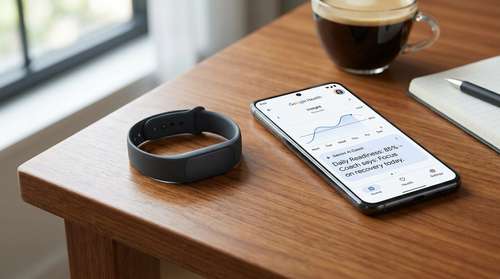
The wearable technology landscape just experienced a massive disruption with the official Fitbit Air launch. Stripping away the glowing AMOLED displays and constant notification pings that have defined smartwatches for a decade, Google has introduced a $99.99 screenless fitness tracker designed to silently monitor your body 24/7. But the hardware is only half the story. Arriving alongside a sweeping Google health rebranding, the tech giant is completely retiring the legacy Fitbit application in favor of the unified Google Health app, which features a Gemini-powered AI fitness coach and encrypted medical record syncing.
The Fitbit Air: A Screenless Paradigm Shift
If you are tired of your wrist constantly buzzing with emails and text messages, the Fitbit Air offers a refreshing alternative. Weighing just 0.4 ounces with its band, this discreet pebble prioritizes passive health monitoring. You wear it, forget about it, and let it do the heavy lifting in the background.
Despite the minimalist exterior and entry-level price point, the device packs an impressive sensor array. It captures 24/7 heart rate data, blood oxygen levels (SpO2), resting heart rate, and heart rate variability (HRV). It also features FDA-approved background AFib detection to monitor for irregular heart rhythms. Because it lacks a power-hungry display, the battery easily lasts up to a week on a single charge. If you happen to drain it completely, a quick five-minute top-off yields an entire day of tracking power.
The Google Health Rebranding: A New Era for Data
This hardware release coincides with a mandatory software overhaul. The familiar, decade-old Fitbit interface is officially transitioning to the Google Health app starting May 19, 2026. This Google health rebranding merges the fragmented ecosystems of Google Fit, Fitbit, and Health Connect into a single, cohesive dashboard.
The new software infrastructure enables seamless integration across disparate sources. You can now pull in metrics from Apple Health or sync your cardiovascular workouts directly with Strava. More importantly, the application brings advanced privacy controls, ensuring your most sensitive health data and medical record summaries remain secure and separated from Google's advertising profiles.
Meet Your Gemini-Powered AI Fitness Coach
The crown jewel of the new application is the AI fitness coach, officially named Google Health Coach. Powered by Google's Gemini artificial intelligence, this feature translates raw metrics into actionable daily routines. Instead of merely telling you that you slept poorly, the system analyzes your sleep disruptions with a claimed 15 percent higher accuracy than previous models and adjusts your recommended daily physical strain accordingly.
One standout feature is the photo-based workout logging. You can simply snap a picture of a treadmill dashboard or a complex circuit written on a gym whiteboard, and the AI will instantly translate the text and numbers into a thoroughly logged session. This eliminates the tedious manual data entry that often discourages consistent tracking. While basic health logging and data viewing remain entirely free, unlocking the customized workout generation and advanced insights requires a $9.99 monthly Google Health Premium subscription—though the Fitbit Air thoughtfully includes a three-month trial right out of the box.
Whoop vs Fitbit Air: The Battle for Your Wrist
When analyzing fitness wearable trends 2026, the shift away from full-featured smartwatches toward minimalist health bands is undeniable. But how does this new entry stack up against the reigning champion of screenless design?
The Whoop vs Fitbit Air debate largely comes down to cost and accessibility. Whoop relies on a strict subscription-only model; you cannot use the hardware without paying a hefty fee, which can range from $199 to $359 a year. Google takes a dramatically different approach. The $99.99 upfront cost of the Fitbit Air secures the hardware permanently. You get comprehensive step tracking, sleep staging, and heart rate monitoring without ever needing to pay a monthly fee. The Premium subscription is strictly optional for those who want the advanced Gemini AI analysis.
What This Means for the Wearable Industry
The Fitbit Air launch represents a clear pivot for Google. By offering a highly capable, reliable screenless fitness tracker at a sub-$100 price point, they are lowering the barrier to entry for robust health monitoring. The device integrates perfectly into existing tech ecosystems. For instance, Pixel Watch users can utilize a new multi-device mode, wearing their full-featured smartwatch during the workday and seamlessly switching to the lightweight, distraction-free Air for undisturbed sleep tracking at night.
Available for retail on May 26, 2026, the tracker comes in multiple band styles, including an exclusive $129 special-edition Stephen Curry variant. As consumers increasingly seek ways to disconnect from their screens while maintaining a pulse on their physical well-being, the industry is forced to adapt. Whether you are a dedicated athlete looking for deep recovery metrics or a casual user wanting to track daily steps without constant digital distractions, this powerful combination of affordable hardware and intelligent software marks a definitive turning point for consumer health technology.