March is National Colorectal Cancer Awareness Month, yet a startling new survey released this Wednesday reveals a massive public health blind spot. According to a joint poll by the Physicians Committee for Responsible Medicine and Morning Consult, nearly half of U.S. adults are completely oblivious to the processed meat colon cancer risk. With colorectal tumors recently becoming the leading cause of cancer deaths for Americans under 50, these findings have ignited a fierce debate among medical professionals and lawmakers. Should everyday breakfast staples and lunchbox favorites carry stark health warnings akin to those found on cigarette packs?
The Knowledge Gap: Colorectal Cancer Nutrition Awareness
The recent survey, which polled 2,202 adults nationwide, highlights a severe breakdown in colorectal cancer nutrition awareness. Despite mounting scientific evidence spanning over a decade, 50 percent of respondents did not know that consuming foods like hot dogs, bacon, and packaged cold cuts directly increases their likelihood of developing tumors in the colon and rectum.
Even more concerning is where the communication breakdown is happening. The poll indicated that only one-third of Americans recall a healthcare professional ever discussing the link between diet and colon health. Dr. Joseph Barrocas, an internal medicine specialist, noted that because early-onset cases are skyrocketing, doctors must move beyond just recommending age-based screenings. Medical professionals need to actively discuss dietary dangers before symptoms ever arise.
Decoding the Health Risks of Deli Meats
To understand why public health advocates are sounding the alarm, you have to look at how these foods are manufactured. The health risks of deli meats stem primarily from the preservation process. When meats are cured, smoked, salted, or fermented, they often generate harmful chemicals such as N-nitroso compounds and polycyclic aromatic hydrocarbons.
These chemicals are the reason the World Health Organization officially placed processed meats on its carcinogenic food list—specifically designating them as Group 1 carcinogens. This is the exact same classification category as tobacco smoke and asbestos. While the absolute risk level differs from smoking a pack of cigarettes, the danger is well-documented. Consuming just 50 grams of processed meat daily—roughly equivalent to a single hot dog or two slices of turkey bacon—can increase a person's risk of colorectal cancer by 16 to 18 percent.
Momentum Builds for Processed Meat Warning Labels 2026
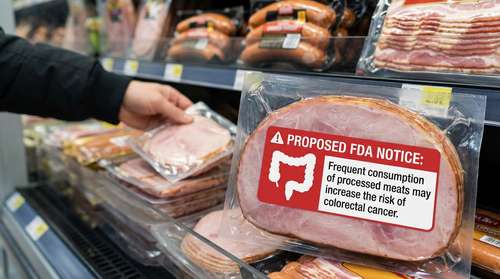
The most striking revelation from the new poll isn't just the lack of awareness; it's the public's reaction once informed. After respondents were briefed on the established cancer links, a resounding 66 percent stated they would support mandatory front-of-package health warnings.
This widespread consumer backing is accelerating the push for processed meat warning labels 2026 initiatives. Nutrition experts and policy advocates argue that shoppers deserve clear, upfront information about what they are feeding their families. Dietitians are pointing to the success of tobacco warning labels as a blueprint for reducing consumption and educating the masses.
Navigating FDA Nutrition Labeling Updates
While sweeping federal FDA nutrition labeling updates can take years to implement due to bureaucratic hurdles and intense lobbying from the agricultural sector, advocates are adopting a grassroots approach. They are eyeing state-level legislation to force the issue. There is growing pressure in states like California to add processed meats to Proposition 65, a law that already mandates prominent signage for products containing known carcinogens. Beyond grocery store shelves, advocates are demanding that these high-risk items be completely removed from public institution menus, particularly in school cafeterias and hospitals, where vulnerable populations are fed daily.
Taking Action: Cancer Prevention Through Diet
You don't have to wait for sweeping policy changes to protect your health. Cancer prevention through diet is one of the most effective, immediate tools at your disposal. The science is incredibly clear: what you leave off your plate is just as important as what you add to it.
Start by auditing your refrigerator. Swap out the daily ham sandwich or breakfast sausage for unprocessed alternatives like fresh roasted chicken, wild-caught fish, or plant-based proteins. It is crucial to remember that marketing terms can be deceptive. Products labeled "nitrate-free" or "uncured" often use concentrated celery powder, which naturally contains nitrates and interacts with your body in the exact same harmful way as synthetic preservatives.
The Protective Power of Dietary Fiber
Fighting cellular damage requires a robust defense system. Diets rich in dietary fiber—found abundantly in whole grains, legumes, fruits, and vegetables—act as a protective sweep for the intestinal lining. Research indicates that individuals who consume high-fiber, plant-forward diets have a 22 percent lower lifetime risk of developing digestive tract cancers compared to those who eat standard omnivorous diets heavy in processed items. By pairing the elimination of carcinogenic meats with a massive increase in fibrous whole foods, you can take proactive control over your long-term health.