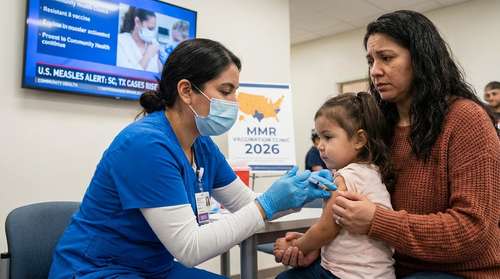
COLUMBIA, S.C. — The United States is facing its most severe public health challenge of 2026 as the measles crisis intensifies across the South. As of Monday, health officials confirmed that the sprawling outbreak in South Carolina has reached 973 cases, inching dangerously close to the 1,000-case milestone. Simultaneously, a separate and alarming cluster of infections has emerged in Texas, affecting both residential communities in the Hill Country and a federal family detention center, sparking urgent warnings from the Centers for Disease Control and Prevention (CDC).
South Carolina Outbreak Centers on Spartanburg
The situation in South Carolina has deteriorated rapidly over the last 48 hours. The South Carolina Department of Public Health (SCDPH) reported 11 new confirmed infections over the weekend, bringing the state's total to 973 since the outbreak began late last year. The crisis remains heavily concentrated in Spartanburg County, which accounts for 95% of the state's cases, though clusters have now been identified in neighboring Greenville and Anderson counties.
State epidemiologists have identified several new high-risk exposure sites, including a Costco location and two large churches in Spartanburg, where infected individuals were present while contagious. "This is no longer just a localized cluster; we are seeing sustained community transmission in areas with low vaccination rates," stated a SCDPH spokesperson on Sunday. Current data indicates that 94% of the patients are unvaccinated, underscoring the critical role of the MMR vaccine for children in preventing such surges.
Local hospitals are feeling the strain, with 38 patients currently hospitalized for severe complications, including pneumonia and dehydration. While no deaths have been reported in South Carolina in 2026, the sheer volume of cases has forced school districts to quarantine over 100 students and staff members, disrupting education and leaving parents on high alert.
Texas Measles Cases Hit Detention Centers and Suburbs
While South Carolina battles the nation's largest cluster, Texas measles cases are climbing, presenting a complex challenge for federal and state authorities. In a concerning development, two active measles cases were confirmed at the South Texas Family Residential Center in Dilley, the nation's largest detention facility for immigrant families. The facility has halted all detainee movement and implemented strict quarantine protocols to prevent a wildfire spread within the congregated living quarters.
"Congregate settings like detention centers are tinderboxes for highly contagious viruses like measles," noted an infectious disease specialist monitoring the situation. Advocacy groups and lawmakers, including Rep. Joaquin Castro, have called for immediate humanitarian interventions to protect the children housed within the facility.
Hill Country Cluster Identified
Beyond the detention facility, the Texas Department of State Health Services (DSHS) is managing a separate cluster in the Texas Hill Country. Six cases have been confirmed across Bandera and Kendall counties, including residents of Boerne. Officials linked these infections to out-of-state travel—likely to regions currently experiencing outbreaks—rather than local origin. However, the presence of the virus in multiple distinct Texas communities has triggered a statewide family health alert 2026, urging residents to verify their immunization status immediately.
National Implications and Vaccine Safety
The resurgence of measles in 2026 threatens the United States' international standing regarding disease elimination. With the national case count now hovering around 982, the U.S. is on track to surpass last year's record of 2,281 cases much earlier than anticipated. The CDC has warned that if transmission continues uninterrupted for more than 12 months, the U.S. could lose its World Health Organization status as a country that has eliminated measles.
This escalating crisis has reignited the national conversation around childhood vaccine safety. Medical experts reiterate that the measles, mumps, and rubella (MMR) vaccine is safe, effective, and the only viable defense against the virus. "The virus finds the vulnerable," explained Dr. Linda Bell, a lead epidemiologist. "When vaccination rates dip below the 95% herd immunity threshold, as we've seen in parts of the Upstate and Texas, outbreaks become inevitable."
Measles Symptoms and Treatment: What Parents Must Know
As the measles outbreak 2026 expands, parents are urged to be vigilant for early warning signs. Measles typically begins with a high fever, cough, runny nose, and red, watery eyes. Three to five days later, a characteristic red rash erupts on the face and spreads downward to the neck, trunk, and limbs. The virus is airborne and can linger in a room for up to two hours after an infected person has left, making it one of the most contagious pathogens known to science.
There is no specific antiviral treatment for measles; care is supportive, focusing on hydration and fever management. However, complications can be severe, leading to permanent hearing loss, brain swelling (encephalitis), and respiratory failure. Health authorities advise that anyone suspecting an infection should call their healthcare provider before visiting a clinic to avoid exposing others in waiting rooms.
With South Carolina measles news dominating headlines and Texas facing its own multi-front battle, the message from public health officials is unified: vaccination is the firewall that protects our communities. As the outbreak nears 1,000 cases, the window to prevent a nationwide epidemic is closing.