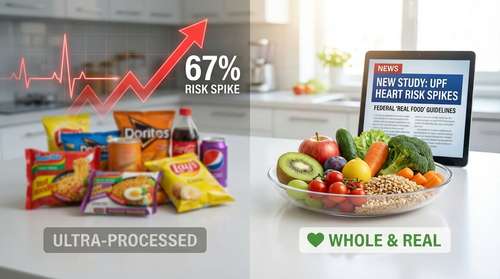
Welcome to the latest healthvot nutrition news. If you routinely grab a packaged snack or a frozen meal to get through a busy afternoon, a groundbreaking presentation from the American College of Cardiology's Annual Scientific Session (ACC.26) this week should give you pause. Staggering new data establishes a direct link between high consumption of factory-made convenience items and a massive spike in ultra-processed foods heart disease risk. These findings arrive at a critical cultural moment, aligning perfectly with newly finalized federal nutrition policies that strongly urge a nationwide pivot toward a "real food" reset.
Inside the UPF Cardiovascular Health Study 2026
The UPF cardiovascular health study 2026, published late this week in the journal JACC: Advances, tracked 6,814 adults across the United States who had no prior history of heart disease. Lead researcher Dr. Amier Haidar and his team from the University of Texas Health Science Center at Houston discovered that individuals eating an average of nine or more servings of ultra-processed foods daily faced a 67% higher risk of suffering a heart attack, stroke, or dying from coronary heart disease compared to those eating just one serving.
What makes this research particularly alarming is the incremental danger. The risk does not simply jump when you reach extreme levels of consumption. Instead, each additional daily serving of an ultra-processed item pushes the likelihood of a major cardiac event up by roughly 5%. The researchers also noted that this health burden is not distributed equally. The data showed an amplified impact among Black Americans, who saw a 6.1% risk increase per serving compared to a 3.2% increase for non-Black participants, highlighting deep disparities in food marketing and neighborhood access.
Crucially, these life-threatening risks remained consistent even after researchers controlled for total daily calorie intake, baseline conditions like diabetes, and overall diet quality. A bad food choice, it turns out, damages the body regardless of whether you burn off the calories.
Processed Food vs Whole Food Nutrition
Why exactly are these shelf-stable items so uniquely harmful? The ongoing debate surrounding processed food vs whole food nutrition often comes down to what happens during industrial manufacturing. Foods in their natural state provide a complex biological matrix of fiber, vitamins, and minerals that support healthy digestion and cardiovascular function.
Conversely, heavily manufactured items strip away these beneficial components and replace them with cheap industrial extracts. The extensive use of modified starches, hydrogenated oils, and chemical emulsifiers triggers chronic inflammation and vascular damage. Specifically, cardiologists have long warned about the profound connection between added sugar and heart failure risk. High glycemic loads from liquid sweeteners and refined flours drive insulin resistance and obesity, accelerating the buildup of fatty plaques within arterial walls.
The 2025-2030 Dietary Guidelines 'Real Food' Reset
This stark clinical data validates the aggressive new stance taken by federal health officials earlier this year. The 2025-2030 Dietary Guidelines for Americans represent a historic, paradigm-shifting reset in national nutrition policy. For the first time, the guidelines explicitly tell the public to significantly limit or avoid highly processed foods, citing their disruption of the gut microbiome and clear links to chronic, diet-driven diseases.
Operating under a clear, uncompromising directive to "eat real food," the updated guidelines prioritize nutrient-dense proteins, whole grains, and fresh produce. The federal mandate aims to overhaul how families eat by discouraging reliance on packaged products loaded with artificial flavors, synthetic dyes, and low-calorie non-nutritive sweeteners. Whether you are dining at home or selecting options at a restaurant, the government is signaling that convenience should no longer supersede nutritional integrity.
The Institutional Impact
The updated guidelines do not just apply to individual choices; they will soon reshape institutional food environments. Over the next few years, these rules will dictate the standards for the National School Lunch Program, which feeds tens of millions of children every day. By forcing food manufacturers to reformulate their offerings to meet stricter, whole-food standards, public health experts hope to reverse the soaring rates of early-onset cardiovascular issues.
How to Identify Ultra-Processed Foods
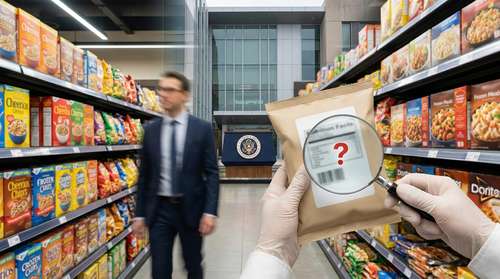
Shifting your dietary habits requires knowing exactly what you are putting in your grocery cart. Learning how to identify ultra-processed foods is the most effective step toward protecting your cardiovascular health.
Nutrition scientists rely on the NOVA classification system, which groups items based on the extent of their industrial processing rather than just their raw nutrient breakdown. You do not need a lab coat to spot them in the supermarket aisles. Here are simple, practical ways to evaluate your food:
- Check the ingredient list: If a product contains items you would never find in a standard home kitchen—like high-fructose corn syrup, maltodextrin, soy lecithin, or artificial preservatives—it falls squarely into the ultra-processed category.
- Beware of health halos: Just because a heavily packaged protein bar or breakfast cereal claims to be "high in fiber," "low carb," or "keto-friendly" does not mean it is a whole food. Often, these are industrial formulations engineered to mimic health foods using isolated fibers and chemical sweeteners.
- Spot the staples: Common culprits masquerading as everyday staples include sugary sodas, mass-produced packaged breads, instant noodle soups, frozen TV meals, flavored yogurts, and deli cold cuts.
By swapping these convenient but risky items for minimally processed alternatives—like fresh fruit, raw nuts, plain dairy, and lean cuts of meat—you can immediately begin lowering your risk profile. As the latest research proves, every single serving matters when it comes to the heart.