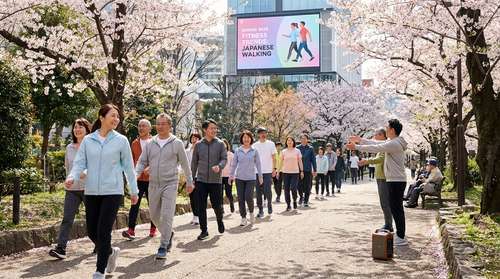
If you feel like everyone suddenly started power-walking in precise three-minute bursts this spring, you aren’t imagining things. A specialized protocol known as Japanese walking has officially become the breakout hit among 2026 fitness trends. Search interest for the routine skyrocketed by nearly 3,000% in March alone, dominating social media feeds and local running tracks alike. Unlike the chaotic, joint-crushing high-intensity workouts that usually dominate the start of a new year, this approach is remarkably accessible. It promises the cardiovascular perks of a heavy sweat session without the pounding impact, making it a favorite for both elite athletes and casual strollers.
What Exactly Is Japanese Walking?
Despite its sudden viral fame, Japanese walking—clinically referred to as Interval Walking Training (IWT)—is deeply rooted in decades of sports medicine. Pioneered by Dr. Hiroshi Nose and researchers at Shinshu University, the method was originally born out of frustration with the standard '10,000 steps a day' advice. Researchers noticed that while hitting an arbitrary daily step count burned a few extra calories, the lack of intensity meant walkers weren't actually improving their cardiovascular fitness. Walking at a moderate, continuous pace simply wasn't enough to force the body to adapt.
The solution they engineered was surprisingly simple. The protocol requires you to alternate between three minutes of brisk, high-effort walking and three minutes of slow, relaxed recovery. You repeat this cycle five times for a complete 30-minute session. It is textbook interval walking, but calibrated perfectly for human biomechanics. Fast intervals demand about 70 percent of your maximum effort—you should be breathing heavily but still capable of speaking a few words. The recovery blocks then drop down to a leisurely stroll.
The Science Fueling the Spring 2026 Surge
So why the massive spike in attention right now? The fitness industry is undergoing a structural shift away from punishing, high-attrition routines toward sustainable, low impact cardio that actually yields measurable results. Data from recent sports science reviews shows that adherence to this specific 3-by-3 method sits at an astonishing 89 percent. People stick with it because the three-minute effort is psychologically manageable. Just as the physical burn becomes uncomfortable, the designated recovery period arrives.
Beyond the mental appeal, the physiological returns are undeniable. According to landmark trials, including pivotal research published in the Mayo Clinic Proceedings, individuals practicing this protocol saw their aerobic capacity (VO2 max) increase by up to 20 percent. Leg strength concurrently improved by 13 percent, a vital metric for maintaining mobility and preventing falls. For those searching for effective metabolic health hacks, the shifting gears between fast and slow keep the cardiovascular system constantly guessing. This fluctuation maximizes fat oxidation, lowers resting blood pressure, and improves insulin sensitivity far better than a continuous, monotonous stroll.
Beyond Basic Steps: A Blueprint for Lifelong Mobility
As the cultural focus shifts toward healthspan and aging gracefully, fitness enthusiasts are actively seeking out longevity exercises that protect joint integrity. Japanese walking fits this precise demand. It challenges the heart, lungs, and skeletal muscles forcefully enough to trigger adaptation, yet the designated recovery periods prevent the sheer exhaustion that often leads to sloppy biomechanics and injury.
Many wellness experts and trainers are now comparing the rhythmic nature of the routine to walking yoga. The deliberate pacing forces you to pay strict attention to your stride, breath control, and posture. Instead of mindlessly trudging on a treadmill while distracted by a smartphone or television screen, you remain highly engaged with your physical output. You are forced to listen to your body's signals, finding the exact threshold where effort peaks before seamlessly transitioning into active rest.
How to Start the Japanese Walking Protocol
Ready to test the interval method that is currently taking over local parks? You do not need a boutique gym membership, a personal trainer, or expensive recovery gear. The barrier to entry requires nothing more than a reliable pair of athletic shoes and a smartphone timer.
Here is the standard 30-minute blueprint designed for maximum efficacy:
- The Warm-up (5 Minutes): Spend the first few minutes walking at a comfortable, natural pace. This lubricates the joints and prepares your muscles for heavier exertion.
- The Push (3 Minutes): Accelerate to a brisk, purposeful pace. Pump your arms, engage your core, and lengthen your stride. You want to feel distinctly winded, operating at roughly 70 percent of your maximum effort.
- The Recovery (3 Minutes): Drop your speed back down to a leisurely, effortless stroll. Let your heart rate settle and your breathing return to normal.
- The Circuit: Cycle through these fast and slow phases a total of five times.
- The Cool-down (5 Minutes): Finish the session with easy movement and light static stretching for the calves and hamstrings.
For optimal physiological adaptation, sports medicine experts recommend completing this routine four days a week. As your baseline stamina improves over the first month, you can artificially increase the intensity of the fast segments by routing your walk up local hills or utilizing the incline setting on a commercial treadmill.
Why This Trend Is Here to Stay
The explosion of Japanese walking in spring 2026 highlights a broader evolution in how we approach physical health. We are finally learning that more pain does not necessarily equate to more gain. By systematically pushing the body's limits in brief, manageable windows, we can unlock elite-level cardiovascular benefits without the typical wear and tear. Whether you are recovering from an injury, looking to break through a weight-loss plateau, or simply trying to live a longer, healthier life, those three-minute intervals might just be the smartest steps you take all year.