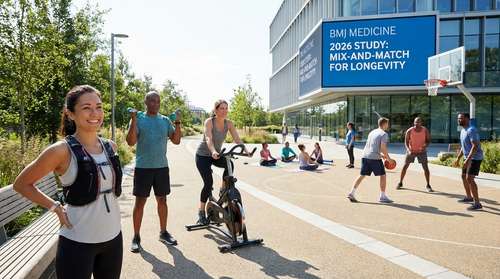
If you have been dutifully clocking your 150 minutes of exercise every week on the same treadmill or spin bike, you might be missing a critical piece of the longevity puzzle. A groundbreaking new study published this week in BMJ Medicine has revealed that how you move matters just as much as how much you move. The massive analysis, involving over 111,000 adults, suggests that mixing up your workout routine—a strategy researchers are calling the "mix-and-match" approach—can slash your mortality risk by a staggering 19% compared to sticking to a single activity.
The Science: Variety Beats Repetition
For decades, public health guidelines have focused primarily on volume: get your heart rate up for a set amount of time, and you will live longer. However, the new BMJ Medicine fitness study 2026, conducted by researchers at the Harvard T.H. Chan School of Public Health, introduces a new metric for health: diversity.
The researchers analyzed 30 years of data from two major cohorts—the Nurses’ Health Study and the Health Professionals Follow-Up Study. They tracked the exercise habits of more than 111,000 participants, looking not just at the total hours spent sweating, but at the types of activities performed. The findings were clear: participants who rotated through a diverse menu of exercises—such as walking, swimming, running, and strength training—saw significantly better health outcomes than those who focused on just one discipline.
According to lead researcher Yang Hu, the data shows that "mixing it up" provides unique protective benefits. Even when total energy expenditure was identical, those with the highest exercise variety for longevity had a 19% lower risk of death from any cause compared to those with the lowest variety.
Why Diverse Workouts Lower Mortality Risk
Why does a diverse workout offer such profound health benefits? The answer lies in the physiological "blind spots" of repetitive training. If you only run, you build incredible cardiovascular endurance in your legs, but you might neglect upper-body strength, core stability, or lateral agility. Over time, this imbalance can lead to overuse injuries and plateaued metabolic adaptations.
By engaging in mixed exercise training science supports the idea that you challenge your body across multiple systems. A game of tennis improves hand-eye coordination and reaction time; weightlifting fortifies bone density; swimming enhances lung capacity without joint impact. This "cross-training" effect ensures that your body remains adaptable and resilient as you age.
The study specifically highlighted that different activities lowered mortality risk physical activity scores in unique ways. For instance, while walking reduced mortality risk by 17%, racket sports (like tennis or pickleball) slashed it by 15%, and strength training contributed a 13% reduction. Combining these creates a cumulative shield against aging.
The Ultimate Fitness Routine for Long Life
So, what does the ideal fitness routine for long life look like? You don't need to be a triathlete to reap the rewards. The key is simply to avoid monotony. The study found that engaging in just two or three different types of activity was significantly better than one.
Sample 'Mix-and-Match' Weekly Schedule
- Monday (Aerobic Base): 30-minute brisk walk or light jog to build endurance.
- Wednesday (Strength & Bone Health): 20 minutes of resistance training (weights or bodyweight) to preserve muscle mass.
- Friday (Agility & Coordination): A game of tennis, pickleball, or a dance class to challenge your brain and balance.
- Weekend (Active Recovery): Gardening, cycling, or a nature hike to keep moving in a low-stress environment.
This approach prevents the "law of diminishing returns" that often hits single-sport athletes. By constantly presenting your body with new stimuli, you force it to adapt, keeping your metabolism fired up and your neuromuscular connections sharp.
Moving Beyond the 'One-Size-Fits-All' Workout
The implications of this study are empowering. You no longer need to feel guilty if you skip the gym to go for a hike or play tag with your kids. In fact, swapping a structured gym session for a different physical activity might actually be better for your long-term health.
“It is important to keep a high level of total physical activity," Dr. Hu noted in the study's release, "but on top of that, diversifying the types of activities may be more beneficial.”
As we move through 2026, the trend is shifting from obsession with intensity to a celebration of variety. The most sustainable plan isn't the one that burns the most calories in an hour; it's the one that keeps you moving in different ways for decades. By embracing the mix-and-match rule, you aren't just making exercise more interesting—you are actively engineering a longer, healthier life.