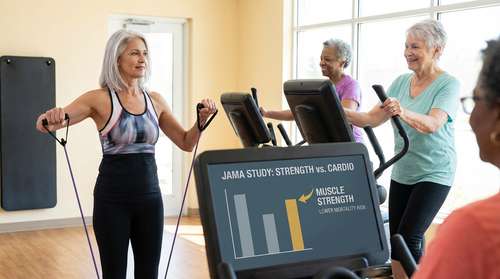
For decades, aerobic exercise has been hailed as the gold standard for heart health and extending lifespan. However, a groundbreaking new study published in JAMA Network Open is shifting the paradigm, revealing that muscle strength vs cardio might be the more critical factor for longevity for women. The research, conducted by the University at Buffalo, indicates that women aged 63 to 99 who maintain higher muscular strength significantly reduce their risk of early death, independent of their aerobic physical activity levels. This discovery suggests that healthy aging requires a fundamental rethink of how we approach fitness in our later years.
The Science: Strength Reduces Mortality Risk by Over a Third
The study, released in February 2026, analyzed data from 5,472 women participating in the Women’s Health Initiative. Led by Michael J. LaMonte, PhD, researchers measured two key indicators of strength: grip strength and lower-body power via the sit-to-stand test. The results were stark. Women in the top quartile for grip strength had a mortality risk roughly 35% lower than those in the bottom quartile. Similarly, those who performed the chair stand test fastest saw a 37% reduction in risk compared to the slowest group.
Crucially, these benefits persisted even after controlling for variables like inflammation, sedentary time, and aerobic activity. In fact, the data showed that even women who did not meet the standard guidelines for aerobic exercise still reaped the survival benefits of being strong. This implies that sarcopenia prevention—avoiding the age-related loss of muscle mass—is an independent and vital predictor of a long life.
Two Simple Tests Determine Your Biological Age
You don't need high-tech equipment to gauge your longevity potential. The study highlighted two specific functional metrics that serve as powerful crystal balls for health:
1. Grip Strength
Measured using a dynamometer, grip strength and mortality are strongly improved. It serves as a proxy for overall upper-body strength and neurological function. The study found that for every 7-kilogram increase in grip strength, mortality risk dropped by approximately 12%.
2. The Sit-to-Stand Test
This test measures the time it takes to stand up from a chair five times without using your arms. It assesses lower-body power and balance, which are essential for preventing falls. Improving this speed by just six seconds was associated with a significant drop in mortality risk. These metrics prove that functional strength is not just about aesthetics; it is a survival mechanism.
Why Muscle Strength Matters More Than Cardio
While cardiovascular health remains important, this research underscores that muscle tissue acts as a metabolic organ. Strong muscles help regulate glucose, manage inflammation, and maintain metabolic rates. As we age, the natural decline in muscle mass can lead to frailty and loss of independence.
Dr. LaMonte’s findings suggest that for healthy aging, the focus must broaden to include muscle maintenance. "When we no longer can get out of the chair and move around, we are in trouble," LaMonte noted, emphasizing that muscle allows for the movement necessary to perform aerobic activity in the first place.
Action Plan: Resistance Training for Seniors
The good news is that it is never too late to start building resilience. You do not need to become a bodybuilder to see results; the study found a dose-response relationship, meaning even modest improvements in strength yielded survival benefits. Here is how to incorporate resistance training for seniors safely:
- Start with Bodyweight: The sit-to-stand motion itself is a perfect exercise. Practice standing up from a sturdy chair without using your hands 5-10 times daily.
- Use Resistance Bands: These provide safe, adjustable tension for building upper body strength without the risk of heavy iron.
- Focus on Consistency: The goal is functional power. Aim for strength sessions twice a week, focusing on major muscle groups.
This shift in focus from endless treadmill sessions to functional strength training could be the missing link in women's health, empowering a generation to live not just longer, but stronger lives.