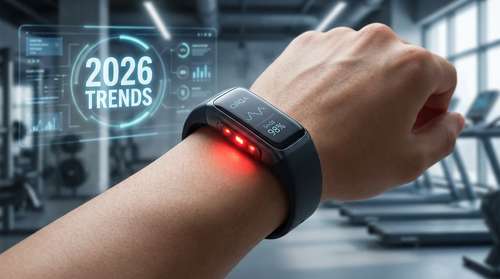
For the better part of a decade, athletes have relied on heart rate and surface-level blood oxygen (SpO2) to gauge their workout intensity. But as we move deeper into the spring of 2026, a massive shift is occurring in the performance tracking industry. The highly anticipated transition toward local muscle measurement is finally here, spearheaded by the Muscle Oxygenation SmO2 revolution. Rather than guessing your fatigue levels based on cardiovascular strain, next-generation devices use advanced optical sensors to see exactly what is happening inside your muscle tissue in real-time.
This technological leap isn't just a theoretical concept. Recent patent filings, alongside a massive accidental Garmin CIRQA smart band leak on the company's own regional websites, confirm that the biggest names in fitness tech are moving away from screens and focusing heavily on internal metabolic data. If you want to know when your muscles are about to hit the wall, the wearable landscape is about to provide a definitive answer.
What is Muscle Oxygenation (SmO2) and Why Does It Matter?
To understand where wearable tech trends 2026 are heading, you have to separate standard pulse oximetry from muscle oxygenation. While traditional SpO2 tracks the oxygen floating through your arterial blood, SmO2 measures the dynamic balance of oxygen supply and demand directly within a working muscle. It essentially shows how much of that oxygen your muscle cells are actually consuming to generate energy.
Why does this matter for athletes? When a muscle runs out of oxygen, performance drops off a cliff. By continuously monitoring these levels using near-infrared spectroscopy (NIRS), users can unlock true precision recovery fitness. You can see precisely when a quadricep or bicep has recovered enough between heavy sets or track intervals to push hard again, turning grueling guessing games into an exact science. It acts as a non-invasive, cost-effective alternative to blood lactate testing. For years, runners and cyclists have struggled to identify their true anaerobic thresholds in the field; SmO2 data delivers that insight instantly, preventing premature fatigue.
The Garmin CIRQA Leak: A Glimpse into the 'Muscle Battery'
The race to commercialize this tech blew wide open in early 2026. Tech enthusiasts were shocked when a product page for the unannounced Garmin CIRQA smart band briefly appeared across Garmin's US, Canadian, and Latin American websites before being hastily pulled. The leak showcased a screenless recovery tracker available in Black and French Gray, signaling Garmin's direct entry into the minimalist, distraction-free wearable market.
But the hardware is only half the story. Recent US Patent and Trademark Office filings from Garmin point to a new software algorithm dubbed "Muscle Battery." Built entirely around SmO2 data, this metric is designed to capture and analyze oxygen saturation via dedicated NIRS sensor wearables. By pairing the screenless CIRQA hardware with the Muscle Battery algorithm, Garmin intends to map the exact physical toll on your body. The lack of a screen is highly intentional. By eliminating mid-workout notifications and glaring displays, the device forces athletes to focus strictly on physiological inputs and post-training recovery metrics.
Whoop 5.0 vs Garmin: The Battle for NIRS Sensor Wearables
Garmin isn't the only heavyweight throwing punches in the SmO2 arena. On April 7, 2026, Whoop was granted a sweeping US patent (12,594,037 B2) for its own body-worn optical device. Unlike traditional wrist trackers, Whoop's patented design features a pressure-sensing strap meant to be worn on the thigh, arm, or chest. This specialized strap detects fit consistency and blood flow restriction, ensuring the NIRS sensors capture flawless hemoglobin and tissue perfusion metrics.
This development sets the stage for a massive Whoop 5.0 vs Garmin showdown. The muscle oxygen sensor market has historically been fragile, with early pioneers like Humon Hex and BSX Insight struggling to bring the technology to a mainstream audience. However, the technical hurdles of miniaturizing NIRS optics and managing battery drain have finally been solved. While Garmin seems poised to offer the CIRQA band as a one-time hardware purchase, both companies are aggressively targeting the exact same physiological goldmine. Smaller specialized platforms like NNOXX have already successfully validated consumer-ready SmO2 tracking, but the arrival of these billion-dollar industry giants guarantees that muscle oxygen tracking will dominate the next decade of training.
Aligning with the ACSM Fitness Report 2026
None of this should come as a surprise to industry insiders. The recent ACSM fitness report 2026 highlighted a massive consumer pivot toward hyper-personalized, data-backed recovery protocols. Athletes are exhausted by arbitrary daily readiness scores that rely too heavily on sleep duration. They want actionable, localized data that reflects the true mechanical toll of their workouts.
As we look toward the summer tech releases, the evolution from generic cardiovascular strain to localized muscle fatigue is crystal clear. The upcoming wave of SmO2 devices promises to fundamentally change how we train. By finally peering beneath the skin to measure the exact oxygen burn in our muscles, the guesswork of athletic progression is officially a thing of the past.