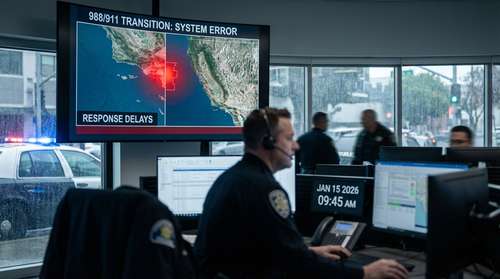
It was supposed to be the year California finally severed the automatic link between mental health crises and armed police response. But as of February 2026, the 988 Suicide and Crisis Lifeline integration has hit a devastating wall. Lawmakers and behavioral health advocates are expressing intense frustration this week following revelations that the California Office of Emergency Services (Cal OES) has missed a critical Q1 2026 deadline to finalize the automated routing protocols between 911 and 988. For thousands of Californians in distress, this technical failure means the difference between receiving a compassionate clinical response or facing law enforcement intervention.
The Stalled Transition: 911 to 988 Interoperability
The core promise of the Miles Hall Lifeline Act (AB 988) was seamless interoperability. The vision was simple: if a panicked family member dialed 911 for a mental health emergency, the dispatcher could instantly and digitally hand off the call to a behavioral health crisis services team. However, reports emerging this week confirm that the technology required to make this "warm handoff" secure and universal is still not operational across most of the state.
According to the latest legislative oversight data, only one of California's 12 crisis centers has been successfully piloted for full 911 routing capabilities. The remaining centers are operating in a dangerous limbo, relying on manual transfers that can drop calls or waste precious seconds. "We are essentially asking analog systems to solve a digital crisis," noted a spokesperson for the 988 California Consortium. Without this digital bridge, emergency dispatch for behavioral health remains fragmented, leaving 911 operators with little choice but to default to police deployment when workflows become unclear.
The Funding Paradox: Why Centers Are Losing Money
Compounding the technical delays is a baffling financial paradox that has left crisis centers reeling. Despite the urgent need for expanded capacity, the state-mandated surcharge on phone lines—intended to fund the 988 Suicide and Crisis Lifeline—was actually reduced from 8 cents to 5 cents entering 2026. This reduction wasn't due to a lack of need, but rather a bureaucratic bottleneck.
Unspent Funds and Budget Cuts
Because Cal OES failed to approve spending plans and technical contracts on time, the 988 State Suicide and Behavioral Health Crisis Services Fund showed a technical "surplus" of unspent tax revenue. Under rigid state formulas, this triggered an automatic reduction in the surcharge. The result is a starving system sitting on a pile of inaccessible cash. Local crisis centers, which need to hire hundreds of counselors to meet the mental health law 2026 mandates, are now facing budget uncertainties just as call volumes hit record highs.
Police Response to Mental Health: The Status Quo Persists
The delay has real-world consequences. The California 911 to 988 transition was designed to honor the legacy of Miles Hall, a young man killed by police during a mental health crisis. Yet, four years after the legislation passed, the "police-first" model remains the default in many counties. Without the assurance of a reliable, automated dispatch system, 911 operators are hesitant to divert calls to 988.
Recent data indicates that fewer than half of the text and chat inquiries initiating from California are currently being answered by in-state counselors due to staffing shortages. When calls are routed out-of-state, those remote counselors lack the ability to dispatch local mobile crisis teams, effectively rendering the mental health emergency response toothless. Families are reporting that despite dialing the new number, they are still seeing uniformed officers arrive at their doors, escalating fragile situations that clinical teams were meant to handle.
Legislative Accountability: The 'Outcomes Review'
In response to these cascading failures, Assemblymember Rebecca Bauer-Kahan and Speaker Robert Rivas have announced an aggressive "Outcomes Review" for the 2026 legislative session. This new oversight mechanism allows lawmakers to bypass standard hearings and directly investigate why the behavioral health crisis services rollout has stalled.
"We passed the law. We funded the law. The failure to implement it is not a policy gap; it is an administrative failure," Bauer-Kahan stated in a press briefing Tuesday. The review aims to force Cal OES to release the blocked funds and expedite the interoperability standards that were promised to be finished by now. Until these administrative knots are untied, the transformative potential of 988 remains just that—potential, not reality.