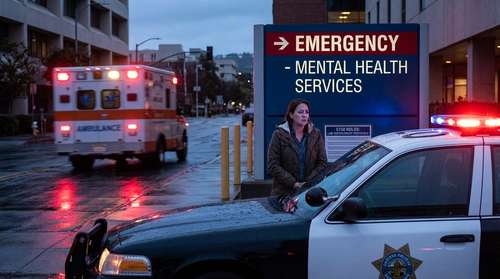
When a loved one spirals into a severe psychiatric emergency, families often dial 911 as a last resort, expecting immediate medical intervention. For decades, law enforcement officers served as the primary transport and enforcement mechanism for California 5150 holds—a legal provision allowing temporary, involuntary psychiatric detention. However, a rapidly spreading trend of police refusing to execute these holds is sparking intense legal and public safety concerns across the Golden State.
The Shift in Mental Health Crisis Response
Under Section 5150 of the California Welfare and Institutions Code, individuals who are a danger to themselves, a danger to others, or gravely disabled can be detained for up to 72 hours for life-saving evaluation. Historically, police officers were the default responders to these distressing calls. Today, the landscape of mental health crisis response is fracturing. Law enforcement agencies are increasingly hesitant to intervene in psychiatric emergencies unless a distinct crime is in progress or there is an imminent, immediate public threat.
The core issue driving this withdrawal is legal exposure. Sheriffs and police departments cite mounting police liability mental health concerns, specifically pointing to Fourth Amendment protections against unlawful entry and excessive force in private residences. Recent federal appellate rulings, such as the widely discussed Scott v. Smith case, have heightened these fears. Officers worry that detaining an erratic but non-criminal individual inside their own home could result in devastating civil rights lawsuits. Consequently, even when on-site clinicians or mobile crisis teams determine an involuntary psychiatric commitment is medically necessary, police backup often declines to force the patient into care.
Alarming Sonoma County Mental Health News
This policy shift is not theoretical; it is actively playing out in communities. Recent data highlights the severity of the disconnect between medical needs and law enforcement protocols. According to newly released figures from early 2026, officers in Santa Rosa and unincorporated areas of Sonoma County refused to carry out 62 separate 5150 holds recommended by mental health professionals over a 14-month period.
This localized Sonoma County mental health news mirrors a broader statewide crisis. In Sacramento and Orange Counties, top law enforcement officials have publicly stated their intent to pull deputies out of the "social work" business. These departments have established formal protocols to disengage from uncooperative individuals who do not pose an immediate criminal threat. This operational shift frequently leaves unarmed civilian crisis teams without the physical backup required to safely transport volatile patients to emergency facilities.
The Burden on Vulnerable Families
The widening gap in mental health emergency services leaves families in an agonizing predicament. When officers decline to execute a hold in a private residence, they frequently offer a chilling alternative: file a restraining order against the mentally ill family member. Relatives are forced to choose between enduring the immediate danger of a psychotic episode or legally criminalizing their child or spouse just to compel a police response.
Disability advocates and families argue that this hands-off approach fundamentally misinterprets the nature of severe psychiatric disorders like schizophrenia. Many patients in acute distress suffer from anosognosia—a neurological inability to recognize their own illness. Without the swift enforcement of a 72-hour hold, these individuals are abandoned to their psychosis until a tragic event forces the justice system's hand.
Clashing With New California Mental Health Laws
The timing of this law enforcement pullback directly conflicts with recent legislative efforts to expand psychiatric treatment access. In January 2026, the majority of California counties officially implemented Senate Bill 43. This sweeping update to California mental health laws broadened the definition of "gravely disabled" to include individuals unable to keep themselves safe or secure necessary medical care due to a mental illness or severe substance use disorder.
Lawmakers designed SB-43 to compel more people into life-saving treatment before they deteriorate on the streets. Yet, the success of this landmark legislation relies heavily on the ability of first responders to safely transport non-compliant individuals to crisis stabilization units or local emergency departments. With police actively retreating from involuntary holds, the newly expanded legal criteria lack the practical enforcement mechanism needed to function effectively in real-world scenarios.
Building Better Emergency Models
As the standoff continues, state legislators and county supervisors are scrambling to find a middle ground. Some jurisdictions are investing heavily in advanced co-responder models, which pair specially trained mental health clinicians directly with plainclothes officers. These specialized units aim to de-escalate situations and conduct thorough field assessments, reducing the reliance on traditional patrol officers and involuntary detention when alternatives are viable.
However, the transition to these hybrid models remains dangerously uneven across the state. Until lawmakers and law enforcement agencies can legally resolve the liability loopholes surrounding private residence interventions, thousands of vulnerable residents remain caught in a bureaucratic blind spot—too sick to voluntarily seek help, but not criminal enough to receive emergency intervention.