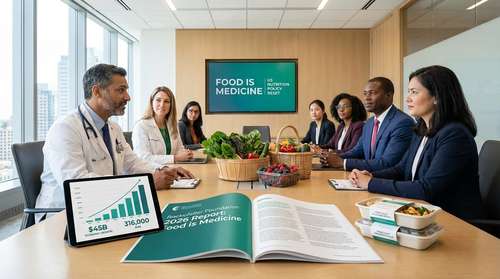
American healthcare is at a critical inflection point. For decades, the medical system has prioritized managing sickness rather than funding foundational health. However, a profound shift is taking shape. Doctors are beginning to write produce prescriptions alongside traditional medications, effectively turning the local grocery aisle into a pharmacy. The momentum behind the Food is Medicine movement just reached a new milestone, backed by hard economic data. According to the landmark Rockefeller Foundation 2026 report released on March 11, scaling these targeted nutrition programs could generate a staggering $45 billion in state economic activity.
The concept is straightforward but revolutionary: integrate high-quality, locally sourced food directly into patient care. By expanding access to these vital programs for the 43 million Americans who currently need them most, policymakers have a rare opportunity to tackle soaring nutrition healthcare costs while simultaneously revitalizing local economies.
Decoding the Rockefeller Foundation 2026 Report
The newly published analysis, titled "From Farm to FIM: The Economic Impact of Local Food is Medicine," provides the most comprehensive look yet at the financial ripple effects of clinical nutrition interventions. Conducted alongside Dalberg Advisors, the research demonstrates that treating food as a medical intervention is not just a public health imperative—it is an unprecedented economic catalyst.
If programs are scaled effectively, the United States stands to gain 316,000 new jobs spanning urban, suburban, and rural communities. These are essential roles in aggregation, processing, meal preparation, transportation, and delivery. Furthermore, by keeping dollars within local supply chains rather than diverting them to massive national distributors, states can drastically multiply the financial benefits of their healthcare spending.
A Lifeline for American Agriculture
Small and mid-sized agricultural operations are facing immense financial pressure, with over 20,000 farms disappearing every single year. The recent analysis highlights that connecting these farms directly to healthcare purchasing could inject $5.6 billion in annual revenue into local agriculture. This reliable market demand supports revenue growth and encourages regenerative farming practices, proving that population health and agricultural sustainability are deeply intertwined.
How Medically Tailored Meals and Produce Prescriptions Drive Cost Savings
To understand the financial implications, one must look at the staggering burden of diet-related illnesses. Currently, 129 million Americans suffer from at least one chronic disease, and managing these conditions accounts for 90% of total U.S. healthcare expenditures. Shifting the focus toward chronic disease prevention through diet offers a clear off-ramp from this unsustainable spending trajectory.
Produce prescriptions allow healthcare providers to give patients structured vouchers to purchase fresh fruits and vegetables. For individuals with more advanced conditions, medically tailored meals offer fully prepared, dietitian-approved food delivered directly to their doors. The data on this specific intervention is striking: scaling medically tailored meals alone could save the healthcare system $23.7 billion annually while preventing an estimated 2.6 million hospitalizations. When patients receive the exact nutrients they need to manage conditions like diabetes or heart failure, emergency room visits plummet, and overall wellness improves.
The Evolution of Nutritional Interventions
These initiatives are not an entirely new concept; they have deep roots in community-based support systems established during the HIV/AIDS epidemic. Organizations in cities like Boston and San Francisco pioneered the practice of delivering nutrient-dense food to vulnerable patients. Today, these grassroots efforts have evolved into sophisticated healthcare strategies aimed at a broader range of diet-related illnesses.
What has changed is the scale of the financial evidence. For example, localized execution will yield massive state-by-state dividends. California alone could see a staggering $511.9 million increase in farmer revenue and the creation of over 32,050 jobs. Texas stands to gain $315.1 million and nearly 29,800 new roles. These localized metrics reinforce why integrating agriculture with healthcare is a bipartisan economic win.
The Urgent Need for a US Nutrition Policy Reset
Unlocking this massive economic potential requires deliberate action. The findings serve as a definitive call for a US nutrition policy reset. Historically, public health initiatives and agricultural support have existed in entirely separate silos. To realize the dual benefits of better health outcomes and robust job creation, states must prioritize intentional program design.
Key policy recommendations for states include:
- Medicaid Integration: Embedding local sourcing preferences directly into Medicaid contracts to ensure healthcare dollars circulate within state economies.
- Infrastructure Investment: Funding the regional food system infrastructure necessary to aggregate, process, and transport fresh produce efficiently.
- Purchasing Commitments: Establishing multi-year purchasing contracts with local farmers to provide the financial stability required to scale their operations.
Without these strategic guardrails, the billions of dollars flowing into clinical nutrition programs could easily be absorbed by corporate conglomerates, entirely bypassing the rural communities that need the economic boost the most.
Scaling 'Food is Medicine' for the Future
The conversation surrounding clinical nutrition has fundamentally shifted. As Rajiv Shah, President of The Rockefeller Foundation, noted regarding the findings, Americans can eat better while saving lives, money, and farms. The empirical evidence is now undeniably on the table.
Scaling Food is Medicine initiatives across all 50 states is arguably one of the most practical strategies available to modern policymakers. It transforms passive healthcare expenditures into active investments in community resilience. By embracing produce prescriptions and funding targeted nutrition interventions, the nation has a blueprint to heal its citizens while injecting billions into the local economy. The prescription for a healthier, wealthier America is already written—it is time to get it filled.