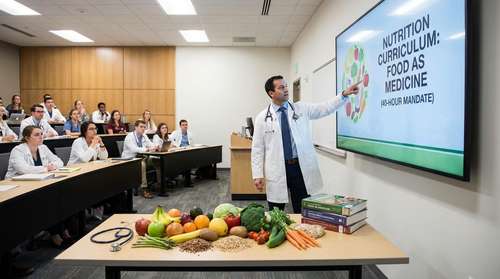
Following a historic federal agreement, faculties at 53 medical institutions across 31 states are actively rewriting their syllabi this week to implement a comprehensive medical school nutrition curriculum. Driven by the staggering physical and financial toll of diet-related illnesses, these universities are laying the immediate groundwork to provide at least 40 hours of dedicated dietary training for future doctors by the fall of 2026. This aggressive timeline aims to transition mainstream clinical practice toward a food as medicine 2026 framework, equipping the next generation of physicians with the practical knowledge to treat and reverse conditions like Type 2 diabetes and obesity.
Historically, doctors have graduated with exceptional pharmacological knowledge but glaring blind spots regarding the very fuel that sustains human health. When patients ask for dietary advice to manage a fresh diabetes diagnosis, physicians often lack both the clinical training and the practical time to translate general guidelines into actionable meal plans. This week's rapid curriculum adjustments represent one of the most significant US medical training updates in decades, heavily backed by both the Department of Health and Human Services (HHS) and major professional organizations like the American Medical Association (AMA).
The Drive for Better Physician Nutrition Education
For generations, physician nutrition education has been treated as a brief elective rather than a core scientific competency. According to recent data highlighted by the HHS, 75% of U.S. medical schools previously required zero clinical nutrition coursework. Surveys published in the Journal of Wellness revealed that medical students averaged a mere 1.2 hours of formal nutrition instruction annually.
The Human and Financial Toll
The urgency behind this academic pivot is undeniable. The U.S. healthcare system currently spends roughly $4.5 trillion a year, with a staggering 90% of those funds directed toward managing chronic diseases. Approximately one million Americans die annually from illnesses linked to poor diet. By prioritizing a chronic disease prevention diet at the educational level, medical faculties hope to pivot the industry from a reactive, prescription-heavy model to a proactive, prevention-first approach.
Inside the New Medical School Nutrition Curriculum
Starting in the autumn 2026 semester, the participating universities—which account for about one-quarter of all accredited U.S. medical schools—will require 40 hours of comprehensive coursework or an equivalent competency standard. Participating institutions include high-profile programs such as the NYU Grossman School of Medicine, the University of Florida, and UT Southwestern, a university that has already begun pioneering culinary medicine alongside its standard clinical training.
Integrating Dietary Science in Medicine
Rather than dictating a rigid federal syllabus, the HHS provided institutions with a framework of 71 core competencies. Grounded in a recent JAMA consensus statement published by 43 nutrition experts, these domains cover critical skills for modern practice:
- Identifying micronutrient deficiencies and interpreting metabolic biomarkers.
- Understanding the pathology of nutrient absorption and digestive health.
- Forming lifelong dietary patterns tailored to chronic disease patients.
- Collaborating effectively with registered dietitians and nutritionists.
Integrating this dietary science in medicine ensures that graduates can confidently prescribe dietary interventions and translate complex nutritional data into actionable meal strategies for everyday patients.
Navigating the Robert F. Kennedy Jr Nutrition Policy
This educational pivot serves as a cornerstone of the broader Robert F. Kennedy Jr nutrition policy, advancing the administration's agenda to address the chronic disease epidemic. While the Health Secretary has faced friction with the broader medical community on other scientific fronts, particularly regarding vaccine policies, this specific initiative has found rare, widespread consensus among top medical academics. Bobby Mukkamala, M.D., president of the AMA, publicly reinforced the movement by stating that nutrition has been treated as an elective for far too long. Leaders from the Association of American Medical Colleges (AAMC) have also openly praised the voluntary collaboration, noting that aligning government resources with academic medicine will yield tangible, long-term benefits for patient care.
To accelerate these programs, the HHS unlocked $5 million in funding through a National Institutes of Health challenge. This financial backing will assist universities, nursing residencies, and dietitian programs in building evidence-based coursework and funding clinical research directly tied to the expanding medical school nutrition curriculum. Furthermore, the Office of the Assistant Secretary for Health will soon mandate that active U.S. Public Health Service (USPHS) officers complete continuing education hours focused squarely on nutrition.
What the Food As Medicine Movement Means for Patients
For the everyday patient, this academic overhaul promises a radically different experience in the doctor's office. By the time the class of 2030 enters residency, roughly 30,000 newly minted physicians will graduate each year with a robust understanding of clinical nutrition. Instead of immediately writing a prescription to manage high blood pressure or elevated blood sugar, these doctors will have the clinical vocabulary to explore a chronic disease prevention diet first.
As medical schools finalize their program structures this week, the foundation is being laid for a healthier future. The days of treating nutrition as an afterthought in medical training are ending. By placing dietary science at the center of patient care, the medical community is acknowledging that the food on our plates is just as critical as the medications in our pharmacies.