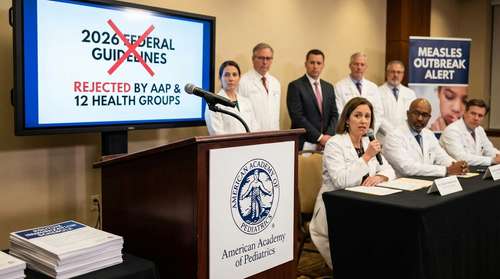
In an unprecedented medical revolt, the American Academy of Pediatrics (AAP) and 12 leading medical organizations have formally rejected the new 2026 federal childhood immunization schedule. Released on January 26, 2026, the AAP’s independent guidance defies recent Centers for Disease Control and Prevention (CDC) directives that removed universal recommendations for several routine shots. As pediatricians nationwide rally behind the science-based 2026 childhood immunization schedule, doctors are urging parents to ignore the confusing federal changes and continue protecting their children against respiratory syncytial virus (RSV), influenza, and hepatitis.
AAP vs CDC Vaccine Guidelines: A Historic Split
For the first time in decades, the nation’s pediatricians and federal health officials are presenting conflicting advice to American families. The core of this dispute lies in the CDC’s controversial decision to downgrade longstanding routine vaccinations to a status of “shared clinical decision-making,” effectively making them optional. While the federal government has narrowed its list of universally recommended vaccines from 17 to just 11, the AAP’s competing schedule maintains routine recommendations for 18 preventable diseases.
“The decision to weaken the childhood immunization schedule is misguided and dangerous,” stated Dr. Andrew Racine, President of the AAP, emphasizing that the academy’s guidance remains rooted in decades of evidence. The AAP is joined by a powerful coalition of 12 major health groups, including the American Medical Association (AMA) and the American Academy of Family Physicians (AAFP), all of whom have endorsed the AAP’s robust schedule over the diluted federal version.
This schism has created a fragmented healthcare landscape. Twenty-seven states and Washington, D.C., have already announced they will bypass the new federal directives and adhere strictly to the AAP vs CDC vaccine guidelines that prioritize comprehensive protection. For parents, this means your local pediatrician will likely recommend a different set of shots than what is listed on the new federal government website.
Routine Childhood Vaccinations 2026: What Has Changed?
The new federal mandates have stripped universal recommendations for several critical vaccines, reclassifying them as optional or high-risk only. The AAP insists these vaccines remain essential for all healthy children. The specific shots caught in the crossfire include:
- Influenza (Flu): Now classified as optional by the CDC, but the AAP argues it is vital for preventing hospitalization.
- Respiratory Syncytial Virus (RSV): Downgraded federally despite being a leading cause of infant hospitalization.
- Hepatitis A and B: Removed from the universal list by the CDC; remains routine under AAP guidance.
- Rotavirus & Meningococcal: Shifted to “shared clinical decision-making” by federal officials.
- COVID-19: No longer universally recommended by the CDC for healthy children.
Under the “shared clinical decision-making” label, insurance coverage for these vaccines remains technically mandated for now, but the removal of the “routine” designation has sparked fears of decreased access and coverage gaps in the future. Doctors argue that routine childhood vaccinations 2026 should be based on biological susceptibility, not administrative policy shifts.
Measles Outbreak US 2026 Highlights Dangers of Vaccine Hesitancy
The debate over pediatric vaccine safety is unfolding against a backdrop of urgent public health crises. Data from early 2026 indicates a sharp rise in preventable diseases, underscoring the risks of relaxing immunization standards. In the first three weeks of January 2026 alone, the U.S. recorded 171 new measles cases, following a disturbing total of 2,242 cases in 2025.
Real-World Consequences
Recent outbreaks in South Carolina and Texas have demonstrated how quickly pockets of unvaccinated children can fuel an epidemic. Health officials warn that the new federal “flexibility” could be interpreted as a lack of necessity, leading to lower coverage rates. “When longstanding recommendations are altered without a robust, evidence-based process, it undermines public trust,” warned Dr. Bobby Mukkamala, President of the AMA. The current measles outbreak US 2026 serves as a grim reminder that viruses do not negotiate with policy changes.
Navigating New Federal Health Mandates
Parents are currently facing a confusing array of information. While the new federal health mandates suggest a “choose your own adventure” approach to healthcare, the medical consensus remains firm. Pediatricians advise that the safest course of action is to follow the schedule that has successfully eliminated diseases like polio and measles from daily American life for decades.
If you are confused by the conflicting schedules, experts recommend having a direct conversation with your child's doctor. Ask specifically about the “18-disease schedule” endorsed by the AAP. Despite the administrative changes at the federal level, private practices and state health departments generally retain the autonomy to uphold the higher standards of care championed by the American Academy of Pediatrics news updates.
Ultimately, the medical revolt signifies a commitment to patient safety over political pressure. By adhering to the AAP’s comprehensive guidelines, parents can ensure their children remain protected against the full spectrum of vaccine-preventable diseases, regardless of shifting federal narratives.