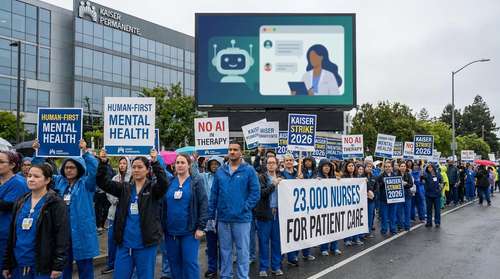
Today, over 23,000 registered nurses across Northern California walked off the job to join a historic labor action. The Kaiser mental health strike 2026 centers on a fiercely debated modern medical issue: the rapid integration of artificial intelligence into clinical therapy. Led by the National Union of Healthcare Workers (NUHW) and bolstered by a massive sympathy strike from the California Nurses Association (CNA), the picket lines represent a growing national movement. Healthcare professionals are demanding strict safeguards to protect the human element in medicine against the encroachment of algorithmic diagnostic tools.
The Core Conflict: AI in Psychiatric Care
Roughly 2,400 mental health professionals—including psychologists, clinical social workers, and addiction medicine counselors—initiated the Unfair Labor Practice strike outside major Kaiser Permanente medical centers in Oakland, Sacramento, Fresno, Santa Clara, and Santa Rosa. The primary grievance stems from widespread fears among staff regarding AI in psychiatric care. Clinicians argue that the health maintenance organization is aggressively deploying untested technology to handle surging patient loads, compromising clinical safety.
Therapists describe a working environment that increasingly resembles an assembly line. Many report being forced into back-to-back sessions while initial patient triage is delegated to unqualified telephone representatives or automated screening software. There is also deep concern over newly implemented programs designed to record and analyze private counseling sessions, a move workers view as a breach of patient trust.
Why 23,000 Nurses Are Joining the Picket Lines
The sheer scale of the healthcare worker strike March 18 is driven by solidarity from registered nurses and stationary engineers. Members of the CNA and IUOE Local 39 formed a united front, maintaining that complex algorithms cannot replicate authentic empathy. Union leaders emphasize that solidarity is essential when executives push potentially unsafe technology onto vulnerable populations. For these frontline workers, standing shoulder-to-shoulder with therapists is a mandatory defense against automated healthcare.
The Debate: Administrative Tool or AI Replacing Therapists?
Kaiser Permanente executives strongly dispute the union's narrative. Lionel Sims, Senior Vice President of Human Resources for Kaiser Permanente Northern California, issued public statements clarifying that the organization has absolutely no intention of AI replacing therapists. According to management data, the healthcare provider has actually increased its licensed mental health clinician staff by 25% over the past five years to meet unprecedented demand.
Hospital leadership maintains that artificial intelligence is utilized strictly to reduce administrative burdens and improve system efficiency, not to override independent clinical judgment. They argue that smart tools allow doctors to spend more face-to-face time with patients by minimizing paperwork. However, the union remains highly skeptical, pointing to contract proposals that they believe would weaken patient care safeguards and open the door to widespread outsourcing.
The Broader Impact: The Ethics of AI in Mental Health
This confrontation in California highlights a massive national conversation surrounding the ethics of AI in mental health. Across the country, hospital systems are experimenting with tools designed to predict patient outcomes, transcribe therapy notes, and manage overwhelmed triage queues. Tech developers promote these automated solutions as a necessary remedy to the nationwide shortage of behavioral health professionals.
Yet, when dealing with severe trauma, deep depression, or active addiction, clinical nuances matter immensely. Subtle shifts in tone of voice, defensive body language, and emotional pacing are critical indicators that algorithms currently lack the capacity to read accurately. Striking psychologists point out that delegating sensitive triage duties to software could result in entirely missed warning signs for patients in acute crisis.
Fines, Parity Laws, and Human-First Mental Health Care
The backdrop to this labor dispute involves a string of severe regulatory penalties for the healthcare giant. In recent years, Kaiser has paid hundreds of millions in fines for behavioral health violations. This includes a historic $200 million settlement in 2023 with the California Department of Managed Health Care, which required the provider to reimburse patients who were forced to seek out-of-pocket treatment due to internal delays. Just this year, they reached an additional $31 million settlement with the U.S. Department of Labor over federal mental health parity laws.
These massive financial penalties fuel the workers' argument that the company is searching for technological shortcuts rather than investing in genuine, human-first mental health care. Picket line attendees have publicly stated that the essence of their profession relies entirely on human connection, an element that automated screeners fundamentally lack.
NUHW Strike Updates and Patient Impact
Following the latest NUHW strike updates, picket lines are expected to remain active until 2 p.m. today, while the nurses' sympathy strike will officially conclude at 6 a.m. on Thursday. Kaiser officials stated they have contingency plans in place to minimize disruptions, though thousands of routine appointments face imminent rescheduling. Both sides remain deadlocked in intense contract negotiations that originally expired last September. Until a breakthrough is reached, the future role of artificial intelligence in the psychiatric therapy room remains highly uncertain.