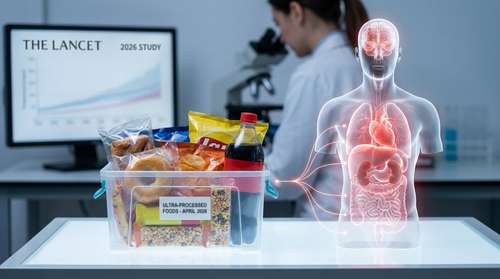
In a sobering update for public health, researchers have unveiled the full extent of the biological havoc caused by our modern diets. A definitive new three-paper series published in The Lancet has identified direct links between ultra-processed foods (UPFs) and severe biological damage across every major human organ system. Analyzing data from over 100 long-term studies, the highly anticipated Lancet ultra-processed foods study 2026 confirms that industrial formulations don't just expand waistlines—they trigger widespread disease. Driven by a global coalition of 43 experts, this landmark publication argues that humans are fundamentally not biologically adapted to digest these synthetic complexes.
The findings, circulating rapidly in nutrition news April 2026, shatter the long-held belief that processed foods are merely empty calories. Instead, researchers found that the combination of heavily modified ingredients and artificial chemicals actively displaces protective nutrients while introducing toxic compounds into the bloodstream. With UPFs now making up more than half of the daily caloric intake for the average adult in the United States and the United Kingdom, public health officials are sounding the alarm.
Unpacking the UPF Organ Damage Research
The depth of the UPF organ damage research presented in the series is unprecedented. By synthesizing narrative analyses, systematic reviews, and meta-analyses, scientists tracked the consumption of UPFs against long-term health outcomes. Out of 104 long-term studies evaluated, an overwhelming 92 reported heightened risks for chronic illnesses. The data definitively connects high UPF intake to cardiovascular disease, chronic kidney disease, Crohn's disease, and even severe depressive symptoms.
Why the Processing Matters
Professor Carlos Monteiro, a leading voice in public health nutrition from the University of São Paulo and a primary author of the series, emphasized that the danger lies in the manufacturing process itself. The industrial disruption of food matrices changes how the human body metabolizes calories. High-pressure processing, extreme heating, and extrusion strip away natural fibers and phytochemicals, leaving behind a hyper-palatable substance that the digestive system absorbs too rapidly.
The Health Risks of Processed Food Additives
While excess sugar, sodium, and fat are well-documented hazards, the health risks of processed food additives are now taking center stage. The Lancet researchers highlighted that UPFs are packed with emulsifiers, synthetic colorings, artificial flavors, and texturizers. These chemical additives are engineered to extend shelf life and enhance taste, but they act as foreign invaders once inside the digestive tract.
As the additives break down, they can strip away the protective mucus lining of the gut, leading to a condition commonly known as leaky gut. This barrier dysfunction allows bacteria and toxins to enter the bloodstream, initiating an aggressive immune response. For practitioners focused on systemic inflammation nutrition, these findings validate the theory that diet-induced chronic inflammation is a root cause of cellular damage across the heart, brain, and liver.
Weight-Independent Metabolic Health Breakthroughs
Perhaps the most startling revelation from the Lancet ultra-processed foods study 2026 is the realization that you cannot simply out-exercise a highly processed diet. Historically, the medical community viewed obesity as the primary bridge between poor diet and chronic disease. However, recent metabolic health breakthroughs demonstrate that lean individuals consuming high-UPF diets are equally vulnerable to internal organ damage.
Controlled feeding trials referenced in the series revealed that matched-calorie diets yielded vastly different metabolic responses depending on the level of processing. UPF diets consistently triggered higher insulin resistance and altered lipid profiles, regardless of the individual's baseline adiposity. This proves that the industrial chemicals and degraded food structures inherently cause metabolic dysfunction, silently damaging organs long before any outward signs of weight gain appear.
Shaping the 2025-2030 Dietary Guidelines for Americans
The urgency of this research arrives at a critical juncture for domestic policy. Federal agencies are currently grappling with how to define and regulate these foods as they draft the 2025-2030 Dietary Guidelines for Americans. The authors of the Lancet series advocate for strict, coordinated policies, warning that voluntary industry reform has repeatedly failed.
The third paper in the series specifically targets the commercial drivers of the UPF epidemic. With multinational food corporations generating nearly $1.9 trillion in annual sales from these cheap, high-margin products, industry lobbying remains a massive hurdle. Public health advocates are now pushing for the upcoming dietary guidelines to include explicit warnings against UPFs. They point to international success stories, such as Brazil's national school feeding program, which has aggressively phased out synthetic foods and mandated that 90% of school meals consist of fresh or minimally processed ingredients by the end of 2026.
Taking Control of Your Nutritional Health
While sweeping policy changes will take time, consumers can take immediate action to protect their health. Here are several actionable steps grounded in the latest research:
- Audit Your Pantry: If a product's ingredient list reads like a chemistry experiment, it belongs to the ultra-processed category. Transition away from foods with unpronounceable additives.
- Embrace Whole Foods: Transitioning toward a diet rooted in fresh vegetables, legumes, whole grains, and lean proteins can rapidly reduce systemic inflammation and support tissue repair.
- Beware of Health Halos: Many protein bars, oat milks, and flavored yogurts are heavily processed despite their wellness-focused marketing. Always read the back of the label, not just the front.
The message from the Lancet ultra-processed foods study 2026 is clear: we must rethink our relationship with convenience food. Treating UPFs with the same regulatory and personal caution as tobacco or alcohol may be the most crucial step we can take for our long-term vitality and organ health.