Major depressive disorder remains one of the most pervasive mental health challenges globally, leaving millions of individuals searching for viable alternatives when traditional selective serotonin reuptake inhibitors and talk therapy fall short. For those caught in the frustrating cycle of unresponsive symptoms, recent clinical developments offer a highly promising alternative. A newly published JAMA Network Open depression study has revealed that a condensed, 10-day protocol of intermittent theta-burst stimulation can significantly alleviate depressive symptoms faster than many conventional methods.
The double-blind randomized clinical trial, led by researchers at UiT The Arctic University of Norway and officially published in July 2026, put this accelerated approach to a rigorous test against a sham placebo. The clinical findings confirm that patients receiving this specific iTBS depression treatment experienced rapid, clinician-rated symptom relief in as little as five days. By demonstrating such fast-acting efficacy, the study establishes a notable depression treatment breakthrough 2026 that could reshape how psychiatric clinics handle acute depressive episodes.
Decoding the Non-Invasive Brain Stimulation Protocol
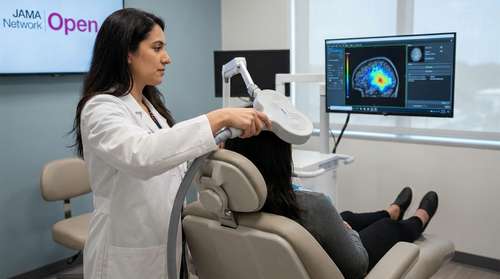
What exactly makes this therapy fundamentally different from conventional psychiatric approaches? Intermittent theta-burst stimulation is a highly targeted form of neuromodulation for depression that builds upon traditional transcranial magnetic stimulation techniques but delivers the pulses in a fraction of the time. During the brief daily procedure, a specialized magnetic coil rests gently against the patient's scalp, delivering concentrated magnetic fields safely through the skull.
These magnetic fields specifically target neural networks in the left dorsolateral prefrontal cortex—a brain region heavily involved in mood regulation, executive function, selective attention, and cognitive flexibility. By mimicking the brain's natural theta waves, the active treatment delivered 600 pulses per session at 120% of the patient's resting motor threshold. The entire session takes just a few minutes, making it highly convenient for outpatient care.
Because it operates entirely outside the body, this non-invasive brain stimulation bypasses the digestive system and the bloodstream, avoiding the systemic side effects—such as weight gain, fatigue, or insomnia—often associated with pharmaceutical interventions. For patients desperately seeking an effective treatment resistant depression therapy, the brief, 10-day timeline is particularly appealing. It offers a stark contrast to the standard four-to-six-week waiting period typical of antidepressant medications before any noticeable mood lift occurs.
Evaluating the Rapid 10-Day Results
To truly gauge the clinical efficacy of the protocol, the research team enrolled 73 adults between the ages of 22 and 65. Every participant was diagnosed with recurrent major depressive disorder and exhibited a baseline score of at least 20 on the Montgomery-Åsberg Depression Rating Scale (MADRS), indicating moderate to severe depression. The cohort was split into two strictly monitored groups: 41 received the active daily pulses, while 32 underwent a sham procedure using a validated placebo coil that mimics the sound and feel of the real device without delivering therapeutic magnetic fields.
The immediate clinical outcomes were striking. The active group demonstrated statistically superior symptom reduction compared to the placebo cohort. Clinicians noted significant improvements at the midway point on day five, which strengthened and continued through the final session on day 10. The speed of this recovery is critical, especially for patients suffering from severe episodes where rapid intervention is paramount.
However, medical science rarely presents a perfectly straightforward narrative. When researchers conducted a follow-up assessment four weeks post-treatment, the gap between the active and sham groups had narrowed considerably. Interestingly, this wasn't necessarily because the active group relapsed, but rather because patients in the sham group continued to show gradual improvement over the subsequent month, leveling the long-term statistical difference. This delayed placebo effect is a known phenomenon in device-based psychiatric trials, yet it raises vital questions about how clinical teams can sustain the rapid initial gains achieved by the active magnetic pulses.
Safety and Patient Tolerance
One of the most encouraging aspects of the trial was its pristine safety profile. Throughout the 10 weekday sessions, the procedure was overwhelmingly well-tolerated by the active treatment group. The clinical team recorded zero serious adverse events throughout the study duration. While participants did report some mild, transient side effects—primarily temporary scalp pain at the stimulation site or minor tension headaches—none of these issues were severe enough to require treatment discontinuation. In fact, tooth pain was reported slightly more frequently in the sham group, highlighting the generally benign nature of the active magnetic pulses.
The Future of Neuromodulation for Depression
While the immediate relief provided by the 10-day protocol is undeniably powerful, the narrowing response at the four-week mark suggests the therapy might require further refinement for long-term management. Accelerated programs provide an incredible tool for breaking through severe depressive episodes quickly. Yet, maintaining that clinical momentum might require adjusted maintenance schedules, such as tapering sessions over several weeks, longer initial treatment windows, or a combination approach pairing the stimulation with targeted psychotherapy.
Psychiatric experts are increasingly looking toward these rapid-acting interventions to stabilize patients during acute mental health crises. The ability to significantly reduce deep psychological suffering in under two weeks represents a massive shift in modern psychiatric care.
As clinicians analyze the data from this latest trial, the focus will likely shift toward optimizing post-treatment protocols to extend the durability of the initial results. For now, the evidence firmly supports intermittent theta-burst stimulation as a potent, fast-acting option for individuals navigating the heavy burden of major depression, offering a clear path forward for those who have exhausted traditional medical routes.