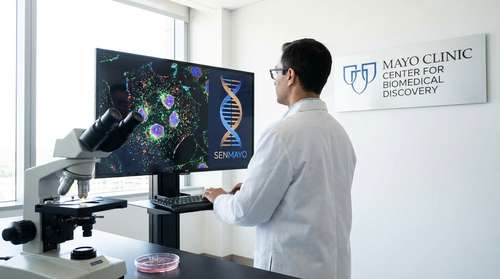
In what is being hailed as one of the most significant healthy aging breakthroughs of the decade, a series of seven groundbreaking studies from the Mayo Clinic has completely reshaped our understanding of the aging process. Published across various Nature journals this week, the comprehensive research dives deep into the biology of senescent zombie cells—the damaged, lingering cells that drive age-related disease. By unveiling novel mechanisms and introducing the revolutionary SenMayo gene set, researchers have laid the critical groundwork for the next generation of targeted treatments.
The Threat of Senescent Zombie Cells
To grasp the magnitude of this Mayo Clinic longevity research, you have to understand what happens to our cells as we age. When a normal cell experiences severe stress or DNA damage, it usually faces two choices: repair itself or undergo a programmed self-destruction called apoptosis. However, a fraction of these cells take a darker path. They shut down their ability to divide but refuse to die, effectively becoming cellular undead.
These senescent zombie cells remain metabolically active. Rather than sitting quietly, they secrete a potent, toxic mix of inflammatory molecules known as the senescence-associated secretory phenotype (SASP). This persistent inflammation acts like a slow-burning fire in the body, contributing heavily to physical frailty, cardiovascular disease, neurodegeneration, and cancer.
Mapping the Threat: The SenMayo Gene Set
One of the most persistent hurdles in aging research has been accurately identifying these rogue cells in living tissue. They are not a single, uniform population; a senescent cell in the liver looks vastly different from one in the brain.
A Universal Identification Tool
To solve this, researchers developed the SenMayo gene set. This powerful new analytical tool provides a consistent, highly accurate method to identify senescent cells across different tissues and biological models. By looking at specific genetic markers, scientists can now map exactly where these cells accumulate over a human lifetime.
Dr. Marissa Schafer, whose laboratory spearheaded several of the studies, noted that precisely identifying and understanding these specific cells is the mandatory first step toward developing therapies that support healthy aging. This work is actively contributing to the National Institutes of Health's Cellular Senescence Network (SenNet) Consortium, an ambitious nationwide project aimed at building a comprehensive atlas of these cells.
The Mitochondrial Engine Driving Inflammation
Finding the cells is only half the battle; understanding why they are so destructive is the other. In a fascinating twist, the Mayo Clinic team discovered a previously unknown mechanism involving mitochondria—the energy-producing powerhouses of the cell.
Led by researchers including Dr. João Passos and Dr. Helene Martini, the studies revealed that dysfunctional mitochondria within these zombie cells leak mitochondrial DNA and RNA. This leakage directly activates immune pathways that trigger heavy inflammation. But the researchers found that this inflammatory signaling alone wasn't enough. The cells also rely on a metabolic signal—specifically an increase in the molecule acetyl-CoA—which alters epigenetic regulation to essentially switch on inflammatory genes.
This discovery opens an entirely new therapeutic door. Instead of just trying to kill the cells, scientists are now exploring whether they can simply switch off the inflammation that makes them harmful.
Anti-Aging Therapies 2026: From Lab to Real-World Impact
If you are wondering how to extend healthspan, the clinical applications of this research offer an exciting glimpse into the future. The seven studies didn't just map the problem; they rigorously evaluated preclinical strategies to reduce the burden of these damaged cells.
The research explored several distinct interventions:
- Senolytic Drugs: Medications specifically designed to target senescent cells.
- Natural Compounds: Testing naturally occurring compounds, including specific derivatives found in tomatoes, that showed remarkable efficacy in clearing cellular debris.
- Genetic Targeting: Advanced genetic approaches engineered to selectively disable the inflammatory pathways.
When applied to aged mouse models, these anti-aging therapies 2026 yielded striking results. The interventions significantly reduced systemic inflammation, lowered brain inflammation, improved cognitive performance, and reversed measures of physical frailty. The animals didn't just live longer; they lived dramatically healthier, more active lives.
What This Means for the Future of Geroscience
The transition from treating individual symptoms of aging to targeting the root cellular causes marks a monumental shift in medicine. By leveraging the SenMayo gene set and understanding the mitochondrial pathways that fuel tissue damage, we are moving closer to a reality where age-related cognitive decline and physical deterioration are preventable conditions rather than inevitable facts of life.
While human trials will require time to ensure safety and efficacy across diverse populations, the foundation has been set. The latest Mayo Clinic breakthrough proves that we finally have the tools to read the biological clock of our tissues—and more importantly, the knowledge to slow it down.