In a major development for public health, state officials have officially declared the South Carolina measles outbreak end, bringing a grueling six-month emergency to a close. The state's Department of Public Health confirmed on Monday that 42 days have passed without a new infection, safely meeting the standard two-incubation-period requirement. With 997 confirmed cases recorded between October 2025 and mid-March, this was the largest single-location outbreak the United States has witnessed in more than 35 years.
The crisis, heavily concentrated in Spartanburg County, exacted a heavy toll on the Upstate community. While local health workers celebrate the containment, the sheer scale of the event is sparking a national conversation about vaccine-preventable diseases 2026. From disrupted classrooms to overwhelmed pediatric wards, the repercussions of this unprecedented public health event will resonate long after the final patient's recovery.
The Impact of the South Carolina Measles Outbreak End
The metrics behind the outbreak paint a stark picture of how rapidly a highly contagious virus can exploit pockets of vulnerability. The virus tore through communities with historically low immunization coverage. Of the 997 total infections, an overwhelming 932 occurred in completely unvaccinated individuals, while only 25 fully vaccinated people contracted the virus.
The financial and logistical disruption was massive. The state absorbed an estimated $2.1 million in outbreak-related costs. Public health investigators logged 30 consecutive weeks of intensive work, issuing 2,294 quarantine letters and making over 1,600 direct calls. The outbreak impacted 33 different schools, forcing 874 students to remain home. Children bore the brunt of the emergency; 639 of the cases were school-age kids between 5 and 17 years old, while another 264 cases involved vulnerable infants and toddlers under age five.
Spotting Measles Symptoms in Children
With active regional threats remaining, parents must stay vigilant regarding measles symptoms in children. The disease typically begins with a high fever, persistent cough, runny nose, and red, watery eyes. Tiny white spots often appear inside the mouth before the characteristic rash breaks out, usually starting at the hairline and spreading downward across the body. Because the virus can linger in the airspace for up to two hours after an infected person leaves a room, recognizing these early signs is critical to securing rapid medical care and preventing community transmission.
How the Emergency is Boosting MMR Vaccine Rates in 2026
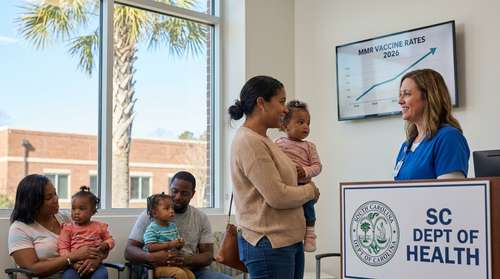
A highly encouraging outcome of the Upstate emergency is its profound impact on MMR vaccine rates 2026. The immediate and visible threat of the virus drove a massive surge in local inoculations. Statewide, healthcare providers administered over 81,000 doses of the measles-mumps-rubella vaccine during the response period—a 31.3% increase compared to the previous year.
In Spartanburg County, the absolute epicenter of the crisis, vaccine administration skyrocketed by an astonishing 93.6%. This sharp rise suggests that witnessing the severe consequences of a local outbreak can effectively cut through vaccine hesitancy. Medical professionals are closely monitoring these pediatric immunization trends, actively working to keep the momentum going. The data offers cautious optimism that families will continue to proactively protect their households rather than waiting for another major medical emergency to prompt action.
Protecting the Fragile US Measles Elimination Status
While South Carolina successfully broke its chain of transmission, the broader national picture remains deeply concerning. The Centers for Disease Control and Prevention tracked 19 separate outbreaks this year, pushing the nationwide total past 1,790 cases as of late April. With dozens of new infections added weekly—including a ballooning 583-case outbreak in Utah that has hospitalized 47 people—the US measles elimination status is under severe threat.
Measles was officially declared eliminated from the United States in the year 2000. Losing that hard-won status would represent a massive step backward for public safety. Epidemiologists stress that maintaining a 95% community vaccination threshold is the only reliable method to keep the highly infectious virus suppressed and to shield immunocompromised individuals who cannot be vaccinated.
Shaping Future Childhood Health Safety News
The resolution in the Upstate provides a textbook example of an effective, modern public health response. Dr. Edward Simmer, the state's DPH Interim Agency Director, publicly praised the immense effort of health workers whose contact tracing and targeted clinics prevented a statewide catastrophe.
Moving forward, state health departments are pivoting their focus toward long-term preventative care. As you follow upcoming childhood health safety news, the lessons from Spartanburg County stand out clearly. Strong community immunization networks do more than protect individual children; they act as a vital, unbreakable shield for the entire population. By sustaining the recent surge in vaccination uptake, American communities can halt these devastating outbreaks before they start.