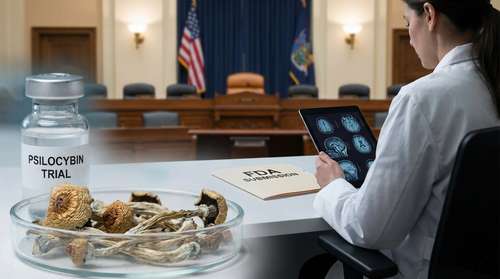
In a watershed moment for mental health treatment in the United States, the Food and Drug Administration (FDA) has accepted a late-stage clinical trial application for psilocybin therapy to treat Post-Traumatic Stress Disorder (PTSD). This federal signal has ignited a legislative firestorm across the country, with states like South Dakota, Iowa, and Kansas racing to pass "trigger laws" in early 2026. These proactive measures are designed to automatically reschedule psilocybin upon FDA approval, potentially cutting years of bureaucratic red tape for patients desperate for relief.
Federal Breakthrough: FDA Accepts Compass Pathways' PTSD Trial
On January 7, 2026, the FDA officially accepted the Investigational New Drug (IND) application from Compass Pathways for its synthetic psilocybin formulation, COMP360. This regulatory green light allows the company to initiate Phase 2b/3 clinical trials specifically for PTSD, marking a critical pivot from their previous focus solely on Treatment-Resistant Depression (TRD).
This development is particularly significant following the FDA's rejection of Lykos Therapeutics' MDMA-assisted therapy application in 2024. The agency's acceptance of the COMP360 trial design suggests a renewed but cautious willingness to advance psychedelic medicine under rigorous scientific standards. With Phase 3 data for depression also expected in the first quarter of 2026, the industry is bracing for a potential approval timeline that could see commercial availability as early as late 2026 or 2027.
South Dakota Leads the Charge with HB 1099
While federal trials progress, state legislatures are refusing to sit idle. South Dakota has emerged as a surprising leader in this legislative sprint. House Bill 1099, introduced in the 2026 legislative session, serves as a classic "trigger law." The bill explicitly proposes to reschedule FDA-approved psilocybin products from Schedule I to Schedule IV immediately upon federal approval.
On February 5, 2026, the South Dakota House Health and Human Services Committee voted unanimously to send HB 1099 to the House floor. Proponents argue that without such legislation, patients would face a lag of 12 to 24 months after FDA approval while the state legislature waits to reconvene and update its own controlled substance schedules. "We are setting the table so that when the meal is ready, people can eat," noted one legislative supporter, highlighting the urgency for veterans and trauma survivors who cannot afford to wait for administrative delays.
The "Trigger Law" Phenomenon: A National Movement
South Dakota is not acting in isolation. A coordinated wave of legislation is sweeping across the Midwest and beyond, often supported by advocacy from Compass Pathways and veteran groups. These bills share a common goal: to synchronize state law with federal changes instantly.
Kansas and Iowa Join the fray
In Kansas, House Bill 2218 has gained significant traction. On January 28, 2026, the House Committee on Health and Human Services recommended the bill be passed as amended. The legislation creates a specific exclusion in the state's definition of psilocybin for FDA-approved pharmaceutical compositions, effectively shielding future prescription therapies from Schedule I criminal penalties.
Similarly, Iowa lawmakers introduced House File 351 on February 12, 2026. Currently under review by the Public Safety Committee, this bill seeks to remove psilocybin and psilocyn from the state's Schedule I list entirely, a bolder move that reflects growing bipartisan frustration with the limitations of current mental health treatments.
Arizona's Preemptive Strike
Some states are already ahead of the curve. Arizona set a precedent by signing Senate Bill 1555 into law in June 2025. This statute proactively mandates that if the FDA approves a psilocybin drug and the DEA reschedules it, Arizona will automatically follow suit. This forward-thinking legislation ensures that Arizonans will be among the first in the nation to access these therapies legally, serving as a model for the bills now circulating in other statehouses.
Beyond Trigger Laws: Pilot Programs and Medical Access
While trigger laws focus on future federal approval, other states are creating immediate state-level access pathways through research pilots. Utah continues to refine its approach with Senate Bill 200 in the 2026 session, aiming to modify its existing pilot program to better facilitate psilocybin production and medical use within state borders.
New Jersey also entered the arena in January 2026, with Governor Phil Murphy signing Senate Bill 2283. This law establishes a psilocybin behavioral health access and services pilot program, positioning the Garden State alongside Oregon and Colorado as jurisdictions willing to explore therapeutic access even before full federal rescheduling.
What This Means for PTSD Treatment in 2026
The convergence of FDA clinical progress and state-level legislative preparation creates a unique landscape for 2026. For the millions of Americans suffering from PTSD, particularly veterans and first responders, these developments offer more than just hope—they offer a tangible timeline.
If the FDA grants approval to psilocybin therapy within the next 18 months, residents in states with enacted trigger laws could see treatments become available almost overnight. In contrast, patients in states without such foresight could remain in legal limbo, waiting for annual legislative sessions to update archaic drug laws. As 2026 unfolds, the pressure will mount on remaining states to pass similar measures, ensuring that geography does not determine who gets access to life-saving mental health care.