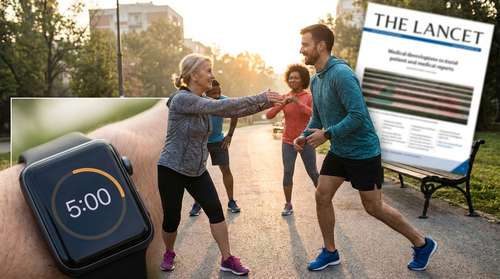
In a fitness world obsessed with hour-long spin classes and marathon training, a groundbreaking new study published in The Lancet this month delivers a refreshing, almost unbelievable promise: just five minutes of movement a day could save your life. The research, which has sparked a wave of viral discussion across health platforms this week, confirms that even 'micro-workouts'—tiny bursts of moderate-to-vigorous physical activity—can drastically reduce the risk of premature death.
For the millions of Americans who struggle to find time for the gym, this finding isn't just good news; it's a paradigm shift. Analyzed from a massive dataset of over 135,000 participants, the study suggests that the threshold for meaningful heart health benefits is far lower than previously thought. As we close out Heart Month in February 2026, these findings, combined with new data from the Apple Heart and Movement Study, are rewriting the rules of longevity.
The 5-Minute Breakthrough: What the Data Shows
The study, led by researchers at the Norwegian School of Sport Sciences and published in The Lancet, analyzed device-measured physical activity from a cohort of more than 135,000 adults across the UK, US, Norway, and Sweden. Unlike previous studies that relied on self-reported questionnaires—which are often notoriously inaccurate—this research used precise accelerometer data to track every minute of movement.
The results were stark. Researchers found that adding just five minutes of moderate-to-vigorous physical activity (MVPA) per day was associated with a 10% reduction in mortality risk across the general population. for the least active individuals—those largely sedentary—that same five-minute investment slashed their risk of early death by roughly 6%. Increasing that daily dose to 10 minutes saw the benefits jump even higher, with risk reductions climbing toward 15%.
"This fundamentally challenges the 'all-or-nothing' mentality that keeps so many people on the couch," says Dr. Elena Russo, a preventative cardiologist commenting on the findings. "We used to think you needed 30 minutes of continuous activity to move the needle. Now we know that biology rewards even the smallest consistent efforts."
Defining 'Moderate-to-Vigorous': It's Not Just Walking
To qualify for the "5-minute rule," the activity needs to meet a specific intensity threshold. The study defines MVPA as any movement that raises your heart rate and makes breathing slightly harder. This doesn't necessarily mean sprinting or heavy lifting. It includes:
- Brisk walking (at a pace where you can talk but not sing)
- Climbing a few flights of stairs
- Vigorous gardening or housework
- Cycling at a casual pace
This aligns with the growing trend of "exercise snacking"—incorporating short bursts of activity throughout the day rather than a single dedicated workout session. A separate analysis trending this week supports this, showing that "vigorous intermittent lifestyle physical activity" (VILPA)—like running for the bus or playing tag with kids—can be just as effective as structured exercise for longevity.
The Sedentary Trap: Findings from the Apple Heart and Movement Study 2026
While the Lancet study provides the solution, new data released this February from the Apple Heart and Movement Study highlights the problem. In a collaboration with the American Heart Association and Brigham and Women’s Hospital, researchers analyzed cardio fitness data from over 200,000 participants.
The 2026 update, released mid-February, reveals a concerning trend: Cardio fitness (measured as VO2 max) begins to decline significantly earlier than expected in adulthood. The data showed that average VO2 max drops steadily from age 20 onwards, with significant variations by region. For instance, participants in Washington, D.C., and Massachusetts logged some of the highest daily exercise minutes, correlating with better heart health metrics, while other regions lagged behind.
This context makes the Lancet findings even more critical. "The Apple data confirms that many adults are effectively losing the battle against sedentary aging," notes fitness analyst Mark Stevens. "The 5-minute rule offers a realistic entry point to reverse that trend without requiring a complete lifestyle overhaul."
How to Integrate Micro-Workouts for Maximum Benefit
Adopting the 5-minute rule is deceptively simple, but consistency is key. Experts suggest "stacking" these micro-workouts onto existing habits to ensure they happen daily. Here are three evidence-based ways to get your daily dose:
1. The 'Stair Snack'
Opting for the stairs instead of the elevator is the classic example of functional fitness. A 2026 analysis suggests that climbing just three flights of stairs three times a day can provide the requisite cardiovascular stimulus to improve VO2 max over time.
2. The 'Wait Time' Walk
Use the "dead time" in your day—waiting for coffee to brew, waiting for a file to upload, or the 5 minutes before a Zoom call starts—to pace briskly or do jumping jacks. The Lancet study confirms that these accumulated minutes count just as much as continuous ones.
3. The Commute Extension
If you take public transit, get off one stop early. If you drive, park at the far end of the lot. These built-in inconveniences often add exactly 3-5 minutes of brisk walking to your day, instantly meeting the study's minimum threshold for mortality reduction.
The Bottom Line
The message from 2026's most significant fitness research is clear: You don't need a gym membership to save your life. By combining the insights from the Lancet study with the tracking capabilities highlighted by the Apple Heart and Movement Study, the path to longevity has never been more accessible. Five minutes isn't just a break; it's a lifeline.