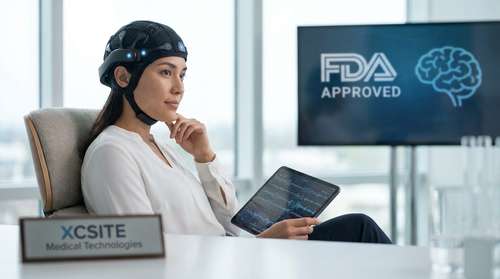
In a landmark decision that could reshape the landscape of mental health treatment, the U.S. Food and Drug Administration (FDA) has officially cleared XCSITE, a groundbreaking noninvasive brain stimulation device developed by neuroscientists at the University of North Carolina at Chapel Hill. Announced this Friday, the approval marks the first time a closed-loop, personalized "brain-tuning" technology has been authorized for widespread clinical use. Unlike traditional treatments that rely on pharmaceuticals or constant electrical currents, XCSITE functions remarkably like a high-tech hairnet, listening to the brain's natural rhythms and delivering precise, alternating electrical currents to synchronize them in real-time.
A New Era of Noninvasive Depression Treatment in 2026
The approval of XCSITE comes at a critical moment. With approximately 14.5 million U.S. adults experiencing major depressive episodes annually, the demand for rapid, drug-free alternatives has never been higher. Traditional antidepressants can take weeks or months to show effects and often come with debilitating side effects. In contrast, clinical trials for XCSITE have demonstrated a stunning capacity to reduce symptoms in a fraction of that time.
"We form a closed-loop system where we listen to the brain and then respond to it, adjusting stimulation moment to moment," explains Dr. Flavio Fröhlich, the lead researcher at UNC-Chapel Hill whose lab pioneered the technology. By targeting specific alpha oscillations—brainwaves occurring between 8 and 12 Hertz—the device effectively "retunes" neural circuits that have fallen out of sync due to depression or anxiety.
How the 'High-Tech Hairnet' Works
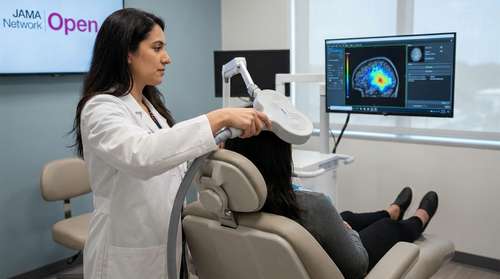
While the colloquial description of a "hairnet" might sound simple, the underlying technology is sophisticated. The XCSITE device uses a mesh of sensors and electrodes that fits comfortably over the patient's head. Unlike older brain stimulation methods like Transcranial Direct Current Stimulation (tDCS), which sends a constant stream of electricity, XCSITE utilizes Transcranial Alternating Current Stimulation (tACS).
Personalized Brainwave Tuning for Anxiety and Depression
The key differentiator of this FDA approved mental health technology is its personalized approach. Every brain's electrical signature is unique. The XCSITE system first records the patient's individual EEG patterns to identify the specific frequency of their alpha waves. It then delivers an imperceptible, rhythmic electrical pulse that matches that frequency, strengthening the brain's natural ability to regulate mood. This "closed-loop" feedback mechanism ensures that the treatment is tailored specifically to the patient's physiological state at that exact moment, maximizing efficacy while minimizing side effects.
Clinical Results and Patient Impact
The path to FDA clearance was paved by compelling data from multi-phase clinical trials. In pilot studies, researchers observed that nearly 80% of participants no longer met the clinical criteria for depression just two weeks after completing a five-day treatment course. This rapid onset of relief is a significant breakthrough compared to the lag time associated with SSRIs and other pharmacological interventions.
"It’s not a before-and-after approach; it’s an active dialogue with the brain," Fröhlich noted in a statement regarding the approval. For patients who have not responded to medication—or who cannot tolerate the side effects—the XCSITE brain stimulation device offers a new lifeline. The treatment sessions typically last about 40 minutes, during which patients report little to no sensation other than a mild tingling.
The Future of Neurotechnology for Mental Health
The commercialization of XCSITE is being led by Pulvinar Neuro, a company spun out of UNC-Chapel Hill and acquired by Electromedical Products International (EPI). With the FDA's green light, the device is expected to roll out to specialized clinics across the country by mid-2026. This approval signals a broader shift in mental health breakthroughs 2026, moving away from a "one-pill-fits-all" model toward precision medicine that respects the individual bio-electric complexity of the human brain.
As this brain stimulation hairnet for depression becomes available, it brings hope to millions that the future of mental health care will be not only more effective but also more personal, noninvasive, and harmonized with the body's natural rhythms.