In a landmark shift for the American food industry, the U.S. Food and Drug Administration (FDA) has officially overhauled its labeling regulations as of February 2026, granting manufacturers the green light to use "No Artificial Colors" claims on products colored with naturally derived additives. The move, announced earlier this week, resolves years of regulatory ambiguity and clears the path for a mass industry transition away from petroleum-based synthetic dyes like Red No. 40 and Yellow No. 5.
FDA Food Labeling Rules 2026: A Victory for the Clean Label Movement
For decades, the FDA maintained a rigid stance that any added color—whether synthesized from petroleum or extracted from a beet—was technically "artificial" in the context of food processing. This technicality often prevented brands using plant-based pigments from marketing their products as free from artificial colors, leaving consumers confused in the grocery aisle.
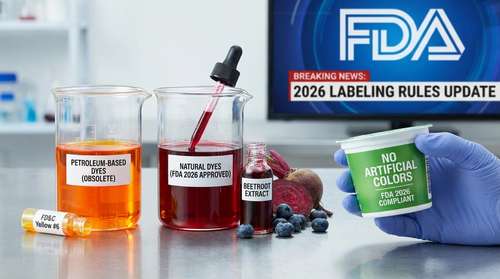
Under the new guidance issued on February 5, 2026, the FDA will exercise enforcement discretion, permitting voluntary claims such as "No Artificial Colors," "Made Without Artificial Colors," or "No Added Artificial Colors" provided the product contains no petroleum-based food dyes. This policy shift is designed to reward transparency and accelerate the adoption of natural food dyes.
FDA Commissioner Marty Makary described the change as a common-sense update. "We acknowledge that calling colors derived from natural sources 'artificial' might be confusing for consumers and a hindrance for companies to explore alternative food coloring options," Makary stated. "We are taking away that hindrance."
Beetroot Red and Spirulina: The New Standard
Alongside the labeling overhaul, the FDA has formally approved beetroot red as a new color additive exempt from certification and expanded the authorized uses of spirulina extract. These approvals are critical for manufacturers scrambling to find stable, vibrant alternatives to synthetic reds and blues.
Beetroot Red FDA Approval Details
Beetroot red, derived from the betalains in beets, can now be used broadly across food categories. Previously, its regulatory status was more limited, but the new approval allows it to be a primary substitute for Red No. 40 in everything from yogurts to confections. Unlike synthetic dyes, which require batch certification by the FDA, beetroot red is "exempt from certification," streamlining the supply chain for food producers.
Expanding the Palette with Spirulina
Spirulina extract, a blue-green algae, has seen its approved uses widened. This is particularly significant for creating natural blue and green hues, which have historically been the most difficult to achieve without synthetic chemicals like Blue No. 1. The expansion allows spirulina to be used in a wider array of temperature-processed foods, a sector previously dominated by artificial additives.
The Phase-Out of Petroleum-Based Food Dyes
This labeling update is not an isolated event but part of a broader federal initiative to remove synthetic dyes from the U.S. food supply. It follows the "Make America Healthy Again" agenda spearheaded by Health and Human Services Secretary Robert F. Kennedy Jr., who has prioritized the elimination of additives linked to health concerns.
The pressure on petroleum-based dyes has been mounting since California passed the "California School Food Safety Act," which bans six synthetic dyes—including Red 40, Yellow 5, and Yellow 6—from public schools starting in 2027. The FDA's new federal guidelines effectively harmonize with these state-level bans, pushing the entire market toward natural alternatives ahead of the compliance deadlines.
"This is real progress," Kennedy said in a statement regarding the new rules. "We are making it easier for companies to move away from petroleum-based synthetic colors and adopt safer, naturally derived alternatives."
Industry Impact: Navigating the Transition
For food manufacturers, the race to reformulate is officially on. Major conglomerates like Kraft Heinz and retailers like Walmart had already pledged to remove artificial colors by 2027, but the new FDA food labeling rules 2026 provide the legal framework to market these changes aggressively.
However, the transition is not without challenges. Natural colors are often more expensive and less stable than their synthetic counterparts. They can be sensitive to heat, light, and pH levels, requiring sophisticated food science to ensure a strawberry-flavored beverage doesn't turn brown on the shelf.
Despite these hurdles, the clean label movement has won a decisive victory. Shoppers can expect to see a wave of "No Artificial Colors" labels hitting shelves later this year as brands rush to capitalize on the new regulations. For HealthVot nutrition news readers, this means ingredient lists are about to get a lot easier to read—and a lot more colorful, naturally.