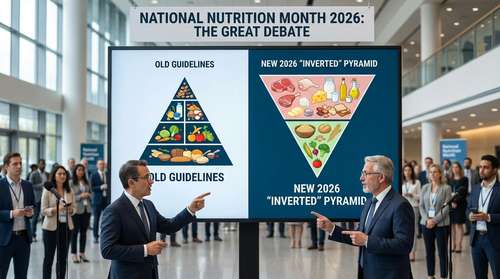
As National Nutrition Month kicks off this week, a fierce debate has erupted across the American medical community regarding the newly implemented 2025-2030 Dietary Guidelines for Americans. While the annual observance typically unifies health professionals under a common theme, March 2026 marks a unprecedented schism. At the center of the storm is the USDA's controversial new "inverted" food pyramid, which prioritizes dense animal proteins and full-fat dairy while relegating traditional grains to the bottom tier. This radical shift has sparked intense scrutiny from cardiologists and nutritionists who argue that the new food pyramid 2026 could undo decades of heart-health progress, even as it aims to combat the country's metabolic crisis.
The 'Inverted' Pyramid: A Radical Departure
Released earlier this year and taking full effect in federal programs this month, the USDA nutrition guidelines update represents the most significant overhaul in federal dietary policy since the original Food Guide Pyramid of 1992. The new visual guide literally flips the script: the largest section at the top now features red meat, poultry, eggs, and full-fat dairy, while the base—traditionally reserved for grains and carbohydrates—has been shrunk significantly.
Under the new protocols, the recommended daily protein intake has nearly doubled, jumping from 0.8 grams to 1.2-1.6 grams per kilogram of body weight. "We are seeing a pivot toward nutrient density and satiety," explains Dr. Sarah Jenkins, a metabolic health advocate supporting the changes. "The goal is to crush hunger and stabilize blood sugar by front-loading high-quality proteins." However, this protein-rich diet controversy is far from settled. Critics warn that such high recommendations for the general population could strain kidney health in vulnerable groups and inadvertently spike saturated fat consumption.
Saturated Fat vs. The "Real Food" Agenda
The most heated point of contention in the last 48 hours involves the mixed messaging regarding fats. While the text of the guidelines technically retains the 10% limit on saturated fats, the visual prominence of butter, beef tallow, and cheese in the new graphic suggests otherwise. This contradiction has become a focal point for the National Nutrition Month 2026 theme, "Discover the Power of Nutrition," which many experts are now using to challenge the federal advice.
The Full-Fat Dairy Debate
For the first time, the guidelines explicitly endorse full-fat dairy health benefits, moving away from the low-fat or non-fat recommendations of the past three decades. Proponents argue that the bioactive compounds in whole milk and cheese are essential for nutrient absorption and satiety. "We've demonized natural fats for too long while replacing them with sugar," notes the USDA's recent press release.
Yet, the American College of Cardiology has issued a fresh statement this week warning that the "unrestricted promotion" of high-fat dairy could confuse the public. They argue that without strict caloric monitoring, this shift could lead to a surge in LDL cholesterol levels, complicating the fight against cardiovascular disease.
War on Ultra-Processed Foods
If there is one area of consensus, it is the aggressive new stance on ultra-processed food restrictions. The 2025-2030 guidelines implement a near-total advisory ban on foods containing high fructose corn syrup, artificial dyes, and industrial seed oils for children under 10. This "clean label" approach aligns with the "Make America Healthy Again" agenda that influenced the guidelines' creation.
Schools participating in the National School Lunch Program are scrambling to adapt to these strictures by the upcoming fall deadline. The new rules require that processed items be replaced with "whole, single-ingredient foods," a logistical challenge that school nutrition directors are debating vehemently at conferences this week. The move aims to drastically reduce the intake of "food-like products," but critics question whether the supply chain can support such a rapid transition to fresh, whole foods for millions of students.
Expert Consensus or Confusion?
As the debate intensifies, the public is left navigating conflicting advice. Major health organizations, including the Harvard T.H. Chan School of Public Health, have released counter-guidance urging Americans to exercise caution with the new meat-heavy recommendations. They emphasize that while reducing processed foods is vital, replacing them entirely with red meat and butter ignores the robust evidence supporting plant-forward diets for longevity.
The clash over the 2025-2030 Dietary Guidelines for Americans highlights a broader fracture in modern nutrition science: the tension between metabolic health (focused on blood sugar and insulin) and traditional cardiovascular health (focused on lipids and cholesterol). As National Nutrition Month progresses, expect this ideological battle to dominate headlines, leaving consumers to decide whether to follow the new federal "inverted" pyramid or stick to established heart-healthy traditions.