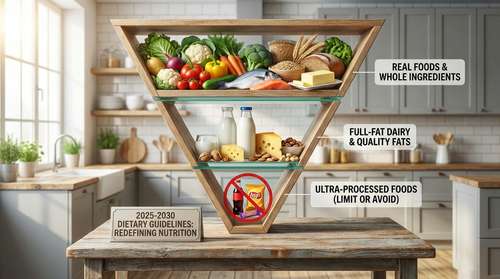
For decades, the standard American dietary advice was predictable: heavily prioritized grains, demonized saturated fats, and a cautious approach to protein. That era officially ended this week as health officials and nutrition experts continued to unpack the implications of the newly implemented 2025-2030 Dietary Guidelines for Americans. In a move that has stunned the food industry and delighted metabolic health advocates, the USDA and HHS have unveiled a controversial "inverted pyramid" graphic that literally flips conventional wisdom on its head. Under the banner of "Make America Healthy Again" (MAHA), the new guidelines declare ultra-processed foods (UPFs) a primary public health enemy and place nutrient-dense animal proteins, full-fat dairy, and healthy fats at the pinnacle of the American plate.
The "Flipped" Pyramid: A Radical Visual Shift
The most immediate and shocking change in the 2025-2030 update is the retirement of the "MyPlate" icon in favor of a new, inverted food pyramid. Released in January and clarified in briefing documents as recently as February 18, 2026, this graphic prioritizes meat, poultry, eggs, and full-fat dairy at the broad top section, signaling that these nutrient-dense foods should form the foundation of the diet.
In stark contrast to the 1992 pyramid, grains and carbohydrates have been demoted to the narrowest point at the bottom. This visual hierarchy explicitly suggests that while whole grains can play a role, they are no longer the "base" of human nutrition. "The visual message is unmistakable," notes Dr. Allison Miner in a widely circulated analysis released yesterday. "We are moving away from a grain-centric energy model to one focused on structural nutrition—protein and essential fats."
War on Ultra-Processed Foods
For the first time in U.S. history, federal guidelines have explicitly distinguished between "real food" and "ultra-processed food products." The 2025-2030 text doesn't just suggest limiting empty calories; it identifies ultra-processed items—defined as industrial formulations containing additives like emulsifiers, seed oils, and high-fructose corn syrup—as active drivers of the metabolic health crisis.
The new mandates, championed by HHS Secretary Robert F. Kennedy Jr., advise Americans to avoid foods with ingredients "you wouldn't find in a home kitchen." This represents a regulatory earthquake for Big Food manufacturers, who are now facing a federal stance that categorizes many of their staple products—from sugary cereals to commercially baked breads—as non-essential and potentially harmful. The guidelines explicitly recommend that schools and federal programs begin phasing out these products in favor of whole-food alternatives by late 2026.
Protein and Fat: The Return of Nutrient Density
Perhaps the most scientifically debated update is the new stance on fats and protein. The guidelines have doubled the recommended protein intake for many adults to 1.2–1.6 grams per kilogram of body weight, citing new evidence on sarcopenia and metabolic function. Furthermore, the decades-long war on dietary cholesterol and saturated fat appears to be thawing.
Full-Fat Dairy is Back
Gone are the warnings to choose non-fat or low-fat milk. The new text supports the consumption of full-fat dairy, citing improved nutrient absorption and satiety. This aligns with recent studies showing that the removal of fat from dairy often leads to increased consumption of added sugars to compensate for flavor loss.
Healthy Fats vs. Industrial Oils
The definition of "healthy fats" has also shifted. While olive oil remains a staple recommendation, the guidelines now include animal fats like tallow and butter in the "real food" category, differentiating them from chemically extracted industrial seed oils, which are now scrutinized for their role in inflammation. This nuance marks a significant departure from the "all saturated fats are bad" narrative of the 2020-2025 era.
Expert Reactions and The Path Forward
The reaction from the nutrition community has been polarized. Traditionalists and some members of the academic old guard have expressed concern, particularly regarding the potential rise in LDL cholesterol associated with higher red meat consumption. A Harvard T.H. Chan School of Public Health analysis released earlier this month warned that the "mixed messages" between the text (which still caps saturated fat at 10% of calories) and the graphic (which visually promotes steak and butter) could confuse consumers.
However, metabolic health practitioners argue this correction is long overdue. With nearly 90% of healthcare spending tied to chronic diseases driven by insulin resistance, the shift toward a low-carbohydrate, protein-prioritized approach addresses the root cause of the crisis. As Americans begin to navigate these new waters in 2026, the directive is simpler than ever: ignore the marketing claims on the box, and if possible, buy food that doesn't come in a box at all.