The era of endless treadmill jogging and calorie counting is rapidly coming to a close. Today, during a highly anticipated sneak-peek event in Forney, Texas, the fitness world witnessed a massive pivot toward functional strength and longevity. The official debut of the Crunch 3.0 gym design sets a new standard for health clubs across America, prioritizing performance, recovery, and lifelong vitality over outdated aesthetics.
The $12 million, 35,000-square-foot facility at 172 Trailhouse Lane perfectly encapsulates the most dominant functional fitness trends 2026 has to offer. By replacing traditional rows of cardio equipment with expanded lifting zones and biometric-driven recovery areas, Crunch Fitness is making a bold statement about how Americans will work out in the future.
The Philosophy Behind the Crunch 3.0 Gym Design
For decades, commercial gym layouts remained relatively stagnant: a massive cardio deck at the front, a few weight machines in the middle, and a cramped free-weight section tucked into the back. The Crunch 3.0 gym design completely flips this architectural script. Driven by shifting consumer demands, this new blueprint allocates premium floor space to heavy lifting, functional movement, and specialized recovery.
At the April 21st "Sip-Sip Hooray" sneak peek event, featuring a ribbon-cutting ceremony by Forney Mayor Jason Roberson, early attendees experienced a facility engineered for modern training philosophies. "We're bringing a high-energy, community-focused fitness experience to the Dallas-Fort Worth area with premium equipment and amenities designed for everyone," noted Tony Scrimale, CEO of CR Fitness Holdings. The layout directly reflects a growing understanding that building and maintaining lean tissue is the ultimate safeguard against age-related decline.
Shifting Metrics: Muscle Quality vs BMI
The fitness industry is undergoing a severe metric recalibration. Medical professionals and trainers alike are abandoning the Body Mass Index in favor of more precise health indicators. The conversation has officially shifted toward muscle quality vs BMI, a change that directly influences how modern gyms are built. For years, gyms catered to weight loss, emphasizing cardiovascular machines to burn maximum calories. Now, the architectural focus is on tissue preservation and metabolic health.
High-quality muscle tissue—characterized by optimal strength, power, and metabolic efficiency—acts as an endocrine organ, regulating blood sugar and protecting joint health. This physiological science is the driving force behind the explosion of strength for longevity training. Gym-goers in 2026 aren't just trying to look good for the summer; they are training to maintain mobility, bone density, and independence into their eighties and nineties. The modular Crunch 3.0 model accommodates this societal shift by removing barriers to heavy resistance training for all age demographics, making serious weightlifting accessible to everyday people.
Revamped Floors: Olympic Lifting Platforms and Functional Zones
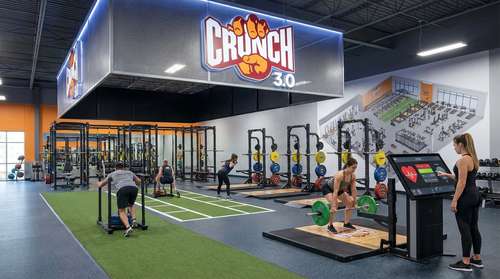
To support this longevity-focused approach, the facility features an unprecedented volume of heavy lifting equipment. Gym floors that once housed dozens of elliptical machines are now outfitted with multiple Olympic lifting platforms. These dedicated spaces allow members of all skill levels to perform compound movements like squats, deadlifts, and cleans safely without waiting in long queues.
Advanced HIITZone Training Routines
Beyond traditional barbells, the Forney prototype highlights dedicated indoor turf areas specifically designed for functional movement. These areas cater to high-intensity, athletic-style conditioning that bridges the gap between raw strength and everyday agility. The newly expanded HIITZone training routines focus on multidirectional movement, heavy sled pushes, and dynamic kettlebell complexes. These workouts improve cardiovascular capacity and explosive power without sacrificing hard-earned muscle mass, perfectly aligning with the core functional fitness trends 2026 is known for.
Next-Generation Recovery and Bio-Individual Fitness Tracking
Perhaps the most striking evolution in the Crunch 3.0 blueprint is the massive emphasis placed on post-workout recovery. Training hard is only half the equation; the physiological adaptations actually occur while the body rests. Recognizing this critical component of health, the new facility includes a comprehensive Relax & Recover® zone that rivals high-end wellness clinics. The days of simply stretching for five minutes and leaving the gym are officially over.
Members have unprecedented access to HydroMassage beds, advanced infrared saunas, and state-of-the-art CryoLounges. When paired with the modern rise of bio-individual fitness tracking—where personal wearable technology monitors daily heart rate variability, sleep architecture, and central nervous system readiness—these recovery tools allow gym-goers to hyper-customize their healing process. Instead of blindly following generic workout templates, members use their specific biometric data to dictate their daily routine. A low readiness score might prompt an athlete to skip the heavy lifting sessions in favor of mobility work and twenty minutes in the infrared sauna.
As the fitness landscape continues to evolve, the inauguration of this $12 million prototype in Texas represents a definitive turning point. By championing heavy resistance, athletic conditioning, and technological recovery, the Crunch 3.0 layout isn't just selling gym memberships—it is providing a comprehensive environment for a longer, stronger life.