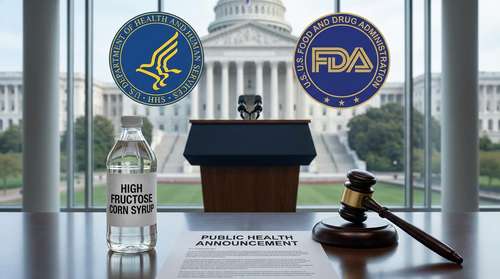
WASHINGTON, D.C. — In a move that signals the most significant shift in American food policy in decades, the Department of Health and Human Services (HHS) and the Food and Drug Administration (FDA) have initiated a sweeping regulatory crackdown on high fructose corn syrup (HFCS) and ultra-processed foods (UPFs). The decisive action, confirmed by officials late this week, follows a landmark study revealing that high consumption of these industrial food products is linked to a staggering 47% higher risk of heart attack and stroke.
HHS and FDA Target "GRAS" Loophole in Massive Overhaul
As of February 19, HHS Secretary Robert F. Kennedy Jr. has confirmed that the administration will formally act on a citizen petition filed by former FDA Commissioner Dr. David Kessler. This petition demands the revocation of the "Generally Recognized as Safe" (GRAS) status for high fructose corn syrup and other refined carbohydrates that saturate the American food supply.
"We will act on David Kessler's petition," Secretary Kennedy stated, marking a pivotal moment in the government's "Make America Healthy Again" (MAHA) initiative. "The questions he is asking are questions the FDA should have been asking a long, long time ago."
The proposed regulatory overhaul targets the decades-old GRAS loophole, which has allowed food manufacturers to self-certify thousands of additives as safe without rigorous federal review. Under the new crackdown, manufacturers would be required to prove that ingredients like HFCS are safe and do not contribute to metabolic disease—a burden of proof that experts say could force a massive reformulation of products ranging from sodas to packaged breads.
Landmark Study: 47% Higher Heart Risk Stuns Medical Community
The regulatory mobilization comes in the immediate wake of a bombshell study published earlier this month in The American Journal of Medicine by researchers at Florida Atlantic University. The study, which tracked the dietary habits and health outcomes of nearly 4,800 U.S. adults, found that those in the highest quartile of ultra-processed food consumption faced a 47% increased risk of cardiovascular disease compared to those with the lowest intake.
This statistic has provided the scientific ammunition needed for federal regulators to challenge the food industry's long-standing safety claims. "A 47% increase is not a margin of error; it is a public health crisis," said Dr. Marty Makary, the FDA Commissioner, who has vowed to prioritize science over industry interests. "When a single class of ingredients is driving nearly half of the risk for our nation's top killer, regulatory inaction is no longer an option."
"The New Tobacco": Officials Compare UPFs to Cigarettes
In a rhetorical shift that has sent shockwaves through the food and beverage industry, health officials are now explicitly comparing the addictive nature and health risks of ultra-processed foods to tobacco. The parallel is not just a talking point but a core component of the new regulatory strategy.
Dr. Kessler, whose petition is the blueprint for the current crackdown, drew a direct line between the two industries. "We changed how this country views tobacco," Kessler told reporters. "We need to change how this country views these ultra-processed foods."
Supporting this comparison is a separate study published in The Milbank Quarterly this month, which concluded that UPFs meet the criteria for addiction standards set for nicotine products. The study found that these foods are "deliberately engineered" to bypass the body's satiety signals, creating a cycle of craving and overconsumption that mirrors drug addiction.
Industry Braces for "Seismic" Shift
The announcement has triggered an immediate response from the food industry. The Consumer Brands Association, a trade group representing major food companies, released a statement emphasizing that their products already adhere to existing science-based evaluations. "We stand ready to work with HHS and FDA," the group noted, while warning that sudden regulatory changes could disrupt the supply chain and increase costs for consumers.
However, the administration appears undeterred. The crackdown is expected to unfold in several phases throughout 2026:
- Phase 1: Immediate review of the GRAS status for high fructose corn syrup and key artificial dyes.
- Phase 2: Implementation of mandatory front-of-package warning labels for foods high in added sugars and refined starches.
- Phase 3: Establishing a federal legal definition for "ultra-processed foods" to facilitate stricter taxation and regulation, similar to tobacco control measures.
What This Means for Consumers
For the average American, these changes could soon become visible on grocery store shelves. If HFCS loses its GRAS designation, companies will be forced to either remove it or display prominent warning labels. This could lead to a resurgence of cane sugar and other natural sweeteners, potentially altering the taste and price of popular products.
"This is the end of the 'trust us' era in food safety," Secretary Kennedy declared. "Americans deserve to know if the food they are feeding their children is slowly poisoning them. The data is now undeniable, and the crackdown has officially begun."