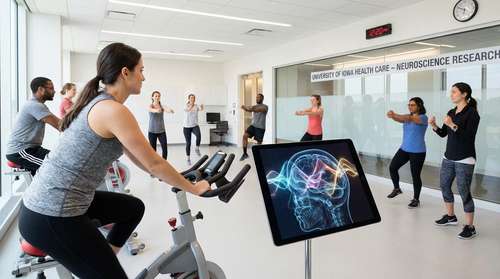
If you have ever felt a sudden wave of mental clarity after a quick jog or a spin class, science finally has a definitive explanation for that phenomenon. A groundbreaking discovery has revealed that a short burst of physical activity fundamentally alters human neural rhythms. At the center of this revelation is brain ripples exercise—a term capturing how moving your body generates high-frequency electrical signals that immediately sharpen information recall.
Published on March 9, 2026, in the journal Brain Communications, the University of Iowa exercise study 2026 provides the first direct evidence in humans that physical exertion instantaneously rewires our cognitive networks. Researchers found that a moderate 20 minute workout for memory isn't just a wellness trend; it is a biological trigger that fires up the brain's learning centers.
Cracking the Code: The Science of Hippocampus Exercise Benefits
For decades, neuroscientists understood that aerobic activity improved cognition. They could see increased oxygenated blood flow in functional MRI scans and observe enhanced test scores in active individuals. However, the exact electrical mechanism in the human brain remained a mystery. We knew that rodents produced "sharp wave-ripples"—brief, rapid electrical events in the brain that consolidate new skills—but confirming this in people proved nearly impossible without invasive technology.
That changed when researchers gained rare access to monitor the living human brain. They discovered that working up a sweat triggers these exact 70 to 160 Hz electrical bursts. These ripples originate in the hippocampus, the ancient seahorse-shaped structure deep inside our temporal lobe responsible for cataloging our experiences. The resulting hippocampus exercise benefits are profound: the ripples surge outward, synchronizing with the cortex to cement new information into long-term storage.
Inside the University of Iowa Exercise Study 2026
To capture this elusive neural data, a team led by Professor Michelle Voss, alongside co-lead authors Araceli Cardenas and Juan Ramirez-Villegas, recruited 14 patients at the University of Iowa Health Care Medical Center. Ranging in age from 17 to 50, these individuals were already undergoing presurgical monitoring for epilepsy using intracranial electroencephalography (iEEG). Because they had electrodes placed directly on their brains, the researchers had an unprecedented window into their real-time neural rhythms.
The experiment was straightforward but illuminating. Participants completed a brief warmup and then hopped on a stationary bike by their hospital beds. They pedaled at a light-to-moderate intensity—keeping their heart rates at roughly 58 percent of their maximum—for exactly twenty minutes. Afterward, they simply rested with their eyes closed.
The monitors immediately lit up with synchronized activity. The rate of hippocampal ripples spiked significantly during the post-workout rest period. This definitively mapped the link between neuroplasticity and fitness, proving that a single session of moderate cycling chemically and electrically primes the mind for learning.
The Ripple Effect Across the Cortex
The most striking finding was not just the increased ripple rate in the hippocampus, but how those ripples behaved. The high-frequency waves began coupling tightly with the brain's Default Mode Network (DMN) and limbic network. These interconnected regions govern autobiographical recall, future planning, and internal thought. Essentially, the exercise forced the brain's isolated memory hubs to start having a highly synchronized, productive conversation.
Why This is the Ultimate Memory Boost Workout
What makes these findings revolutionary is the speed and efficiency of the cognitive upgrade. You don't need months of grueling marathon training to see neurological improvements. A simple memory boost workout requires nothing more than reaching a conversational, moderate heart rate for a fraction of your day. Working at 58 percent of your maximum heart rate equates to a brisk walk, a light jog, or a relaxed cycling session.
Because the synchronized brain waves appear in the minutes of quiet rest immediately following the activity, the timing of your fitness routine could be highly strategic. Hitting the stationary bike or taking a brisk walk just before sitting down to study for an exam, tackle a complex work project, or learn a new language might dramatically improve your retention. The physical exertion acts as a primer, effectively turning up the dial on your mind's recording equipment.
Redefining Exercise for Brain Health
As the medical community continues to battle rising rates of cognitive decline and neurodegenerative diseases, targeted interventions are becoming critical. Utilizing exercise for brain health is no longer just broad lifestyle advice; it is a specific, actionable prescription based on mapped electrophysiological data. The synchronized neural firing acts as a defense mechanism, keeping synaptic pathways robust and functional as we age.
The Iowa team is already planning future trials to pair this brain wave monitoring with specific memory tests, further cementing how these post-exercise neural rhythms translate to behavioral performance. Until then, the takeaway for the rest of us is abundantly clear. The next time you feel mentally sluggish or hit a wall at work, step away from the desk. A quick twenty-minute ride or jog might be the exact electrical jumpstart your neurons need to get back on track.
Practical Takeaways for Your Daily Routine
- Timing matters: Exercise directly before learning tasks or meetings to take advantage of the immediate ripple effect.
- Intensity is key: Keep it moderate. Pushing to exhaustion isn't necessary; a steady 58 percent of your maximum heart rate is the sweet spot.
- Consistency counts: View movement through the lens of neurological fitness. Staying active is an immediate, daily investment in your intellectual performance.