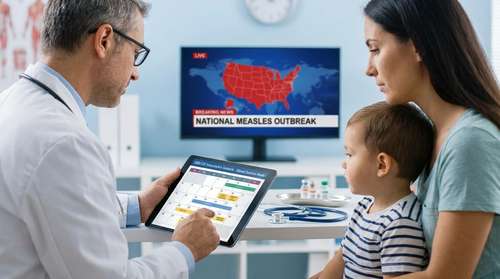
February 26, 2026 – The landscape of pediatric health in America has undergone its most significant transformation in decades, just as a preventable crisis begins to spiral out of control. Earlier this year, the 2026 childhood vaccine schedule was radically overhauled, reducing the number of universally recommended immunizations from 17 to just 11. Now, as the Centers for Disease Control and Prevention (CDC) implements this controversial "Shared Clinical Decision-Making" model, the nation is grappling with a severe measles outbreak 2026 that has already infected nearly 1,000 children across 26 states.
The New 2026 Childhood Vaccine Schedule: What Changed?
On January 5, 2026, the CDC officially released its updated immunization guidelines, a move described by Department of Health and Human Services (HHS) officials as an effort to align the U.S. with "peer nations" like Denmark and Germany. The new policy removes universal recommendations for several major vaccines, reclassifying them instead under a category known as "Shared Clinical Decision-Making" (SCDM).
Under the CDC immunization updates 2026, the following vaccines are no longer routinely recommended for all healthy children but are instead optional topics for discussion between parents and providers:
- Influenza (Flu)
- COVID-19
- Respiratory Syncytial Virus (RSV) (except for high-risk groups)
- Hepatitis A and B
- Rotavirus
- Meningococcal
The core schedule now focuses on just 11 diseases, including measles, mumps, rubella (MMR), polio, and tetanus. Officials argue this streamlined approach empowers parents and reduces "vaccine fatigue." However, the American Academy of Pediatrics (AAP) has sharply criticized the move, warning that removing the "routine" label may be interpreted by many parents as a signal that these protections are unnecessary.
Understanding ‘Shared Clinical Decision-Making’
The term "Shared Clinical Decision-Making" has become a focal point of confusion for family health policy 2026. Unlike a standard recommendation—where a doctor says, "It is time for your child's flu shot"—SCDM implies that the vaccination is not required for everyone but should be considered based on individual risk factors.
According to a recent Annenberg Public Policy Center survey, widespread confusion exists regarding what this designation actually means. While insurance plans, including Medicaid and the Vaccines for Children program, are still required to cover these shots, the removal of the clear "recommended" stamp has led to inconsistent messaging in pediatrician offices. Critics argue that shifting the burden of medical analysis onto parents, without clear public health guidance, is contributing to the rapid decline in uptake rates seen in the first quarter of 2026.
Measles Outbreak 2026: A Crisis Unfolding
The policy shift coincides with a grim milestone. As of late February, the CDC has confirmed 982 measles cases nationwide, putting the U.S. on track for its worst outbreak in a generation. The epicenter of the crisis is South Carolina, which has reported nearly 800 cases, with significant clusters also identified in Utah, Florida, and Arizona.
This measles outbreak 2026 is particularly concerning because measles is one of the most contagious viruses known to science. Maintaining herd immunity requires a 95% vaccination rate, a threshold that many communities are now falling below. While the MMR vaccine remains on the "core" list of 11 recommended shots, public health experts fear that the broader skepticism fueled by the overhaul of the 2026 childhood vaccine schedule is bleeding over into acceptance of even these foundational vaccines.
Legal Battles and Pediatric Health News
The backlash to the new guidelines has moved swiftly from medical offices to the courtroom. On February 25, a coalition of 15 states filed a lawsuit against HHS and the CDC, challenging the scientific basis of the overhaul. The lawsuit alleges that the removal of vaccines like Hepatitis B and Rotavirus from the universal list ignores decades of safety data and places children at unnecessary risk of severe illness.
For parents, the new vaccine guidelines for kids present a complex challenge. Navigating these changes requires proactive engagement with healthcare providers. Pediatricians are urging families to look beyond the "routine" label and evaluate the specific benefits of vaccines now categorized as SCDM, particularly as viral activity for flu and RSV remains high.
What This Means for Your Family
If you are confused by the CDC immunization updates 2026, you are not alone. Here is the bottom line for navigating pediatric health news right now: virtually all vaccines available in 2025 are still available today. Insurance coverage remains intact. The primary change is in the recommendation language, not the availability. In the face of rising measles cases and changing policies, the most critical step is to schedule a comprehensive consultation with your pediatrician to ensure your child remains protected against both core and reclassified preventable diseases.