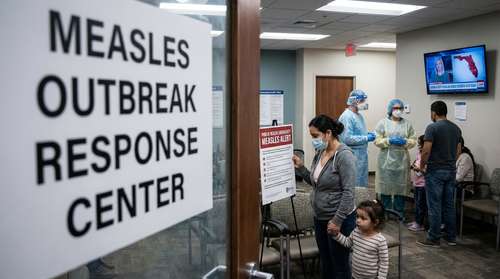
The United States is currently grappling with its most severe measles outbreak in over three decades, a public health emergency that has already sickened more than 1,000 Americans in the first six weeks of 2026. At the epicenter of this crisis are Florida and South Carolina, where a perfect storm of declining childhood vaccination rates and loosening school immunization laws has allowed the highly contagious virus to tear through communities. As federal health data confirms the surge is outpacing the historic outbreaks of the early 1990s, families across the Southeast are bracing for continued disruption, with schools closing and quarantine orders expanding daily.
South Carolina: The Epicenter of the 2026 Crisis
While cases have popped up in over 20 states, South Carolina has emerged as the primary battleground for the measles outbreak 2026. State health officials reported this week that the total number of confirmed cases in the Palmetto State has surpassed 950, with the vast majority concentrated in the Upstate region, particularly Spartanburg and Lancaster counties.
The outbreak, which began late last year, has accelerated violently in February. “We are seeing transmission rates that we haven’t witnessed in a generation,” said Dr. Linda Bell, South Carolina’s State Epidemiologist. Alarmingly, the virus is no longer confined to close contacts; exposure sites identified by the Department of Public Health now include everyday locations like the Itto Ramen Bar and HomeGoods in Greenville, forcing hundreds of unsuspecting residents into a 21-day quarantine monitoring period.
The severity of the South Carolina measles cases is also raising red flags among clinicians. At least 19 individuals have been hospitalized, and officials have confirmed reports of measles encephalitis—a dangerous swelling of the brain—among some patients. This severe complication, once a rarity thanks to high MMR vaccine safety and efficacy, has returned as a terrifying reality for parents of unvaccinated children.
Florida Health Crisis: Politics Meets Pathology
South of the border, the Florida health crisis is taking a different, but equally concerning, trajectory. A significant cluster of cases has erupted at Ave Maria University near Naples, where over 60 students have tested positive. The outbreak has turned the college campus into a microcosm of the national debate, as unmasked and unvaccinated students mingle in dorms and dining halls, fueling a rapid spread that local clinics are struggling to contain.
The situation in Florida is complicated by a volatile political backdrop. The outbreak comes just months after Governor Ron DeSantis and Surgeon General Joseph Ladapo announced controversial plans to dismantle childhood vaccine requirements for public schools—a move that would make Florida the first state to make all school vaccinations voluntary. While these changes are still being debated in Tallahassee, the rhetoric has already had a chilling effect on vaccine uptake.
“We are seeing the real-world consequences of politicizing school immunization laws,” says Dr. Rana Alissa of the Florida chapter of the American Academy of Pediatrics. “When you tell parents that these protections are optional or unnecessary, the virus takes that as an invitation.”
College Campuses and the Spread to Adults
Unlike previous outbreaks that were largely contained within elementary schools, the public health emergency 2026 is striking young adults with ferocity. Beyond Ave Maria University, cases have been reported at Clemson University and Anderson University in South Carolina, as well as the University of Florida in Gainesville.
Health officials warn that college campuses act as “high-octane fuel” for measles transmission due to communal living arrangements. Many of the infected students belong to a generation that missed booster shots or were opted out of childhood vaccine requirements by their parents years ago. The American College Health Association has issued an urgent advisory, recommending that universities implement immediate “catch-up” vaccination clinics, but for many institutions, the virus is already well ahead of the response.
A New Coalition Challenges Immunization Laws
As the case count climbs, a new coalition of activists, emboldened by support from select federal health leaders, is pushing back against containment measures. This week, legal challenges were filed against quarantine orders in Spartanburg, arguing that they infringe on personal liberty. Simultaneously, in the South Carolina legislature, a fierce battle is underway over a bill that seeks to remove religious exemptions for vaccines—a measure the state Attorney General has already publicly criticized.
The clash between public health necessity and individual rights is defining the 2026 response. With MMR vaccine safety data largely being ignored by vocal opposition groups, public health experts fear that the current outbreak is not an anomaly, but the new normal for a nation that has lost its herd immunity.