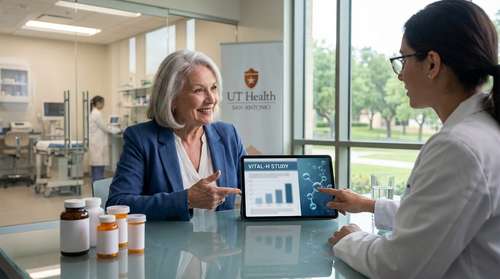
Just days ago, researchers at UT Health San Antonio's Sam and Ann Barshop Institute initiated a landmark shift in the science of human aging. Backed by a monumental $38 million federal contract from the Advanced Research Projects Agency for Health (ARPA-H), the newly launched VITAL-H clinical trial is setting out to answer one of modern medicine's most profound questions: can we delay the physical and cognitive decline associated with getting older? Moving away from experimental biohacks, this massive human study relies on three widely used FDA-approved medications. The goal is to determine if treating the underlying mechanisms of aging can safely extend human healthspan.
The ARPA-H Healthspan Study: A Proactive Approach to Aging
For decades, the standard medical model has been reactionary—waiting for a disease to develop before attempting to treat it. The ARPA-H healthspan study flips this paradigm entirely. Funded under the agency's Proactive Solutions for Prolonging Resilience (PROSPR) program, the initiative views age-related functional decline as a modifiable trajectory rather than an inevitable slide into disability.
The VITAL-H clinical trial will enroll 726 generally healthy adults between the ages of 60 and 65, primarily from South Texas. Researchers selected this specific demographic window because it is typically when functional decline begins, yet the overall disease burden remains relatively low. By targeting this critical midlife period, scientists hope to prove that early intervention with targeted longevity drugs for seniors can preserve cognitive and physical capabilities long before chronic illnesses emerge.
Repurposing FDA-Approved Medications
Instead of spending decades developing new compounds from scratch, the forefront of healthy aging research 2026 focuses on repurposing existing drugs with well-established safety profiles. The trial will divide participants into four arms: a placebo group and three distinct medication groups, testing their effects over a three-year period with an additional six-month follow-up. UT Health San Antonio is collaborating closely with other leading institutions, including Stanford University, the Buck Institute for Research on Aging, and Columbia University, to ensure the trial's rigorous design.
Rapamycin for Longevity
Originally approved in 1999 as an immunosuppressant for organ transplant patients, rapamycin became a cornerstone of geroscience after a landmark 2009 study demonstrated it extended the lifespan of mice. At lower doses, researchers believe rapamycin for longevity works by modulating cellular pathways that influence inflammation and biological aging, making it a prime candidate for preserving long-term resilience.
Semaglutide Anti-Aging Benefits
While GLP-1 receptor agonists are currently dominating medical headlines for weight loss and diabetes management under brand names like Ozempic and Wegovy, their systemic impacts go much further. The trial is heavily focused on semaglutide anti-aging benefits, backed by recent post-market data showing the drug significantly reduces cardiovascular events, improves metabolic health, and lowers systemic inflammation.
Dapagliflozin and Inflammaging
The third medication, dapagliflozin (sold as Farxiga), is an SGLT2 inhibitor that helps the kidneys flush excess glucose out of the body through urine. Beyond its standard use for diabetes, it offers profound cardioprotective and nephroprotective effects. Crucially, it targets inflammaging—the slow, chronic background inflammation that gradually damages tissues over time, essentially rusting the body's biological machinery.
Redefining How to Reverse Biological Age
One of the historical challenges in longevity science has been the lack of scalable, sensitive metrics. You cannot easily measure lifespan in humans without waiting decades. Instead of simply looking at how to reverse biological age on a microscopic cellular level, the VITAL-H trial aims to validate a practical clinical concept known as intrinsic capacity.
Intrinsic capacity is a holistic, composite measure of an individual's physical and mental function. It evaluates five key domains: cognition, mobility, psychological health, vitality, and sensory abilities. To track this, the study employs a modern, decentralized model. Participants will take one daily pill, wear continuous health-tracking devices like Oura rings to monitor sleep and heart health, and complete regular in-person assessments. Working alongside Stanford University, the research team hopes to turn intrinsic capacity into an FDA-recognized, regulatory-grade endpoint. This would provide a standardized way to measure whether a drug successfully preserves a patient's everyday abilities.
The Future of Longevity Science
According to Dr. Elena Volpi, director of the Barshop Institute and principal investigator, the VITAL-H trial represents the culmination of 50 years of aging research at UT Health San Antonio. However, the ambitious scope comes with steep logistical demands. To generate enough statistical power, the research team must retain at least 85 percent of their participants over the entire multi-year study—a tall order for any large-scale clinical trial.
By recruiting heavily from South Texas, including historically underrepresented Hispanic communities, the trial ensures its findings will mirror the projected demographic makeup of the aging U.S. population. If successful, this groundbreaking $38 million initiative will move longevity science out of the realm of speculation and into clinical practice, offering a tangible path to more years of healthy, vibrant living.