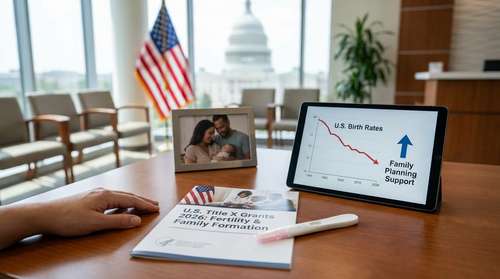
The federal government has officially initiated the most dramatic transformation of the nation's safety-net family planning program in over fifty years. With the rollout of Title X funding 2026 guidelines this April, the Department of Health and Human Services (HHS) is redirecting millions of grant dollars away from traditional contraception. Instead, the administration is prioritizing fertility, family formation, and restorative reproductive medicine. This unprecedented pivot is designed to counter a shrinking national population, but medical experts are raising immediate alarms. By sidelining birth control access for low-income patients, public health advocates warn this policy shift could inadvertently trigger an escalation in maternal mortality and sharply reduce access to life-saving preventive care.
The Driving Force: Tackling the US Birth Rate Decline
At the heart of these sweeping family planning changes is mounting anxiety over domestic demographics. According to new data released by the Centers for Disease Control and Prevention, there were 3.6 million births in 2025—a 1% drop from the previous year. The national fertility rate has now plunged 23% since 2007, reaching 53.1 births per 1,000 women aged 15 to 44.
Eager to reverse this trend, officials have tied the federal grant structure directly to demographic outcomes, with the administration openly calling for a "new baby boom". Proponents of the new approach argue that a robust fertility health policy is essential to supporting individuals who want to build families but face physical or financial hurdles. Demographers, however, remain skeptical. Many point out that the US birth rate decline is driven primarily by delayed adult milestones—such as securing stable employment, housing, and marriage—rather than a lack of fertility awareness.
How HHS Title X Grants Are Redefining Reproductive Care
Established with bipartisan support over five decades ago, Title X has functioned as the cornerstone of subsidized reproductive health, serving up to 5 million low-income and uninsured patients annually at its peak. The newly released 67-page Notice of Funding Opportunity for fiscal year 2027 fundamentally rewrites this historical mandate.
Nonprofit organizations vying for a share of the estimated $257 million in HHS Title X grants must now align with a framework that distinctly de-emphasizes preventing unintended pregnancies. In fact, the federal funding document mentions contraception only once, categorizing it alongside an "overreliance on pharmaceutical and surgical treatments" and describing it as overprescribed.
A Shift Toward "Restorative" Medicine
Instead of subsidizing hormonal birth control and barrier methods, the revised grant criteria favor natural family planning and fertility awareness-based practices. Clinics are being encouraged to tackle underlying conditions like polycystic ovary syndrome (PCOS), endometriosis, and low testosterone. While treating these chronic conditions is undeniably valuable, clinic administrators argue that the allocated budget is drastically insufficient to cover complex endocrinology and infertility treatments without completely abandoning the program's foundational contraceptive services.
Public Health Backlash and Maternal Mortality Risks
The most urgent outcry from the medical community centers on patient safety. Restricting contraceptive availability for vulnerable populations is not a risk-free demographic experiment. Providers caution that reducing access to reliable birth control will inevitably lead to an increase in high-risk, unintended pregnancies.
The United States already struggles with severe maternal mortality risks, reporting 17.9 deaths per 100,000 live births in 2024—one of the highest rates among wealthy nations. According to the CDC, four in five pregnancy-related deaths in the U.S. may be preventable. Because pregnancy carries substantially higher risks of cardiovascular complications, stroke, and blood clots compared to hormonal contraception, denying low-income patients the tools to space pregnancies can be physically dangerous. Organizations representing health professionals emphasize that replacing individual patient autonomy with a government-mandated birth-rate agenda directly contradicts established standards of medical care.
The Future of Reproductive Healthcare Access
As clinics scramble to adapt to these new federal expectations ahead of the upcoming grant application deadlines, the landscape of reproductive healthcare access remains fractured. Six in ten Title X patients rely on these clinics as their sole source of healthcare in any given year. If providers either lose their funding or are forced to alter their service menus to comply with the new pronatalist directives, millions could lose access to sexually transmitted infection screenings, basic health evaluations, and essential family planning tools.
The rollout of the Title X funding 2026 overhaul represents a watershed moment in American public health. As the administration leverages federal dollars to stimulate a domestic population surge, the tension between national demographic goals and individual medical needs has never been starker. Whether this restructuring will genuinely support family formation or simply dismantle the nation's fragile reproductive safety net remains to be seen as the new fiscal cycle begins.