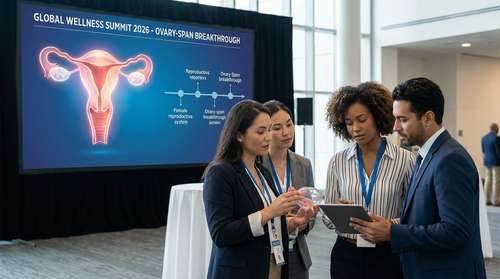
A landmark report released this week from the Global Wellness Summit (GWS) 2026 has officially declared a new era in medicine: the age of "ovary-span." For decades, women's longevity research was an afterthought, often extrapolated from male-centric data. But the 2026 Future of Wellness report has shattered that paradigm, identifying ovarian healthspan as the single most critical lever for extending women's healthy years. The report dubs the ovaries the "command central" for female aging, sparking a global race to slow ovarian decline not just for fertility, but to prevent dementia, heart disease, and osteoporosis.
The New Paradigm: Ovaries as 'Command Central'
For the first time, top medical experts are converging on a singular truth: women age fundamentally differently than men. While men experience a gradual decline, women face a steep "gonadal death" during menopause, which accelerates systemic aging. The GWS 2026 report argues that slowing this decline is the "next big biotech breakthrough."
"Ovary-span" is now the buzzword of the year. It refers to the functional lifespan of the ovaries, which directly dictates the onset of frailty in women. By maintaining ovarian function longer, we aren't just delaying menopause; we are delaying the chronic diseases that statistically kill more women than men. This shift from managing symptoms to optimizing ovarian biological age is transforming a multi-billion dollar industry overnight.
Breakthrough Science: The VIBRANT II Study & Rapamycin
Leading the charge in this scientific revolution is the expanded VIBRANT II study from Columbia Fertility, which made headlines alongside the summit. Led by Dr. Yousin Suh and Dr. Zev Williams, this massive multi-center trial is enrolling 1,000 women to test if rapamycin—an inexpensive, FDA-approved immunosuppressant—can slow ovarian aging by up to 20%.
Early data suggests that low-dose rapamycin mimics calorie restriction, potentially reducing the "burn rate" of ovarian reserve. If successful, this could be the first pharmacological intervention to decouple a woman's biological age from her chronological age. The implications are staggering: a simple pill that could add five to ten years of high-functioning vitality to a woman's life.
The Rise of 'Fem-Gevity' Startups
The 2026 investment landscape is already reacting. Gameto, a biotech firm utilizing iPSC-derived ovarian support cells, announced its "Fertilo" therapy is moving toward a late-stage interim readout this year. Meanwhile, their "Ameno" program, backed by ARPA-H funding, is developing an implantable cell therapy designed to restore ovarian hormone production naturally—effectively a bio-identical ovary.
Another key player, Oviva Therapeutics (now part of Granata Bio), is tackling ovarian fibrosis—the stiffening of tissue that stops ovaries from functioning. By targeting the root causes of this tissue aging, they aim to keep the "command central" online for decades longer.
Diagnostics: Ovarian Aging Tests as the 'New Vital Sign'
Perhaps the most immediate change for consumers in 2026 is the reclassification of ovarian aging tests. No longer just for fertility clinics, these diagnostics are becoming a standard "vital sign" in longevity check-ups. The GWS report predicts that knowing your "ovarian biological age" will soon be as common as knowing your blood pressure.
New biomarker panels released this year go beyond simple AMH (Anti-Müllerian Hormone) testing. They integrate inflammatory markers and genetic risk factors to give a comprehensive "Ovary-Span Score." This data empowers women to intervene early—whether through lifestyle changes, supplements like fisetin and urolithin A, or emerging pharmaceutical therapies—before the irreversible cascade of menopause begins.
Beyond Menopause: A Societal Shift
This "Ovary-Span" movement is about more than just medicine; it's a cultural correction. The 2026 summit highlighted a move away from the "bro-science" of extreme biohacking toward a model of female-specific optimization. The narrative has shifted from "anti-aging" (fighting the inevitable) to "longevity architecture"—building a body that remains robust through the final decades of life.
With companies like Ovo Labs also announcing breakthroughs in "rejuvenating" human eggs to reduce chromosomal defects, the message is clear: biology is no longer destiny. For women in 2026, the ovary is not just a reproductive organ; it is the engine of youth, and for the first time in history, we have the tools to keep it running.