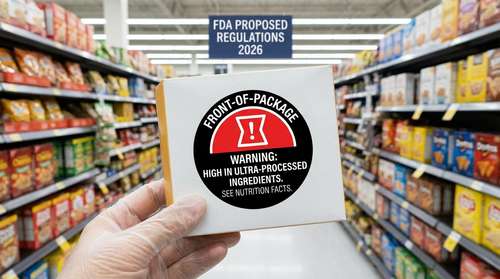
The United States is on the brink of a massive shift in grocery store aisles. Driven by recent mandates, sweeping changes to FDA nutrition labels are entering their final regulatory phases this spring. In a move aimed at combating the rising tide of chronic diseases, the agency is preparing mandatory front-of-package labeling to give consumers immediate, at-a-glance warnings about what is actually in their food. This shift coincides with a historic milestone: the impending release of the first-ever federal ultra-processed foods definition.
U.S. Health Secretary Robert F. Kennedy Jr. recently confirmed that the government will officially define ultra-processed items by April 2026. Speaking on a popular podcast in early March, he noted that the definition will immediately pave the way for aggressive front-of-package warning systems. This rapid timeline signals a major acceleration of federal health initiatives, which seek to mitigate processed food health risks and enforce stricter food transparency laws nationwide.
Inside the Proposed Nutrition Info Box
Under the current framework, the centerpiece of these healthy eating regulations 2026 is the proposed Nutrition Info Box. Instead of hiding critical data on the back of a package in tiny print, food manufacturers will be required to display standardized interpretive labels right on the front. The design highlights three heavily over-consumed metrics: added sugars, sodium, and saturated fats.
Consumers will see these nutrients categorized clearly as Low, Med, or High, based on their percentage of the daily recommended value. However, recent discussions indicate the administration may take the design a step further. Officials are floating a red, yellow, and green light graphic to visually communicate the overall healthfulness of a product at a single glance. For shoppers with limited time or nutritional literacy, this visual shorthand strips away confusing marketing claims and exposes the raw nutritional profile underneath.
Establishing an Ultra-Processed Foods Definition
Establishing a unified ultra-processed foods definition is complex but necessary. Currently, the scientific community relies on the NOVA classification system, which categorizes food into four tiers based on industrial processing. However, this broad system sometimes lumps vastly different items, like heavily dyed artificial snacks and fortified plant-based milks, into the exact same category.
To build a better framework, the FDA launched a joint Nutrition Regulatory Science Program with the National Institutes of Health to examine exactly how and why these industrial formulations degrade metabolic health. The agencies are zeroing in on high-fructose corn syrup, hydrogenated oils, and synthetic emulsifiers that cannot easily be replicated in a standard home kitchen. Several states, including California and Arizona, have already bypassed federal delays by banning specific artificial additives from public schools. A nationwide benchmark will harmonize these fragmented local rules. By creating a standardized definition, the government will force the food industry to compete on actual health benefits rather than engineered flavors and extended shelf lives.
Addressing Processed Food Health Risks
The urgency behind these food transparency laws stems from a growing body of clinical research. Diets heavily reliant on industrially manufactured products are directly linked to cardiovascular disease, obesity, type 2 diabetes, and certain cancers. Currently, an estimated 70% of the U.S. food supply falls into the ultra-processed category, and children consume over 60% of their daily calories from these sources. Beyond the sheer volume of consumption, the physical structure of these foods encourages overeating. Because they are engineered for extreme palatability and rapid digestion, they often bypass the body's natural satiety signals.
By mandating front-of-package labeling, the federal government hopes to disrupt these automatic purchasing habits. When buyers are confronted with a bright red warning about high sodium or a High rating for added sugars, they naturally gravitate toward whole-food alternatives. The FDA expects this behavioral shift to significantly reduce the national burden of diet-related chronic illnesses, ultimately alleviating strain on the broader healthcare system.
Industry Pushback and the Shift to Transparency
Food and beverage manufacturers have long relied on voluntary, industry-designed labels that often highlight positive nutrients while minimizing negative ones. The transition to mandatory, standardized FDA nutrition labels is inevitably facing pushback. Some industry groups argue that singling out specific additives or processing methods might confuse consumers or penalize products that are otherwise nutritionally dense, such as fortified cereals or whole-grain breads.
Despite these concerns, public health advocates maintain that the primary objective is clarity, not prohibition. The administration does not plan to ban these foods outright at the federal level. Instead, the upcoming food transparency laws are designed to spark a competitive marketplace where brands reformulate their products to earn a non-ultra-processed label or a green light rating.
Implementation and the Future of the Grocery Aisle
As the FDA finalizes the rule in spring 2026, food manufacturers are bracing for a massive logistical overhaul. Once the mandate takes effect, larger businesses will have roughly three years to achieve compliance, while smaller operations generating under $10 million in annual food sales will be granted a four-year window.
These healthy eating regulations 2026 represent the most significant update to food packaging since the original Nutrition Facts panel debuted decades ago. For the everyday shopper, the days of decoding complex ingredient lists are coming to an end. Armed with the new Nutrition Info Box and a clear ultra-processed foods definition, Americans will soon have the tools they need to navigate the supermarket with absolute confidence.